Families should not have to guess during grief.
In an ageing society, more families will eventually face estate, CPF, property, insurance and family decision matters. Many people only learn about probate, letters of administration, CPF nomination and LPA after a crisis has already happened.
After death
Families may need to report the death, obtain the digital death certificate, arrange the funeral, locate documents and understand whether estate authority is required.
Estate authority
If there is a valid will, the named executor may apply for probate. If there is no valid will, eligible beneficiaries may need letters of administration.
Planning ahead
A will, CPF nomination, insurance nomination, LPA and organised documents can reduce confusion, delay and family disagreement.
Acknowledgement of inspiration
This public awareness page was inspired by a community education post shared by Rachel Ong 王心妍 and the Telok Blangah Legal Clinic on the topic of administering a deceased estate in Singapore.
The content on this page has been independently rewritten, redesigned and expanded for general family-readiness education. The legal, CPF and LPA references below are aligned to official Singapore sources where possible.
No endorsement, partnership or affiliation is implied. Credit is given respectfully for the public education inspiration.
Singapore family readiness slides
These slides summarise the key awareness points. Families should still check the latest requirements with official Singapore sources or seek legal advice for personal matters.
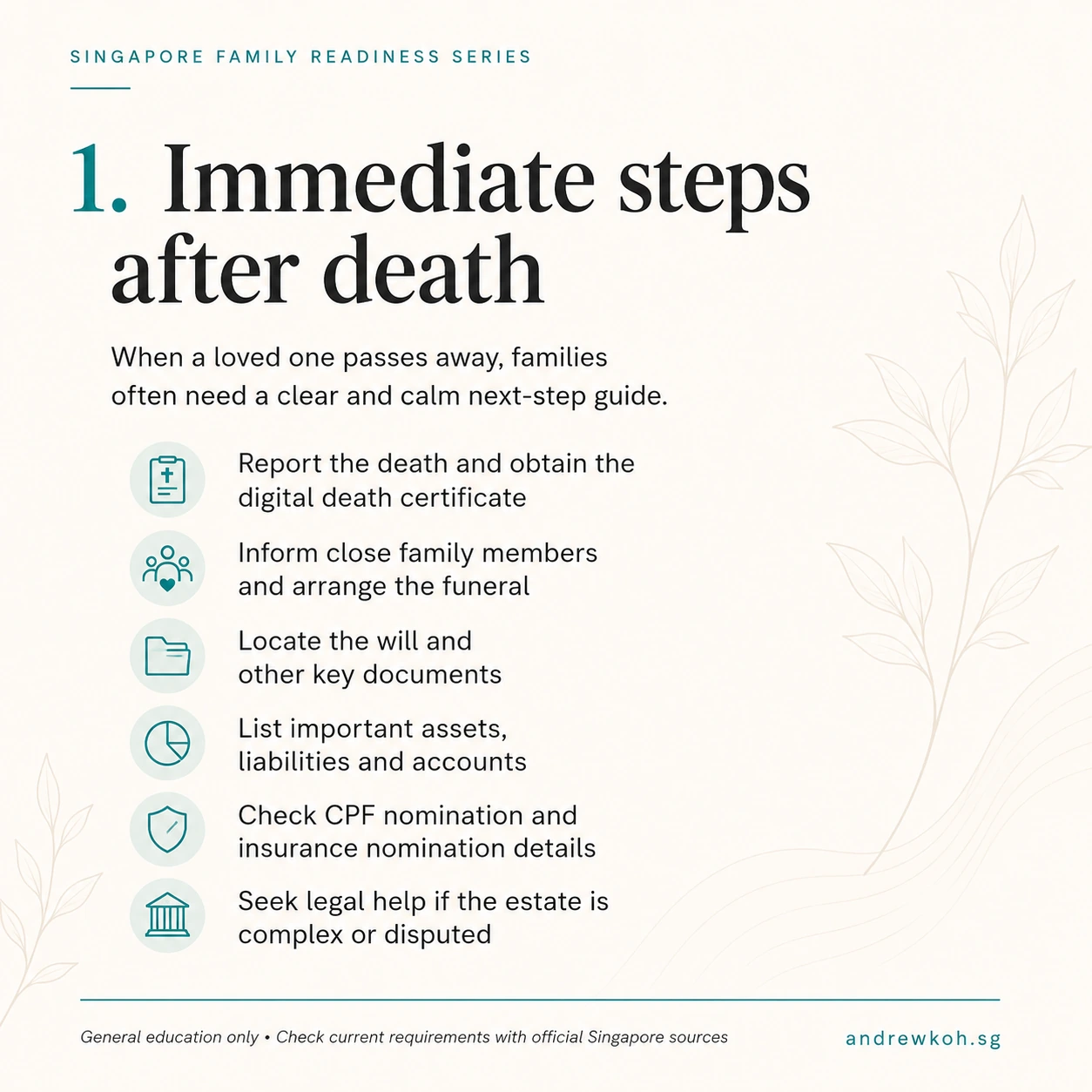
Immediate steps families may need to take
According to MyLegacy@LifeSG, when death happens, families may need to report the death, download the digital death certificate, arrange the funeral, manage wills and inheritance, manage estate settlement and assets, and seek emotional support.
Report the death and obtain the death certificate
If the death is from known natural causes, a doctor may certify the death online. Once certified, the family can download the digital death certificate.
Arrange the funeral
Families commonly decide on the funeral director, wake location, wake duration, and whether to arrange burial or cremation.
Locate important documents
Look for the will, NRIC details, death certificate, property documents, bank account information, insurance policies, CPF nomination information, loans, debts, tax records and other important records.
Check whether estate authority is required
Some institutions may require a Grant of Probate or Letters of Administration before releasing funds or allowing estate matters to be handled.
Probate and Letters of Administration
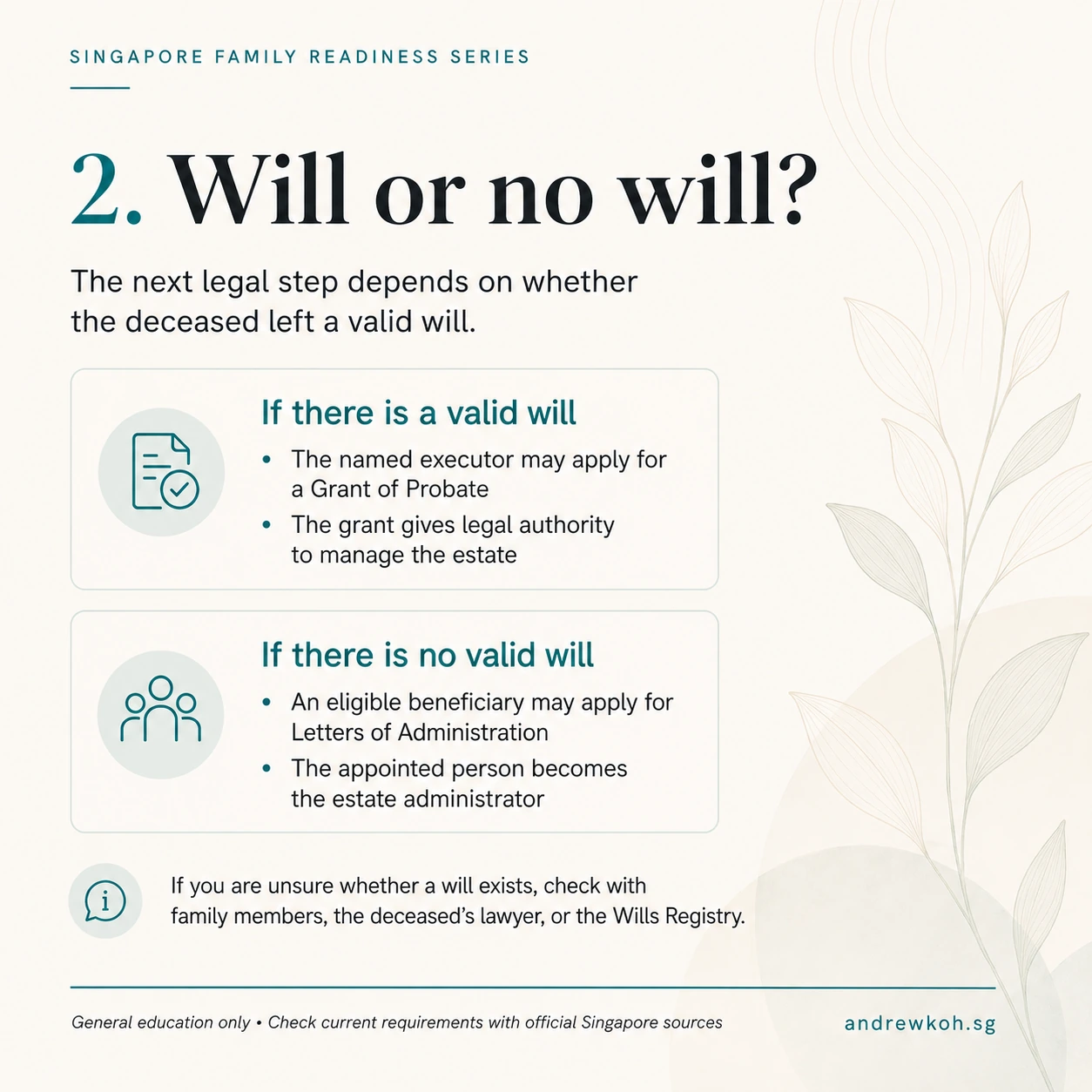
If there is a valid will
The named executor may apply for a Grant of Probate. This legally recognises the executor’s authority to manage the deceased’s estate.
- Check the original will and any codicil.
- Confirm who the executor is.
- Seek legal help if the estate is complex or disputed.
If there is no valid will
An eligible beneficiary may apply for a Grant of Letters of Administration. The appointed person becomes the administrator of the estate.
- The estate may be distributed according to intestacy rules.
- The family cannot simply decide informally who gets what.
- Seek legal help if beneficiaries disagree or documents are unclear.
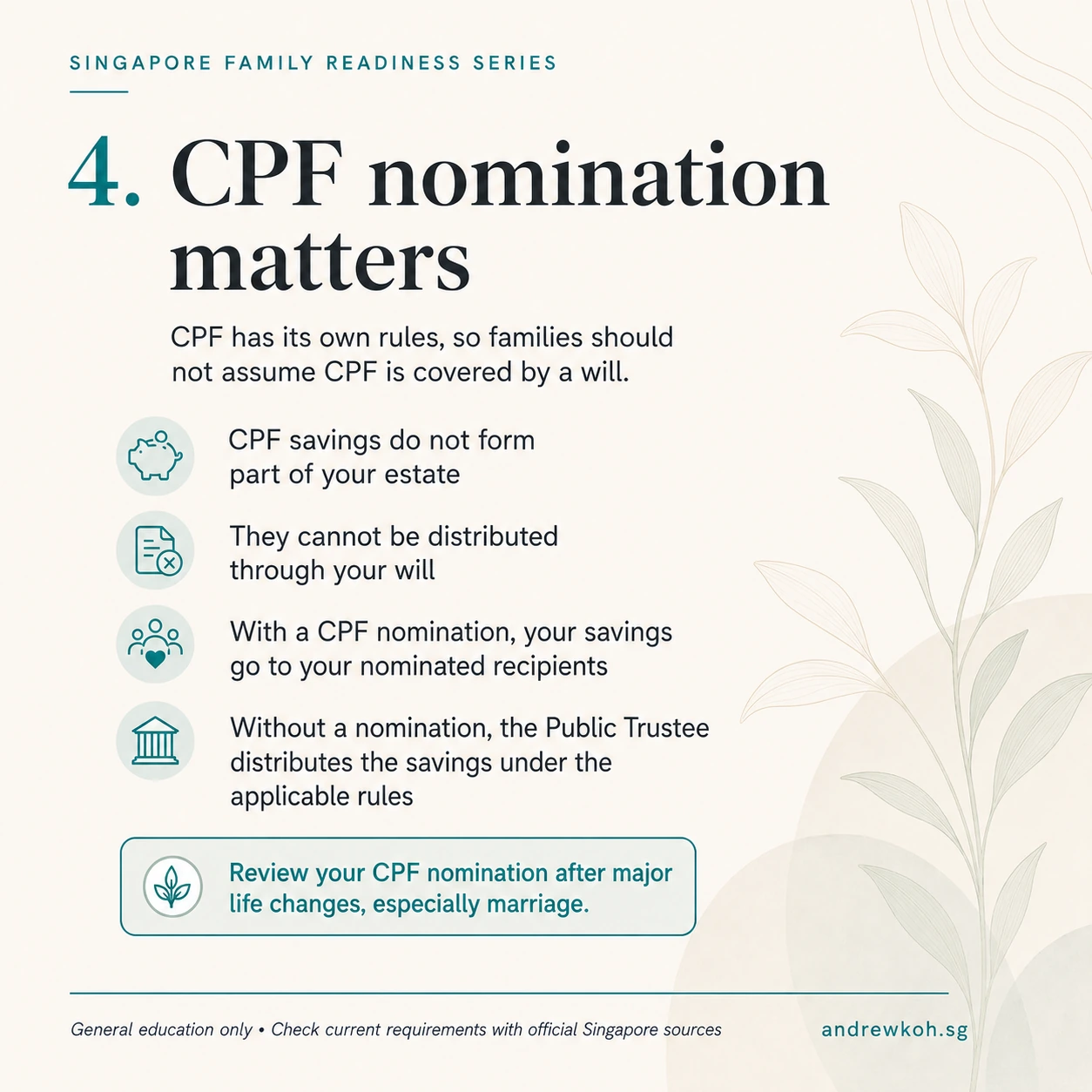
CPF nomination is not the same as a will
CPF savings are a common blind spot. CPF Board explains that CPF savings cannot be included in a will because they do not form part of the estate. With a CPF nomination, CPF savings are distributed to nominees according to the member’s wishes. Without a CPF nomination, CPF savings may be transferred to the Public Trustee’s Office for distribution under applicable rules.
Make a CPF nomination
A CPF nomination lets you decide who receives your CPF savings and how much each nominee receives.
Do not rely only on a will
CPF savings are not distributed through your will. A separate CPF nomination should be considered.
Review after life changes
CPF nominations should be reviewed regularly, especially after major life events such as marriage.
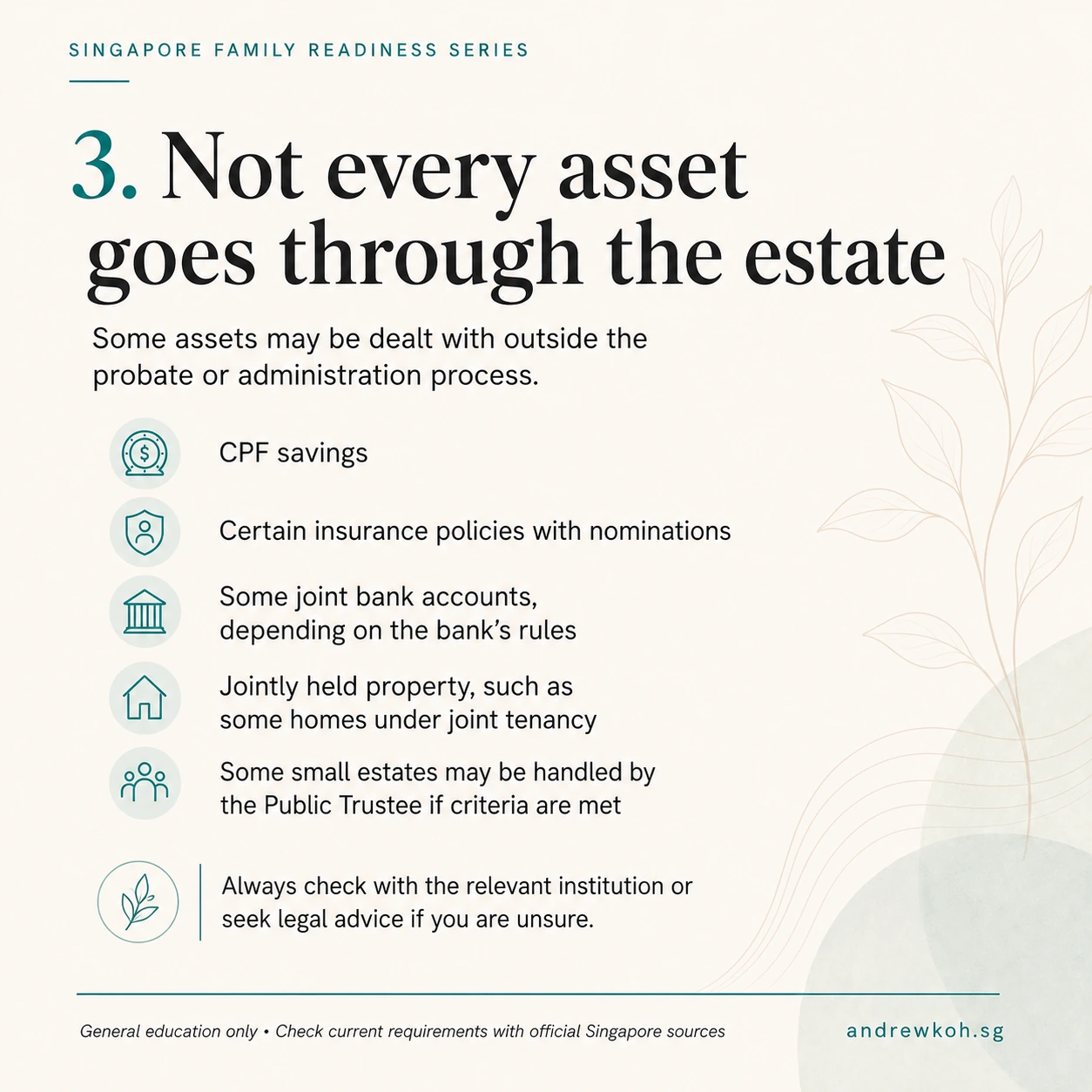
Not every asset may need the same process
Singapore Courts notes that a grant may not be required for some assets, depending on the facts, institution rules and legal criteria. Examples may include CPF money, certain insurance policies with nominations, certain joint bank accounts, and some jointly held property.
- CPF savings: usually handled under CPF nomination or applicable CPF/Public Trustee processes.
- Insurance policies: check whether there is a valid nomination and what the insurer requires.
- Bank accounts: check each bank’s rules, especially for joint accounts.
- Property: check ownership type, mortgage status and title arrangements.
- Small estates: check whether the Public Trustee can administer the estate if criteria are met.
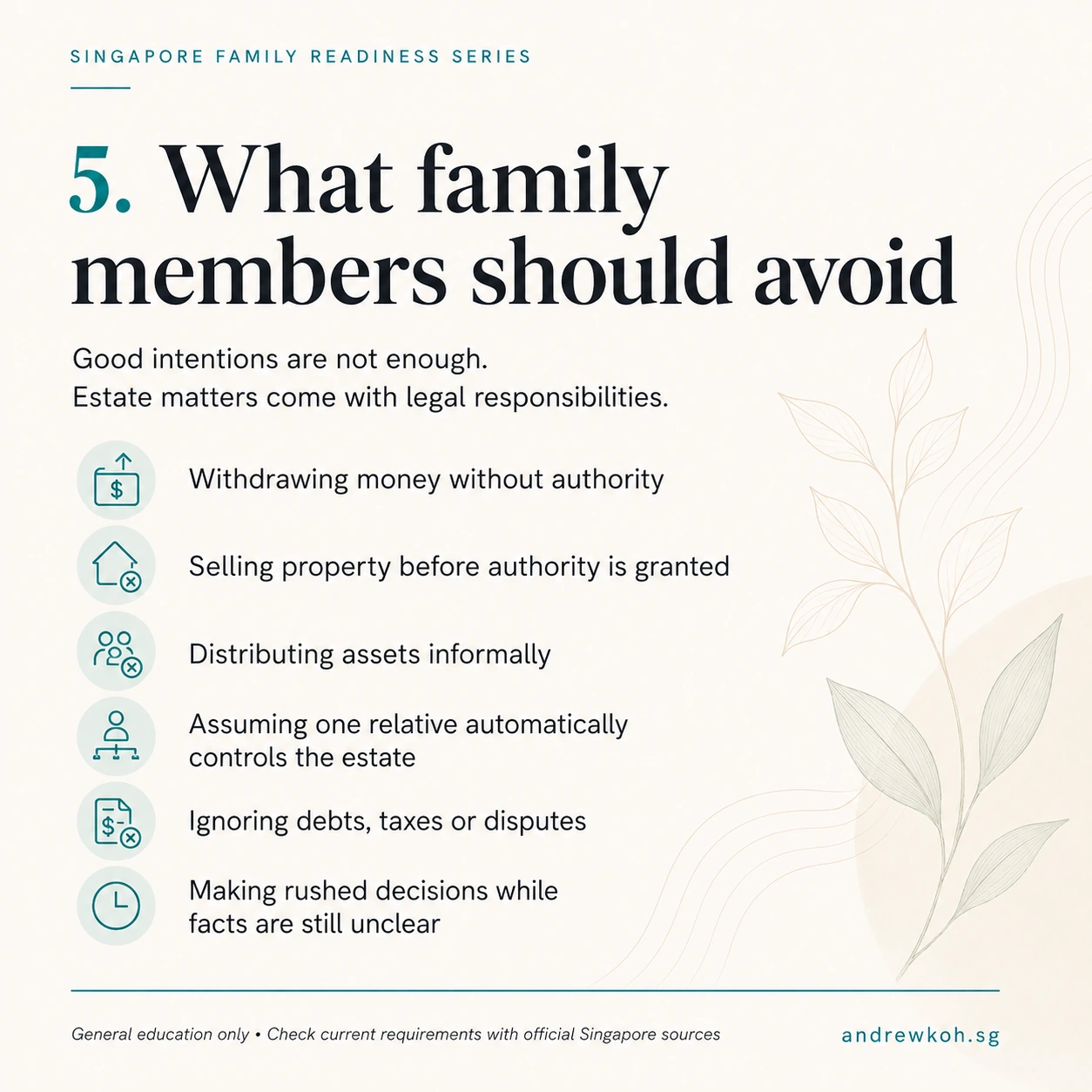
Common mistakes families should avoid
Avoid informal estate handling
- Withdrawing money without proper authority.
- Selling property before authority is granted.
- Distributing assets informally among family members.
- Assuming the eldest child automatically controls the estate.
Avoid ignoring liabilities
- Forgetting debts, taxes, loans or unpaid bills.
- Ignoring disputes between beneficiaries.
- Missing insurance, CPF or bank nomination details.
- Making rushed decisions while facts are still unclear.
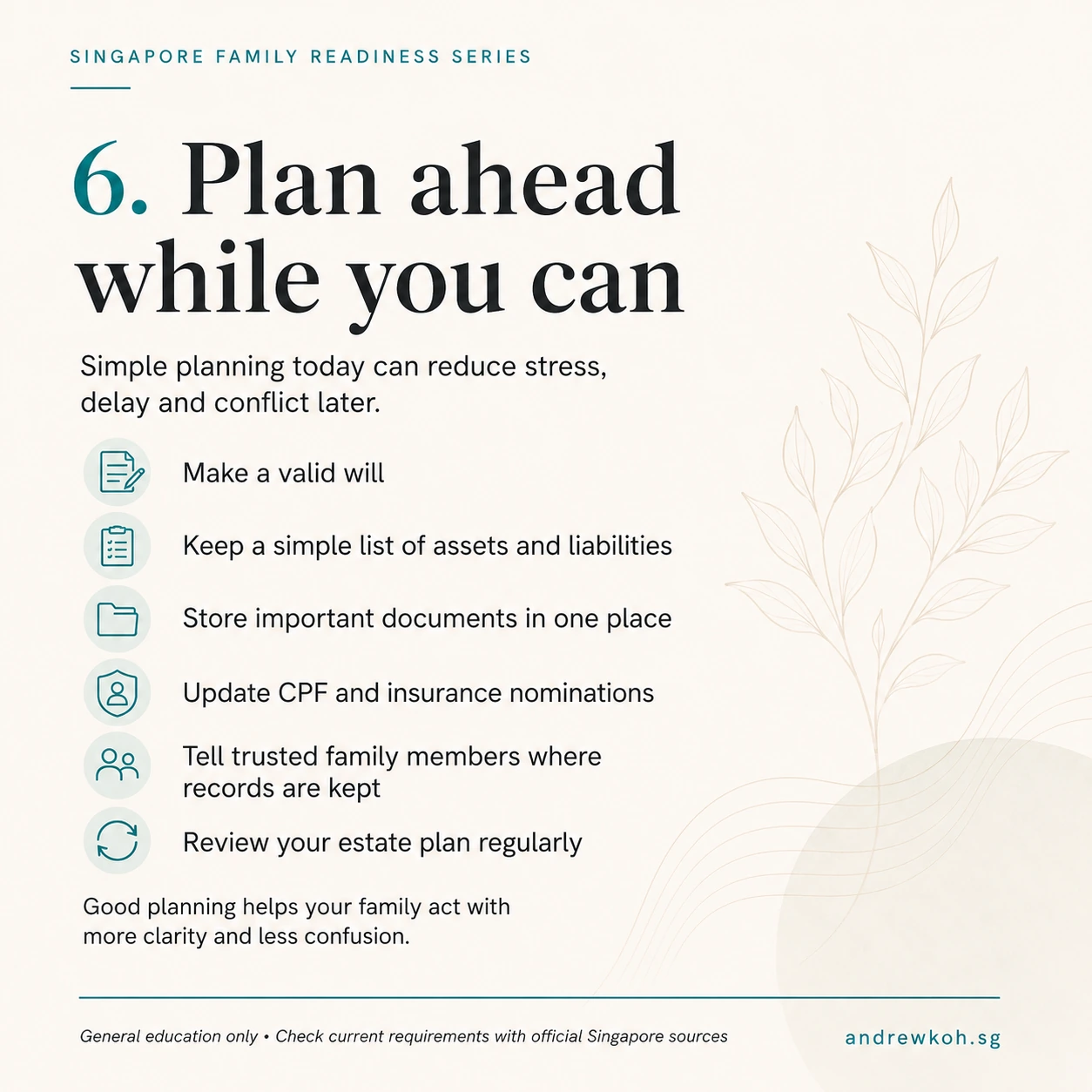
Plan ahead while you can
Good planning can reduce stress, delay, uncertainty and conflict for the family.
Make a valid will
A will can state how estate assets should be distributed and who should act as executor.
Make or review CPF nomination
CPF nomination is separate from a will and should be reviewed after major life changes.
Consider LPA
A Lasting Power of Attorney allows a trusted donee to make decisions if the donor loses mental capacity.
Organise documents
Keep a simple list of assets, liabilities, accounts, policies, loans and key contacts.
Inform trusted family
Let trusted family members know where important records are kept.
Seek professional advice
Use a Singapore-qualified lawyer or the relevant official agency where the matter is complex.
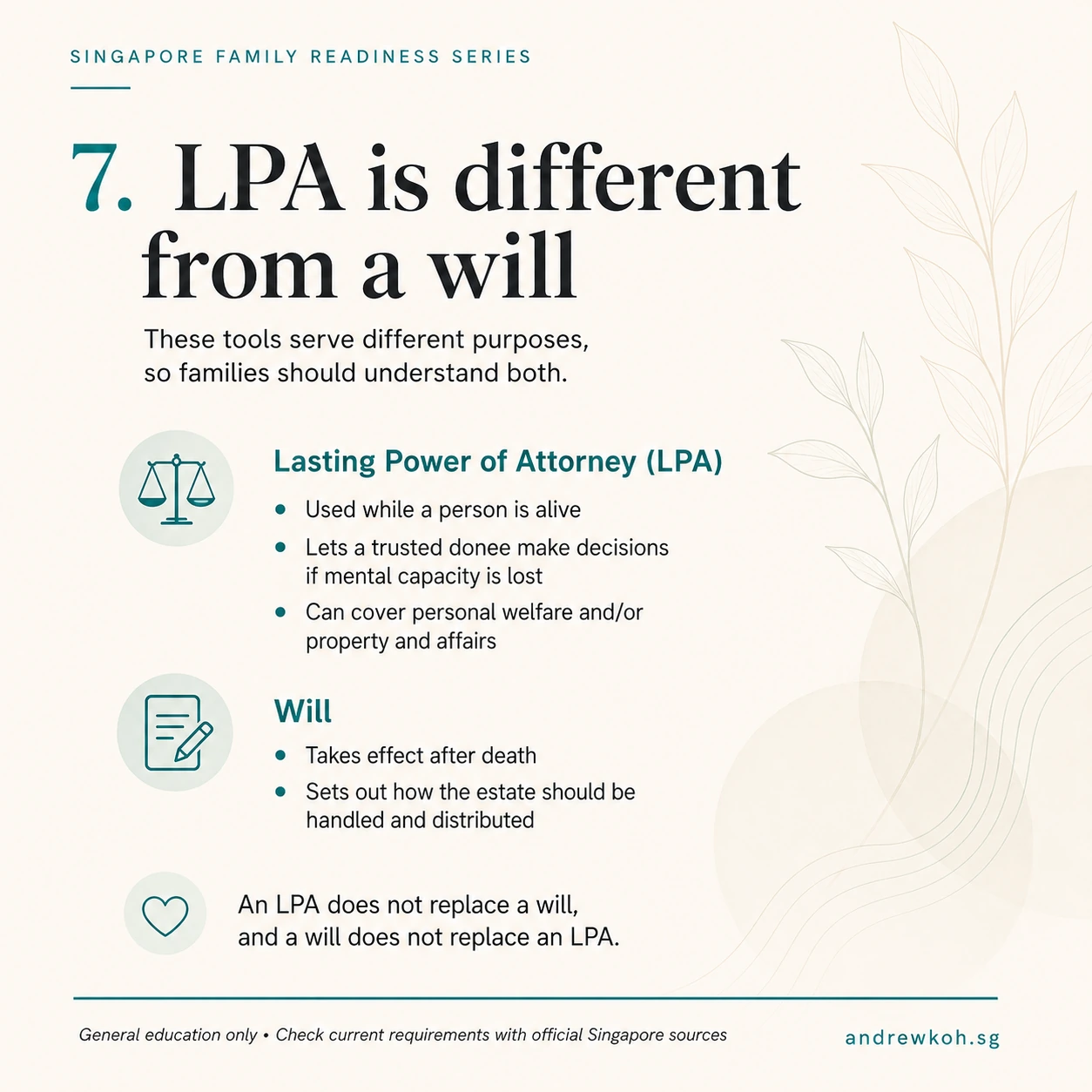
LPA is different from a will
Lasting Power of Attorney
An LPA is used while a person is alive. It lets appointed donees make decisions on personal welfare and/or property and affairs if the donor loses mental capacity.
Will
A will takes effect after death. It deals with estate distribution and appointment of an executor for the deceased’s estate.
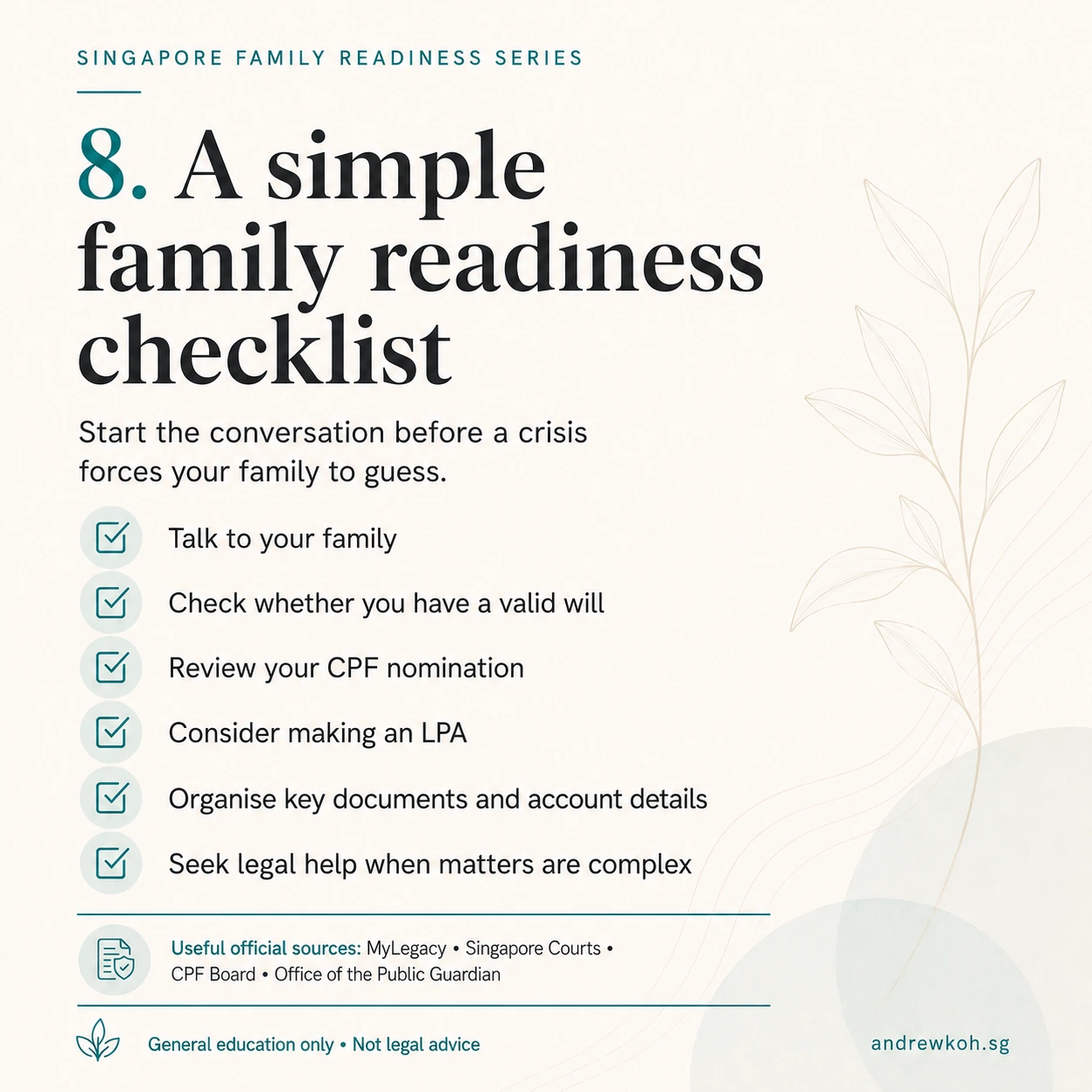
A simple checklist to start the conversation
- Have we spoken as a family about basic estate readiness?
- Do we know whether there is a valid will?
- Do we know where important documents are kept?
- Has CPF nomination been made and reviewed?
- Are insurance nominations and policy details known?
- Do we know the difference between a will and an LPA?
- Do we know who to contact if a loved one passes away?
- Do we know when to seek legal help?
Official Singapore sources to check
Estate, CPF, LPA and death-related processes may change. Always check the current official source before acting.
-
MyLegacy@LifeSG — When death happens
For reporting death, downloading the digital death certificate, funeral matters, wills, inheritance and estate settlement. -
Singapore Courts — Probate and administration
For information on Grant of Probate and Grant of Letters of Administration. -
Singapore Courts — Apply for Letters of Administration
For what Letters of Administration means and who may apply. -
CPF Board — Making a CPF nomination
For CPF nomination, CPF distribution and why CPF savings are not included in a will. -
Office of the Public Guardian Online — LPA services
For LPA applications, LPA status checks and donee matters. -
MSF Office of the Public Guardian — What is a Lasting Power of Attorney
For understanding what an LPA is and why it matters. -
Population.gov.sg — Longevity and ageing population trends
For Singapore’s ageing population context.