Beyond Living Alone Purpose, Participation and Contribution as Singapore Ages
Older adults need more than activities to fill their time. They also need meaningful roles, trusted relationships and opportunities to remain part of society.
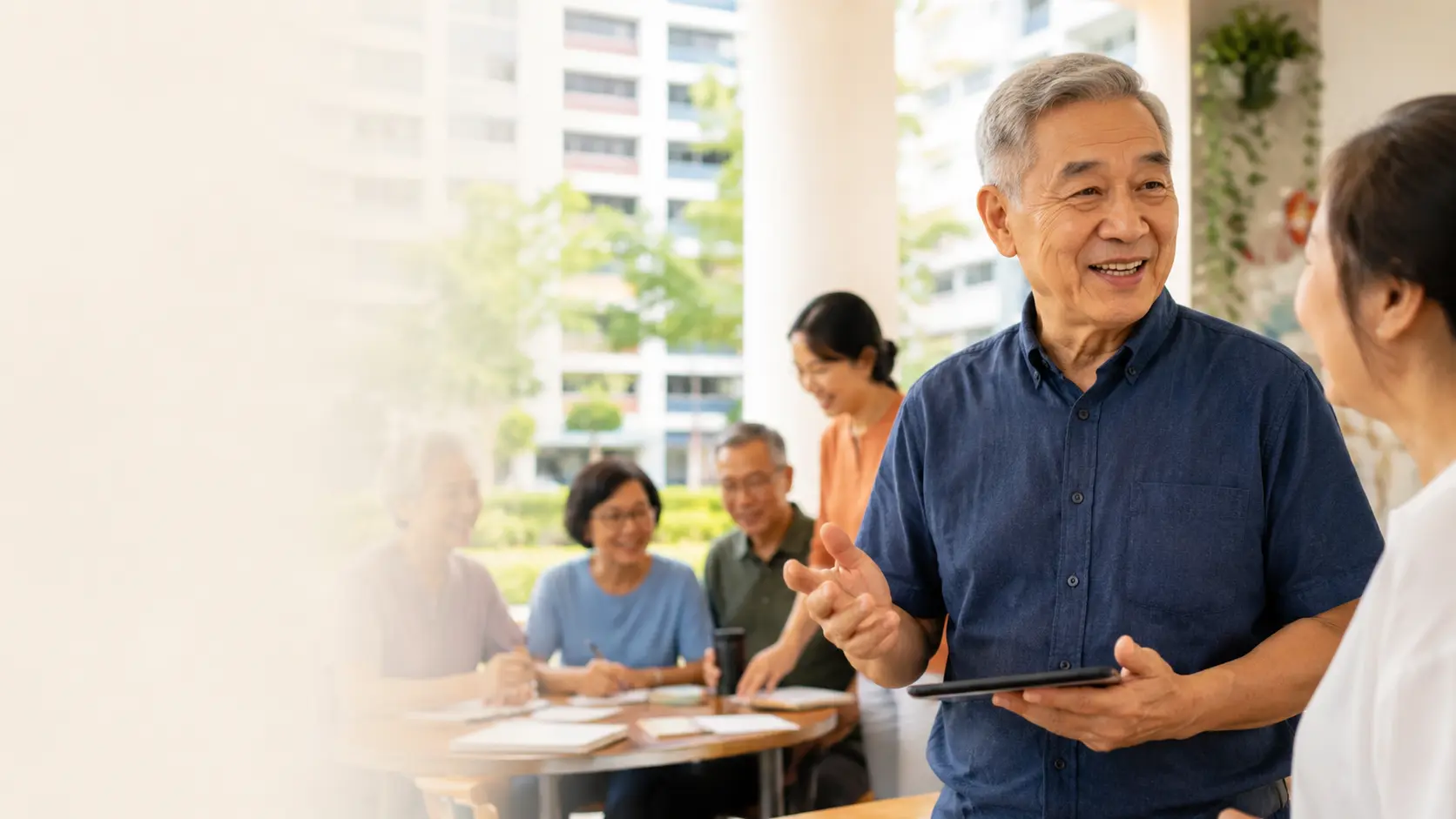
Editorial illustration
A July 10, 2026 Straits Times report drew attention to a significant demographic change: 88,400 Singapore residents aged 65 and above were living alone in 2025, compared with 41,200 in 2015. Yet the same report also noted that most seniors continued to live with a spouse and/or children.
Those figures deserve attention, but they should not lead us to assume that everyone who lives alone is lonely or that everyone living with family feels meaningfully connected. Where someone lives is only one part of ageing. Another important question is whether the person still has a recognised role, a reliable routine and a place where their contribution matters.
This commentary was prompted by the July 10, 2026 Straits Times report. The demographic figures are credited to that report and to official Singapore sources linked below. The discussion and anonymous illustrations are independent reflections.
The missing conversation: what happens when familiar roles disappear?
Singapore often discusses ageing through healthcare, retirement adequacy, housing, falls, dementia, caregiving and social support. These are essential concerns. But another dimension receives less attention: the gradual loss of familiar roles.
Retirement can remove a workplace identity. Bereavement can change daily companionship. Adult children may become independent. Health changes may reduce mobility. A person who once supervised staff, cared for family members, organised events or made important decisions may suddenly have fewer people depending on them.
Older adults do not only need somewhere to go. Many also need a meaningful reason to turn up, participate and return.
An activity fills time and provides something to do.
The person joins, interacts and develops a sense of belonging.
The person has a responsibility or capability that benefits someone else.
All three levels have value. But contribution often provides the strongest message: “My presence makes a difference.”
Singapore stories of purpose: six anonymous illustrations
The following stories are composite illustrations. They are not descriptions of named individuals. Each reflects common pathways already visible in Singapore’s workplaces, community clubs, Active Ageing Centres, families and volunteer networks.
The retiree who teaches Tai Chi
A retiree gives a few mornings each month to guide a Tai Chi or chair exercise group at a community venue. He arrives early, checks the space, welcomes participants and modifies movements for beginners.
The physical activity benefits everyone, including the instructor. But the deeper value may be relational. Participants recognise him. A newcomer asks for guidance. Someone says, “See you next week.” His experience has become useful to others.
He is not merely attending an exercise class. He is helping to create one.
The mature worker who remains part of a team
A mature employee continues working in administration, retail, transport, hospitality, healthcare support or a professional service. Income matters, but so do the conversations, deadlines, teamwork and sense of competence.
Younger colleagues may help with new digital tools, while the older employee contributes judgement, patience, institutional knowledge and practical experience. This is not a one-way relationship. Both generations learn.
Work can provide a reason to prepare for the day, solve problems and remain connected to a wider system. However, continued employment must be fair, safe and based on genuine capability not tokenism or pressure.
The participant who becomes a volunteer
A senior first enters an Active Ageing Centre as a participant. After becoming familiar with the people and routines, she begins welcoming newcomers, helping to organise communal meals or checking in on a neighbour who has missed several sessions.
Her relationship with the centre changes. She is no longer only receiving a programme. She is helping to sustain the community around it.
The caregiver and grandparent whose role must also be supported
Some older adults remain deeply involved in family life—helping with school routines, preparing meals, accompanying a spouse to appointments or sharing family history and values with grandchildren.
These roles can be meaningful, but they can also become exhausting. Purpose should not be confused with unlimited obligation. A caregiver needs rest, support, information and the freedom to maintain an identity beyond caregiving.
Healthy participation means being valued without being taken for granted.
The senior who keeps learning
A person in their sixties or seventies enrols in smartphone training, photography, language learning, digital safety, artificial intelligence awareness or a practical SkillsFuture course.
Learning protects more than employability. It preserves curiosity and self-belief. It also creates new conversations with younger family members and peers.
The message changes from “technology has left me behind” to “I can still understand something new.”
The older adult who shares knowledge online
An older adult posts about gardening, local history, cooking, exercise, caregiving lessons, crafts or professional experience. The purpose is not necessarily fame. Digital platforms may provide a channel to document knowledge and remain connected.
Posting should not automatically be dismissed as attention-seeking or treated as evidence of loneliness. It may represent creativity, confidence, professional continuity or a desire to help.
Digital participation is healthiest when it complements real relationships and meaningful activity. Seniors should also be supported to recognise scams, impersonation, misinformation and requests for sensitive information.
Why employment can matter beyond income
Employment is not suitable or necessary for every older adult, and financial need should not be romanticised. Some people have earned the right to retire fully. Others may have health limitations, caregiving responsibilities or personal priorities that make work inappropriate.
Nevertheless, for those who wish and are able to continue, employment may provide several forms of value at once:
- regular routines and time structure;
- interaction with colleagues and customers;
- continued use of professional knowledge;
- intergenerational learning and mentoring;
- income and financial confidence;
- a visible role within an organisation or industry.
Singapore’s official labour data shows that older workers are already a substantial part of the workforce. The policy objective should therefore not be simply to “keep seniors working,” but to create suitable work that respects capability, safety, training, fair treatment and individual choice.
Why Active Ageing Centres matter
Age Well SG is a national programme led by the Ministry of Health, Ministry of National Development and Ministry of Transport. Its purpose is to support seniors to age actively, remain socially connected and receive care within their homes and communities.
MOH has identified Active Ageing Centres as important neighbourhood nodes. AIC describes AAC services as including active-ageing programmes, befriending and buddying, information and referrals, social-connector support, community screening and volunteering opportunities.
This design matters because an AAC can become more than a venue. It can function as a bridge:
| From | To | Why it matters |
|---|---|---|
| Attending an activity | Helping to organise it | The senior moves from recipient to contributor. |
| Meeting people occasionally | Building repeated relationships | Familiarity creates trust and belonging. |
| Receiving support | Offering appropriate peer support | Experience becomes useful to others. |
| Learning a skill | Sharing or facilitating it | Knowledge is reinforced through contribution. |
Not every senior will want to volunteer or lead. Participation must remain voluntary and suited to the person’s interests, health and comfort. The goal is to provide pathways not pressure.
Purpose should not become another burden
The language of “staying useful” must be handled carefully. A person’s dignity does not depend on productivity, employment, caregiving or public contribution. Older adults remain valuable even when they need substantial support or can no longer participate as before.
Purpose may be quiet and personal: maintaining a garden, caring for a pet, attending worship, speaking regularly with a friend, reading, creating art or following a health routine.
A four-part framework for purposeful ageing
These pillars reinforce one another. Movement can introduce new friendships. Learning can support employment or volunteering. Connection can reveal opportunities to contribute. Contribution can strengthen confidence and purpose.
What families, employers and community organisations can do
Families
Ask older relatives what they wish to learn, lead or contribute not only whether they need help. Include them in suitable decisions and respect both their independence and their limits.
Employers
Create age-inclusive roles, fair training, ergonomic adjustments and opportunities for mentoring or flexible work. Judge individuals by capability rather than assumptions about age.
AACs, Community Clubs and volunteer organisations
Build visible pathways from participant to volunteer, facilitator, buddy or organiser. Provide training, safeguarding, role clarity and support so that contribution remains safe and sustainable.
Digital platforms and families supporting seniors online
Encourage creation and communication while strengthening privacy, scam awareness and verification habits. Online connection should ideally lead to trusted relationships rather than dependence on public reactions alone.
A better question for an ageing Singapore
The rise in seniors living alone is important, and Singapore should continue strengthening outreach, care and social support. But intervention should not begin only after someone becomes isolated or vulnerable.
A more preventive approach is to preserve participation earlier through suitable employment, volunteering, movement, learning, caregiving support, neighbourhood relationships and meaningful digital engagement.
A society that ages well should not ask only, “How do we care for older adults?” It should also ask, “How do we continue making room for their contribution?”
The goal is not merely to keep older adults busy. It is to recognise them as people with experience, capacity, preferences and something valuable to offer—while ensuring that those who need care are equally respected.
Official information and source references
These links provide current Singapore information on ageing, employment, community participation and support.