I did not go to the Gardens that Sunday morning expecting to write about inclusion. I went because Singapore Botanic Gardens has long been part of the rhythm of my life.
I have known the Gardens since I was seven. Sunday mornings often meant jogging there with my father and uncle, followed by teh tarik and roti John at Taman Serasi. These days, I am more likely to order kopi kosong, but the Gardens still gives me the same feeling of movement, reflection and connection.
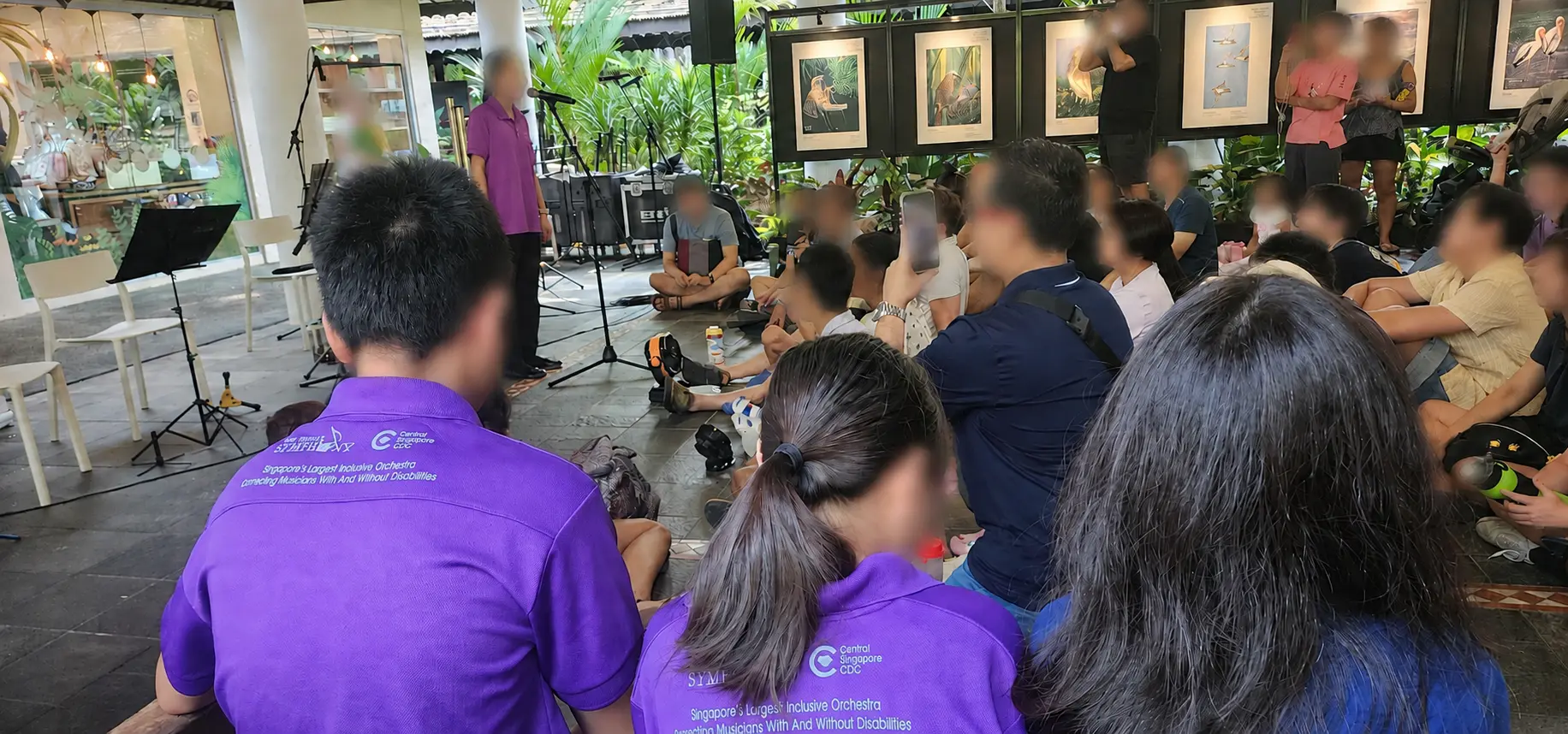
That morning, music drew me towards the Nassim Visitor Service Centre. A crowd had gathered around performers from The Purple Symphony. Some people sat on chairs. Many found a place on the floor. Children watched from close by while families and visitors paused to listen.
The atmosphere felt easy and unforced. There was no grand entrance and little distance between the musicians and the audience. People were simply sharing the same space and giving their attention to the music.
In that moment, inclusion did not feel like an abstract idea. It looked like people contributing together and being valued for what they brought to the music.
The music came first
What stayed with me was how naturally the music came before the labels. I was not thinking about who had a disability and who did not. I was listening to musicians performing together.
That distinction matters. Inclusion is not about sympathy, lowered expectations or praise offered out of politeness. It is about removing barriers so that people can learn, develop and contribute meaningfully. Every performer had a place in the shared sound, and the performance was stronger because of that collective effort.
The orchestra did not ask the audience to admire an idea. It invited us to listen. The idea became clear through the performance itself.
When a public place becomes a shared place
A formal concert hall can create distance between performers and audiences. At the Gardens, that boundary almost disappeared. People who had come for a walk could stop for a few minutes and find themselves drawn into the occasion. Children could sit close to the musicians. Families could listen without needing a ticket or a formal introduction.
This made inclusion feel ordinary, which may be one of its most powerful forms. The musicians were not separated from everyday life. They were part of it, performing in one of Singapore’s most familiar public spaces, surrounded by greenery, conversation and the gentle movement of a Sunday morning.
Why The Purple Symphony matters
Central Singapore CDC describes The Purple Symphony as Singapore’s first all inclusive orchestra. It brings together musicians with and without disabilities across five musical sections: plucked strings, bowed strings, wind, percussion and choir. The orchestra debuted at the Singapore Conference Hall on 31 July 2015 with 83 pioneer members from different organisations.1
The performance I encountered was part of ArtsEverywhere at SBG: The Garden Sessions with The Purple Symphony. NParks listed a series of free Sunday morning performances at different locations in Singapore Botanic Gardens during August 2026, followed by a final orchestral showcase at the Shaw Foundation Symphony Stage on 5 September 2026.2
Those facts explain the programme, but being there made its purpose easier to understand. A meaningful platform does more than allow people to appear. It gives them room to practise, perform, grow and be recognised for their contribution.
What stayed with me
I kept thinking about the nature of an orchestra. Its instruments do not need to sound alike. Harmony does not come from making every part identical. It comes from listening, timing and giving each sound a place within something larger.
Perhaps community works in much the same way. Inclusion does not erase difference. It makes room for difference without allowing it to become a reason for exclusion.
That Sunday morning connected two parts of my life. It brought together a place filled with childhood memories and a fresh reminder of what belonging can look like. I left grateful for the music and for the quiet lesson within it: people flourish when they are welcomed, prepared, heard and valued.
The performance lasted for a morning. Its meaning stayed with me much longer.
Learn more about The Purple Symphony
Visit the official Central Singapore CDC page to learn more about the orchestra, its musicians and its inclusive mission.
References
- Central Singapore CDC, The Purple Symphony. Accessed 25 August 2026.
- NParks, ArtsEverywhere at SBG: The Garden Sessions with The Purple Symphony. Accessed 25 August 2026.
Editorial note: This is an independent personal reflection by Andrew Koh. It is not an official statement from The Purple Symphony, Central Singapore CDC or NParks.