A colourful savings graphic may look helpful, official and caring. But its appearance does not prove that every price, entitlement or condition is accurate.
Useful-looking images are regularly forwarded through family WhatsApp chats, neighbourhood groups and senior circles. Most are shared with good intentions: someone wants relatives and friends to save money or enjoy a useful benefit.
Problems arise when the graphic has no identifiable source, no verification date, outdated prices or missing eligibility conditions. Instead of helping, it may create confusion, wasted journeys or misplaced trust.
Before you share, pause and verify the information first.
Why this matters
Older adults are not the only people who can be misled. Anyone may place too much confidence in a polished image especially when it is forwarded by a relative, friend or familiar community group.
It looks credible
Familiar Singapore landmarks, professional illustrations and precise-looking prices can create an impression of authority.
It comes from someone trusted
Information shared by family or friends may receive less scrutiny than an unfamiliar advertisement.
It appears useful
Savings, healthcare and transport information may encourage people to forward first and check later.
Inaccurate information may lead to:
- A wasted journey because a promotion has ended
- Confusion over age, citizenship or residency requirements
- Embarrassment when the outlet conditions differ from the graphic
- False assumptions about healthcare or government-linked benefits
- A habit of forwarding information without checking its source
Misinformation is not automatically a scam
An inaccurate graphic may have been assembled carelessly, copied from an older source or forwarded without proper checking. It should not be labelled a scam unless there is evidence of deliberate deception or fraudulent intent.
However, repeatedly accepting unverified information can weaken the habit of checking. That same behaviour may later be exploited through fake promotions, impersonation messages, suspicious links or payment requests.
Five warning signs to check
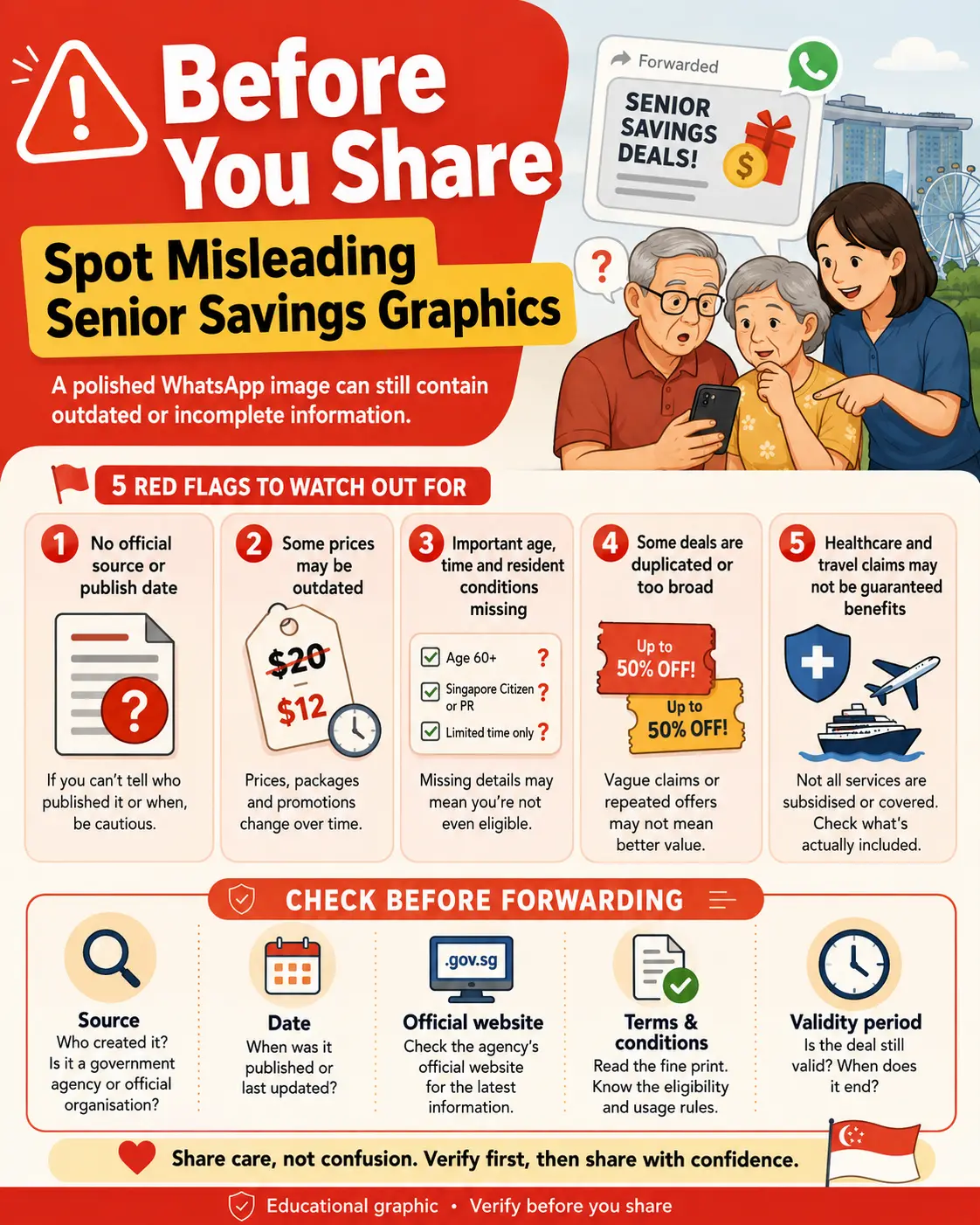
No identifiable source or publication date
Be cautious when you cannot determine who created the graphic, where the information came from or when it was last checked.
Prices may be outdated
Admission fees, meal promotions, mobile plans and transport concessions can change. A previously correct price may no longer apply.
Important conditions are missing
Age limits, residency requirements, participating outlets, weekday restrictions and booking rules should be shown clearly.
The claim is vague, duplicated or too broad
A phrase such as “up to 50% off” has limited value unless it names the provider, qualifying item, location and validity period.
A benefit sounds permanent or guaranteed
Not every healthcare, dining, transport or travel discount is universal, government-funded or available at every outlet.
Selected examples verified in July 2026
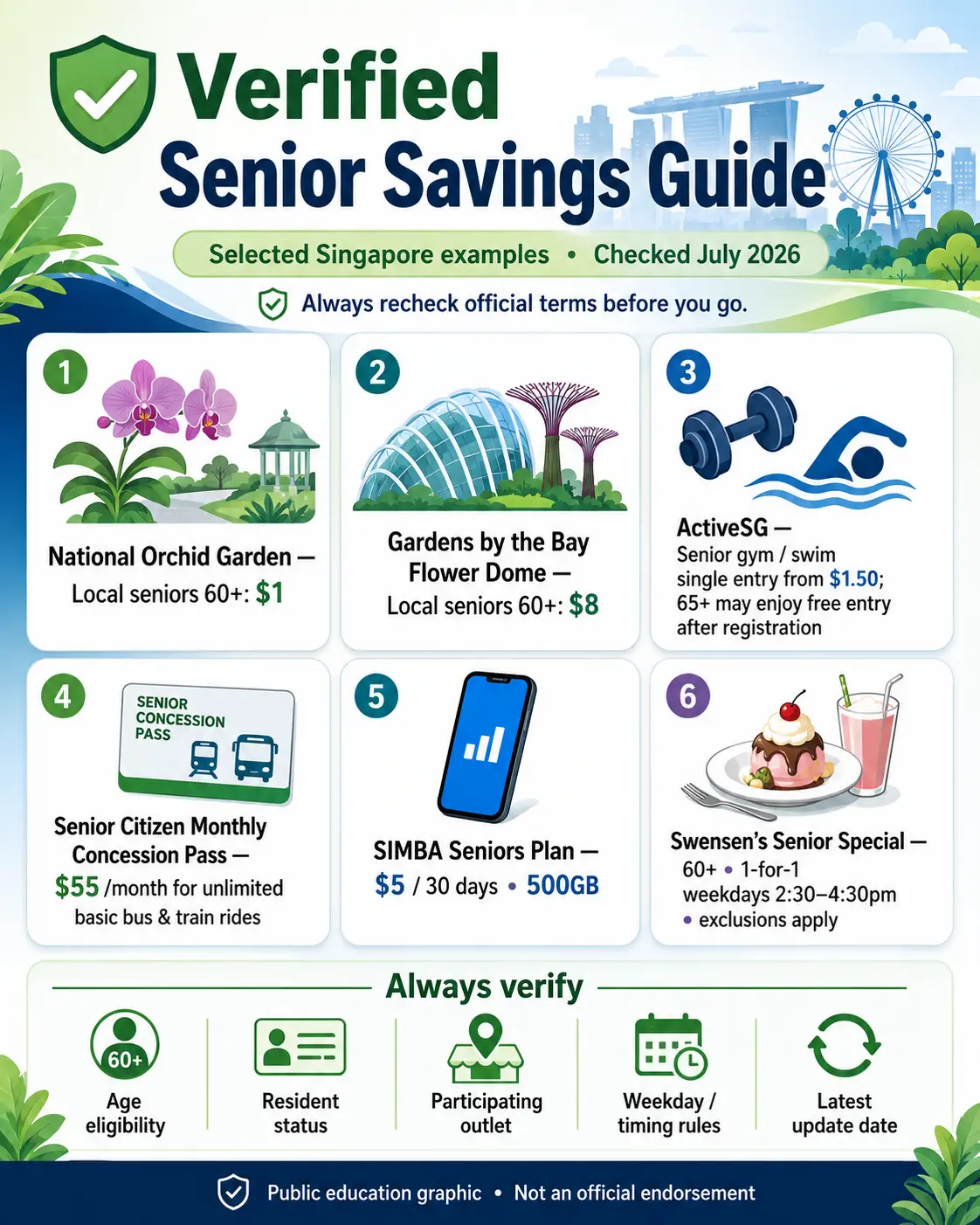
The following examples were checked against official provider pages on 19 July 2026. They are included to demonstrate how eligibility and conditions should be presented not as a promise that the offers will remain unchanged.
National Orchid Garden
The local senior admission category is $1 for visitors aged 60 and above. [1]
“Local” includes Singapore citizens, permanent residents and eligible residents living in Singapore. Proof may be required.
Gardens by the Bay Flower Dome
The displayed senior admission price is $8 for visitors aged 60 and above. [2]
Check the official ticket page again before visiting because attraction packages and promotional combinations may change.
ActiveSG facilities
The ActiveGYM single-entry rate for the student/senior category is $1.50. Senior swimming rates vary by facility and day. [3]
Singapore citizens aged 65 and above may receive free entry to ActiveSG pools and gyms after registering as ActiveSG members. [4]
Senior Citizen Monthly Concession Pass
The pass is listed at $55 per month for unlimited basic bus and train rides. [5]
A monthly pass may be most useful for frequent travellers. Compare it with your actual monthly travel pattern before purchasing.
SIMBA Seniors Plan
SIMBA currently lists its Seniors Plan at $5 per 30 days with 500GB of main data. [6]
The stated data allowance includes promotional benefits valid until further notice. Eligibility and full terms should be checked before registration.
Swensen’s Senior Special
Swensen’s lists a 1-for-1 senior offer for qualifying diners aged 60 and above, from Monday to Friday, 2.30pm to 4.30pm. [7]
Public holidays, special occasions and other exclusions apply. Proof of age is required, and the complimentary item is subject to the official terms.
Five checks before forwarding
Use this simple sequence whenever you receive a savings guide, healthcare message, promotion or benefit claim.
Source
Who created it, and can the organisation be identified?
Date
When was it published or last reviewed?
Official page
Can you confirm the same information directly?
Conditions
Are age, residency, outlet and timing rules stated?
Validity
Is the promotion still available today?
Do not rely only on a logo, screenshot or forwarded image. Open the provider’s website yourself, search for the promotion and check its complete terms.
When the message may be a scam
Take extra care when a message asks you to click an unfamiliar link, scan a QR code, install an application, provide banking details, disclose an OTP, use Singpass unexpectedly or make an urgent payment.
ScamShield allows users to check suspicious numbers, links and messages, including messages received through WhatsApp. [8] Its 24-hour helpline is available at 1799 when you are uncertain whether something is a scam. [9]
Scams are not only a senior problem
It is important not to describe older people as automatically gullible. Scam victims come from every age group. Singapore Police reporting for 2025 stated that most victims were below 65, although elderly victims experienced the highest average loss per person. [10]
The better message is therefore not “seniors cannot be trusted online.” It is that families should build a shared verification habit, regardless of age.
How families can respond respectfully
When a relative forwards questionable information, avoid mocking or scolding them. A harsh response may discourage them from seeking help when a genuinely suspicious message arrives.
- Thank them for trying to help
- Check the information calmly
- Explain what is outdated, incomplete or unclear
- Share the corrected official source back to the group
- Encourage everyone—not only seniors—to verify before forwarding
My view
Helpful-looking misinformation is often shared with sincere intentions. That is precisely why families need a practical checking habit rather than blame.
Digital awareness is not limited to recognising suspicious phone calls or fake links. It also means noticing when an attractive and useful-looking message has not provided enough evidence to be trusted.
Share care, not confusion. Verify first, then share with confidence.
Related guidance on AndrewKoh.sg
Useful official Singapore resources
Official references
- National Parks Board, National Orchid Garden admission charges .
- Gardens by the Bay, Flower Dome ticket information .
- ActiveSG, Individual gym and swimming facility rates .
- Sport Singapore, ActiveSG free-entry information for Singaporeans aged 65 and above .
- Public Transport Council, Public transport fares and monthly concession passes .
- SIMBA Telecom, Current mobile-plan allowances and charges .
- Swensen’s Singapore, Swensen’s Senior Special terms and conditions .
- ScamShield, ScamShield app checking features .
- ScamShield, Check for scams and the 24-hour 1799 helpline .
- Singapore Police Force, 2025 scam and cybercrime age-group findings .
Editorial note: This article is intended for public education and awareness. Promotions, prices, concessions, plan allowances and eligibility conditions may change.
Readers should verify the latest information directly with the relevant provider or agency before travelling, registering, booking, purchasing or sharing a claim. The appearance of a provider, attraction or service in an educational graphic does not imply sponsorship or endorsement.
Last fact-checked: 19 July 2026.