When Someone You Love Becomes Vulnerable: Protecting Dignity, Decisions and a Lifetime of Savings
Financial abuse does not always begin with a stranger, a suspicious telephone call or an online scam. Sometimes the person with the greatest access to a vulnerable adult’s money, property, telephone, documents and daily life is someone they already know and trust.
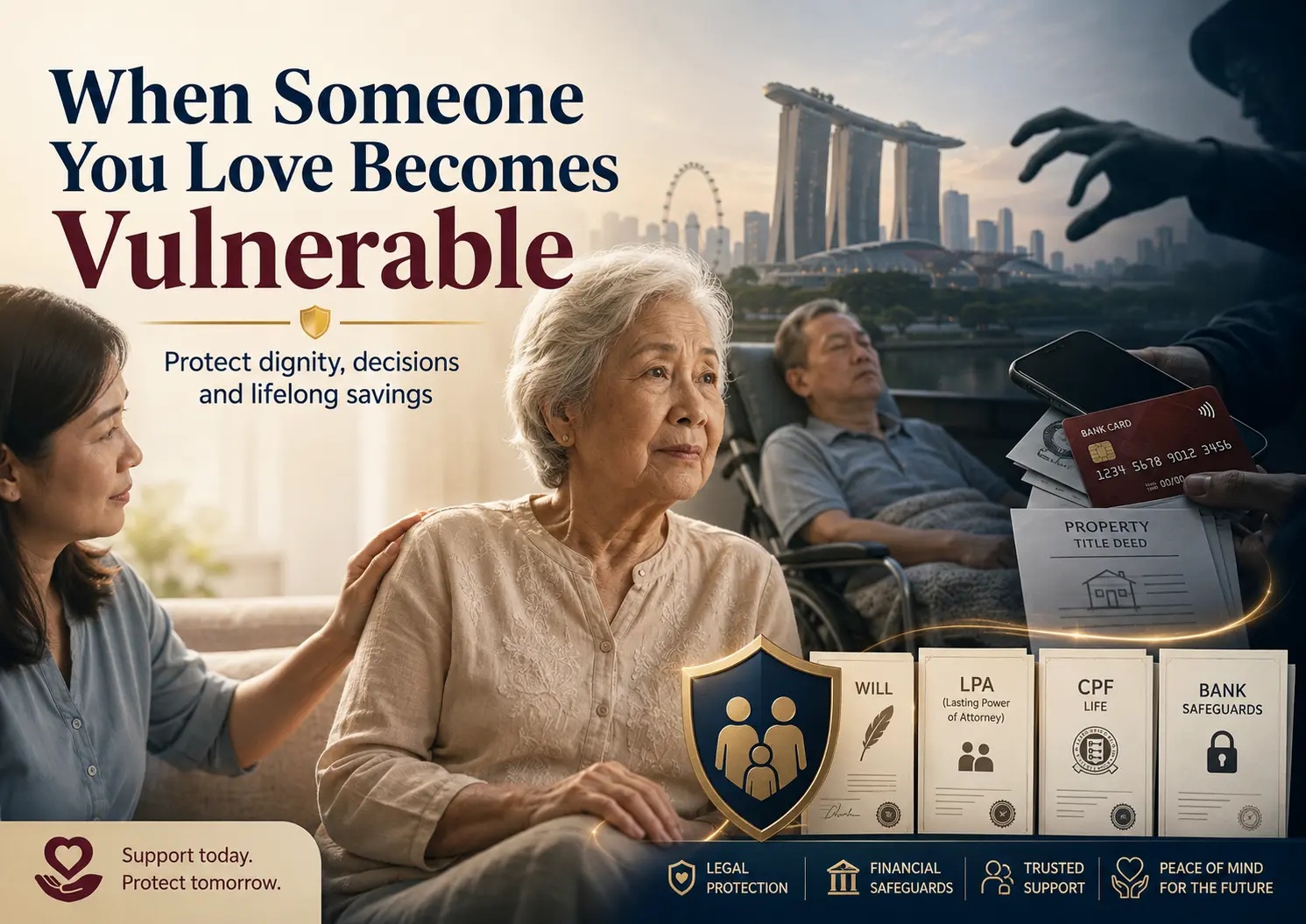
A person may spend 40 or 50 years building a home, CPF savings, investments and financial security, yet become most vulnerable at the stage of life when illness, frailty, disability or cognitive decline makes them increasingly dependent on another person.
Singapore has spent decades helping people live longer, healthier and more secure lives.
But longevity creates another question that deserves greater public attention:
Who protects a person’s decisions, dignity and lifetime savings when that person gradually becomes unable to manage everything independently?
The answer cannot simply be: “Family will take care of it.”
Most families do care for one another responsibly. Children, spouses, siblings, relatives and caregivers provide enormous amounts of care every day.
But real Singapore cases also show that family relationships do not automatically remove greed, addiction, financial pressure, coercion, conflicts of interest or a developing sense of entitlement.
1. Why This Matters Now
Singapore reached super aged status in 2026. Age Well SG states that at least 21 per cent of the population is aged 65 or above, and that by 2030 around one in four citizens will be 65 or older.
Age itself does not mean incapacity.
A person in their 80s or 90s may remain mentally sharp, independent and fully capable of making financial decisions.
The vulnerability arises when ageing or illness is accompanied by conditions such as dementia, stroke, terminal illness, physical disability, frailty, impaired eyesight or mobility limitations.
These conditions can increase dependence on another person.
MSF’s Domestic Violence Trends Report 2025 recorded 359 new Tier 1 elder abuse cases in 2024, compared with 297 in 2023.
At the same time, new high risk Tier 2 elderly Vulnerable Adult cases declined from 42 to 38.
These figures should not be interpreted as proof that Singapore families are becoming worse. Reporting can also rise as awareness and willingness to report improve.
2. Four Conditions That Can Turn Trust Into Risk
None of these factors proves wrongdoing.
A child, sibling, niece, nephew or friend helping an older person with banking may be performing an important and caring role.
The danger begins when assistance gradually becomes unchecked control.
3. Real Singapore Cases: What Can We Learn?
The following selected Singapore cases demonstrate several different ways in which family access and vulnerability can intersect.
S$1.6 Million Taken From a 62 Year Old Father
CNA reported in August 2026 that Tay Yi Cong obtained approximately S$1.6 million from his adoptive father, including S$533,800 from his father’s CPF savings.
The offences were linked to gambling. The court also heard that after his father began questioning falling bank balances, Tay posed as bank officers in an attempt to delay discovery.
He was sentenced to seven years’ imprisonment.
Lesson: Correct passwords, facial verification or possession of someone’s telephone do not always prove that a transaction reflects the account holder’s independent intention.
Teenager Transferred S$91,149 From His Father’s Finances
The Straits Times reported that a teenager who had previously helped his father with online financial matters became familiar with his father’s credentials.
He subsequently made unauthorised CPF withdrawals, obtained loans against insurance policies and transferred a total of S$91,149 to himself.
Another relative helping the father review his insurance policies eventually discovered the transactions.
Lesson: Helping someone use digital banking should not automatically mean permanent unrestricted access to that person’s financial credentials.
Son Exploited His Mother’s Dementia
CNA reported that a man repeatedly accompanied his mother, who had dementia, to obtain money from his parents’ joint account.
The court heard that he knew she was not capable of understanding why she was helping him obtain the money.
Approximately S$42,000 was involved.
He was sentenced to 13 months’ imprisonment.
Lesson: The fact that someone can physically attend a bank or participate in a transaction does not remove the need to consider whether that person understands the decision and is acting freely.
Senior Reportedly Left Without Her Home or Sale Proceeds
The Straits Times reported a case encountered by social service professionals involving a woman in her 70s.
Her son allegedly promised to care for her after she sold her landed property. According to the report, he later disappeared after taking the sale proceeds.
She was left without her money or a home.
Lesson: A home is not merely a future inheritance asset. For an older person, it can represent shelter, independence, financial security and dignity.
Bank Staff Noticed an Elderly Customer’s Unease
The Straits Times reported a situation in which a daughter sought to become a joint holder of her elderly father’s POSB account.
When bank employees spoke to him, he reportedly appeared uncomfortable and repeatedly indicated that he did not want his daughter added.
The request was declined.
Lesson: Sometimes an effective safeguard is simply allowing the account holder to communicate privately, without another interested person controlling the conversation.
An 86 Year Old Woman and Her 90 Year Old Brother
A Singapore court case involved an 86 year old woman with dementia who had appointed her 90 year old brother under a Lasting Power of Attorney.
The court subsequently revoked the LPA after determining that the relevant requirements concerning mental capacity had not been satisfied.
Lesson: This is not a young versus old issue. Capacity, independence, proper authority and safeguards matter more than the age of the person involved.
4. When Future Inheritance Starts to Feel Like Present Ownership
One of the more difficult risks does not necessarily begin with theft.
It may begin with an apparently harmless expectation.
None of those thoughts automatically makes someone abusive.
The danger begins when expectations about a future inheritance start influencing decisions about how much should be spent on the vulnerable person today.
That question matters.
A vulnerable person’s savings exist first to support their own life.
Their assets may need to pay for:
- medical treatment;
- nursing home or home care;
- professional caregivers;
- mobility equipment;
- accessible accommodation;
- transport;
- food and daily needs;
- comfort and personal wishes;
- and quality of life during their remaining years.
Caregiving can involve real sacrifice.
A son, daughter, spouse, sibling, niece, nephew or friend may spend years providing care, transport, time and money.
Legitimate caregiving expenses can be reimbursed transparently.
But there is an important difference between documented reimbursement for genuine caregiving expenditure and privately deciding how much of the vulnerable person’s wealth a caregiver deserves.
5. What About Larger and Wealthier Families?
This part requires careful distinction.
There is no evidence presented here showing that a person living in a landed property or condominium is automatically more likely to experience financial abuse than someone living in an HDB flat or rental home.
But substantial wealth can increase the financial stakes, number of assets and complexity of a later family dispute.
Smaller Estate
Someone may have S$40,000 in accessible savings. If S$20,000 disappears, half of their liquid financial security may be gone.
Larger Estate
Someone may own a landed home, CPF savings, investments, insurance policies and bank deposits worth several million dollars.
More assets can create more complicated questions about control, beneficiaries, ownership and future inheritance.
Financial abuse can therefore be devastating across income levels.
Wealth may increase the size and complexity of what is at stake. Having very little may make even a relatively small loss impossible to recover from.
Consider a Family With Six Adult Children
Their widowed mother owns a valuable home and later develops dementia.
- One child lives with her.
- One manages her banking.
- One regularly pays medical expenses.
- One believes the property was verbally promised to them.
- One has significant personal financial problems.
- Another contributes little to caregiving but expects an equal inheritance.
None of these circumstances proves wrongdoing.
But when the parent becomes unable to explain earlier decisions clearly, questions may arise.
- Was that S$200,000 transfer genuinely a gift?
- Did Mum really promise the property?
- Why was one sibling added to the bank account?
- Why was the will changed?
- Who paid for Mum’s care?
- Why are there no receipts?
- Was Mum mentally capable when the document was signed?
- Why can no one else see the financial records?
6. Vulnerability Has No Age Limit
Singapore’s Vulnerable Adults framework is broader than elder protection.
A Vulnerable Adult can be an adult aged 18 or above who, because of mental or physical infirmity, disability or incapacity, cannot adequately protect themselves from abuse, neglect or self neglect.
A 90 year old can remain fully capable.
A 45 year old who suffers a serious brain injury may become vulnerable overnight.
7. Single, Widowed and Childless Seniors: Who Will Look Out for Them?
Not every older adult has a spouse, son or daughter available to watch over their affairs.
Some seniors are single. Some are widowed. Some never had children. Some are estranged from relatives. Others may have family members living overseas or relationships that have become distant over time.
Living independently can be a source of pride and dignity. It should not automatically be treated as a vulnerability.
The risk appears when an independent senior becomes increasingly dependent while lacking a broad support network.
A single senior may gradually rely heavily on one niece, nephew, sibling, friend, neighbour, helper or caregiver.
That person may genuinely be caring and trustworthy.
But if one person eventually controls the senior’s banking, phone, Singpass, medical appointments, correspondence, property documents and contact with the outside world, a large concentration of influence has developed.
Consider an older aunt who lives alone
She is 82, unmarried and owns a valuable home.
She also has CPF savings, investments and cash reserves.
A niece begins helping her with groceries and medical appointments. Over time, the niece also starts helping with banking, correspondence, Singpass, property matters and legal appointments.
There may be nothing improper about this arrangement.
But one person now sits at almost every gateway into the aunt’s life.
This is precisely when reasonable safeguards become valuable.
A strong arrangement may include:
- an LPA made while the senior still has mental capacity;
- carefully chosen Donees;
- CPF safeguards and appropriate trusted contacts;
- an organised asset record;
- independent legal advice for substantial property decisions;
- healthcare planning;
- regular contact with friends, community organisations or Active Ageing Centres;
- and more than one trustworthy person remaining connected to the senior’s life.
For someone who has no suitable family member or close friend, Singapore also has a Professional Deputies and Donees Scheme.
This is particularly important because loneliness itself can affect decision making.
A senior may hesitate to challenge someone because they fear losing the only person who regularly visits them.
They may think:
That is why social connection is not merely about companionship. It can also form part of a person’s protective network.
8. Pride, Dignity and Why Abuse Can Remain Hidden
Financial abuse within a family is different from a conventional scam.
The person causing the problem may also be the person who:
- buys groceries;
- brings the person to medical appointments;
- visits the nursing home;
- helps with banking;
- handles paperwork;
- or provides most of the daily care.
That dependency can make disclosure extremely difficult.
A parent may think:
- “He is still my son.”
- “I do not want my daughter to get into trouble.”
- “I do not want the family to break apart.”
- “Who will care for me if I complain?”
- “I feel embarrassed.”
A single senior may think:
- “This is the only person who still visits me.”
- “I do not want to be left alone.”
- “Perhaps I should just accept it.”
Pride, loyalty and fear of isolation can therefore become part of the vulnerability.
9. A Practical Safeguard Framework
- Plan while mentally capable. Discuss an LPA, will, CPF nomination, important accounts, healthcare preferences and trusted persons before a crisis occurs.
- Keep financial credentials personal wherever possible. Helping someone use technology should not automatically mean retaining their ATM PIN, banking password, Singpass credentials or unrestricted telephone access.
- Use CPF safeguards. CPF provides protections including the Withdrawal Lock and other transaction safeguards.
- Consider CPF Trusted Contacts. Eligible members may appoint trusted persons to receive notifications for selected important account activity without giving those people authority to transact.
- Understand joint accounts before creating them. Ask the bank exactly what each account holder can do independently. Joint ownership can have important practical and legal consequences.
- Keep a transparent record of care expenditure. Record nursing home fees, hospital expenses, caregiver expenses, transport, purchases and reimbursements.
- Introduce independent scrutiny for life changing transactions. Selling a home, making a very large gift, transferring substantial savings or changing ownership arrangements during serious illness may justify independent legal advice.
- Make an LPA while capacity remains. Choose Donees carefully. An LPA Certificate Issuer must be satisfied that the donor understands the LPA and is not acting under fraud or undue pressure.
- Separate healthcare planning from financial control. Advance Care Planning can help record the person’s future healthcare and care preferences.
- For larger families, make transparency normal. Do not wait until after the vulnerable person’s death for relatives to discover years of unexplained transactions.
- For single seniors, build more than one layer of support. Where possible, maintain trusted personal relationships, community connections, appropriate professional support and financial safeguards.
10. When Mental Capacity Becomes Uncertain
Dementia does not automatically mean that someone lacks capacity to make every decision.
Likewise, being terminally ill, bedridden or living in a nursing home does not automatically transfer control of someone’s finances to a relative or caregiver.
Mental capacity relates to the person’s ability to understand and make the particular decision involved.
Where a valid LPA already exists, the Donee may act only within the authority properly granted.
Where the person has already lost capacity and there is no applicable LPA, Singapore’s Family Courts can appoint a Deputy.
Deputies are expected to act for the person’s benefit, remain within the authority granted by the court and keep appropriate records.
11. Warning Signs That Deserve Attention
One warning sign alone does not prove abuse. Several appearing together may justify closer scrutiny.
- Someone answers every financial question for the vulnerable person.
- The person appears frightened or uncomfortable around a particular individual.
- One person controls the telephone, Singpass and banking.
- Large unexplained withdrawals suddenly appear.
- A relative unexpectedly becomes a joint account holder.
- Bank statements or financial correspondence disappear.
- The person’s standard of living falls despite substantial assets.
- Large gifts begin during significant cognitive decline.
- There is sudden pressure to sell or transfer the home.
- A will, LPA or beneficiary arrangement changes during serious illness.
- One caregiver prevents others from speaking privately with the person.
- Caregiving expenses cannot be supported by records.
- Independent legal or medical advice is discouraged.
- Someone repeatedly speaks about the assets as though they already belong to the family.
- A previously independent single senior suddenly becomes completely dependent on one person.
- Friends, neighbours or relatives gradually lose access to the senior.
12. What If You Suspect Financial Abuse?
Family financial disputes can be highly emotional. Suspicion should not automatically become accusation.
Where circumstances warrant:
- Prioritise immediate safety.
- Speak privately with the vulnerable person where this can be done safely and appropriately.
- Preserve relevant evidence such as statements, messages, transaction histories and documents.
- Contact the relevant bank or CPF Board where unauthorised access or compromised accounts may be involved.
- Obtain independent legal advice for substantial property, LPA, deputyship, will or estate issues.
- Refer to the Office of the Public Guardian where there are concerns about the conduct of a Donee or Deputy.
- Use Singapore’s Adult Protection System where abuse, neglect or serious vulnerability is suspected.
13. Banks and CPF Can Be Part of the Protection System
Banks should not decide which relative deserves someone’s money.
Nor should financial institutions unnecessarily restrict customers who remain mentally capable.
But they can serve as an important checkpoint when something appears inconsistent with the person’s normal behaviour or expressed wishes.
Singapore banks are increasingly developing processes to recognise familial financial abuse and cognitive vulnerability.
The Association of Banks in Singapore’s Banking a Longevity Society framework includes the goal that seniors should be protected from financial abuse and scams while remaining able to access banking services and preserve their independence.
14. What Should a Vulnerable Person’s Money Be Used for First?
A person’s savings are not simply an estate waiting to be divided.
While that person remains alive, their resources may have a much more important purpose.
- medical treatment;
- high quality nursing care;
- professional caregivers;
- safe accommodation;
- mobility and accessibility;
- nutrition;
- comfort;
- social connection;
- personal preferences;
- and dignity during the final stages of life.
That is a question families and trusted caregivers should be willing to ask honestly.
The purpose of accumulated wealth should first be to support the person who accumulated it.
15. A Better Standard for Families and Trusted Caregivers
A large family can create additional disagreements.
But it can also provide something valuable: more than one pair of eyes.
A single senior may have fewer natural checks. That makes building a wider support network particularly important.
Transparency can turn family and trusted relationships into a stronger source of protection.
Where substantial assets are involved, appropriate independent professional involvement can also reduce future conflict.
The cost of professional advice may be very small compared with years of litigation, financial loss and damaged relationships later.
16. The Meaning of Dignity
Ultimately, this subject is larger than money.
It concerns whether a human being continues to have a voice when their body becomes weak.
Whether their choices remain respected when memory begins to fail.
Whether their home continues to represent security rather than merely a future inheritance.
Whether someone who lives alone continues to receive protection when there is no spouse or child naturally looking over their affairs.
Whether their lifetime savings are used to care for them rather than quietly preserved or redirected for someone else’s future benefit.
Growing Vulnerable Should Not Mean Losing Control of Your Life’s Work
Singapore’s pioneers and today’s working generations have spent decades building homes, families, CPF savings and financial security.
Some have large families. Some have only one child. Some are single, widowed or childless.
Every one of them deserves the same basic protection.
Illness, disability, dementia, frailty, loneliness or dependence should never become an opportunity for another person to assume unchecked control.
The objective is not to distrust families, relatives, friends or caregivers.
It is to make trust stronger through planning, transparency, proper authority and accountability.
Protect dignity. Protect choices. Protect care. Protect what a person spent a lifetime building.Official Singapore Resources and References
Government and Institutional Resources
- Age Well SG: Singapore’s ageing landscape
- MSF: Adult Protection System
- MSF: Domestic Violence Trends Reports
- Office of the Public Guardian: Lasting Power of Attorney
- Office of the Public Guardian: LPA Certificate Issuers
- Office of the Public Guardian: Professional Deputies and Donees Scheme
- Singapore Courts: Deputyship
- CPF Board: CPF Account Safeguards
- Ministry of Health: Advance Care Planning
- Association of Banks in Singapore: Banking a Longevity Society
Selected Case References
- CNA: S$1.6 million taken from father including CPF savings
- CNA: Dementia and withdrawals from parents’ joint account
- The Straits Times: S$91,149 taken from father’s finances
- The Straits Times: Financial abuse involving loved ones
- The Straits Times: POSB staff intervention
- The Straits Times: LPA and mental capacity case