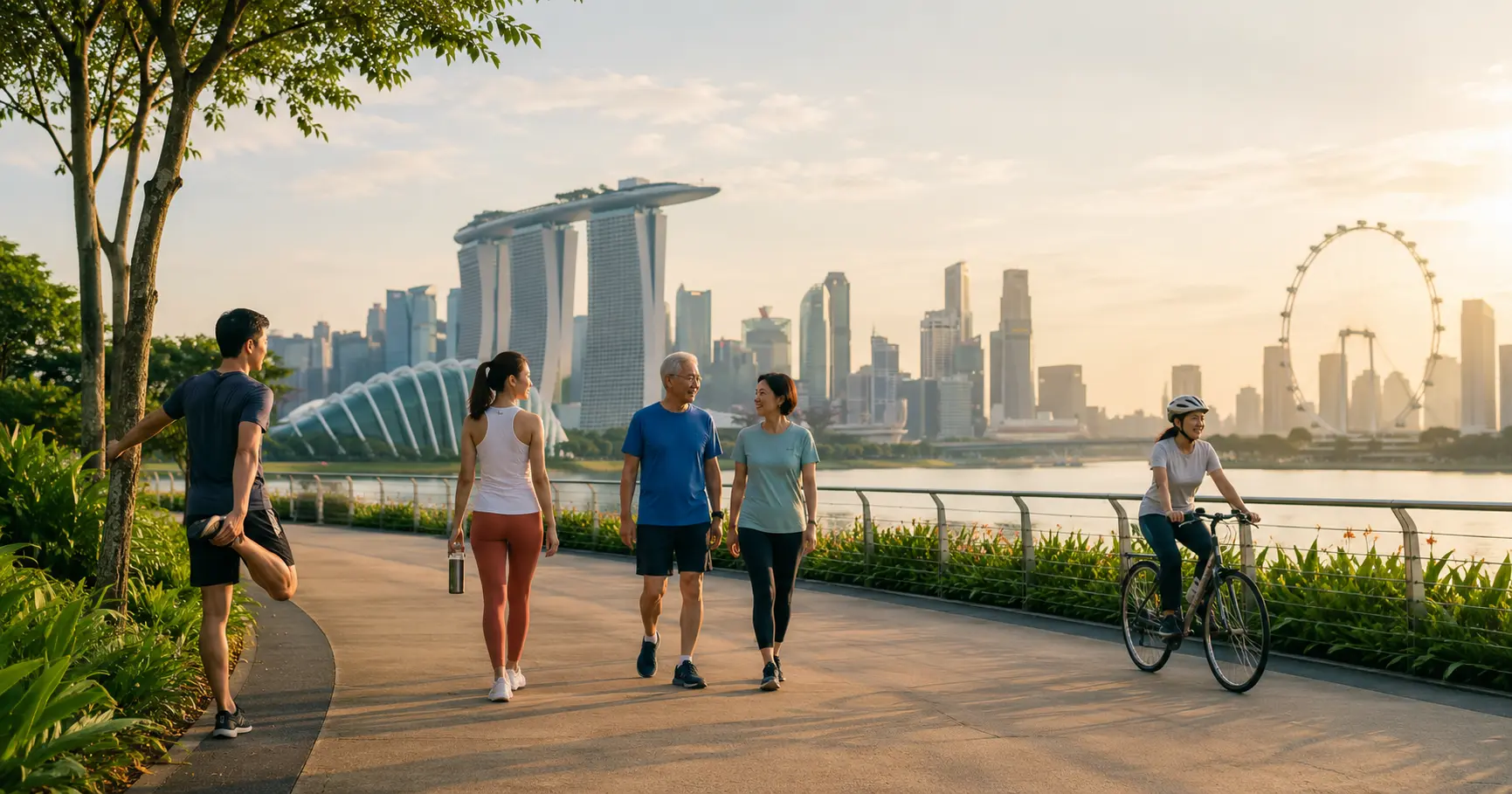
Singapore makes modern living remarkably convenient. But convenience does not automatically create health.
We can cross the island efficiently, order meals within minutes, work from almost anywhere and access parks, healthcare, exercise facilities and community programmes close to home.
Yet an ordinary weekday can still involve hours of sitting, hurried meals, constant notifications, insufficient recovery, limited intentional movement and too little sleep.
That creates an interesting urban paradox.
The healthier and more connected our city becomes, the more important it is that we learn how to use it well.
Urban wellness is therefore not about escaping Singapore’s city life. It is about designing healthier behaviour into the life we already have.
Our parks, neighbourhoods, hawker centres, homes, transport network and community infrastructure already provide many of the building blocks.
The challenge is turning those resources into habits we can sustain.
Singapore Wellness Snapshot
Start with what the evidence already tells us.
Build movement into everyday life
Physical activity does not always have to begin with a gym membership or an intensive training programme.
Some of the most sustainable activity is movement that becomes part of things we already need to do.
Walk part of your journey to the MRT. Take the stairs when appropriate. Walk to buy breakfast. Use the park connector near home. Take a short walking break after lunch. Meet someone for a walk rather than always meeting over food.
Singapore’s physical activity guidance recommends that adults accumulate at least 150 to 300 minutes of moderate intensity aerobic activity each week, together with muscle strengthening activity on at least two days.
Make it practical
- Start with ten or twenty minutes if you have been inactive.
- Break up long periods of sitting during the working day.
- Include strength, balance and mobility as you grow older.
- Progress gradually rather than chasing an unsustainable start.
The important word is not always exercise.
It is movement.
Make Singapore’s green spaces part of your routine
Urban living does not have to mean being disconnected from nature.
Singapore’s parks, nature reserves and extensive Park Connector Network mean greenery can become part of ordinary life rather than something reserved for an occasional excursion.
A neighbourhood park, waterfront path or park connector can become part of the weekly routine.
Try this
- A morning walk before the working day starts.
- A short walk through greenery after lunch.
- A weekend park connector walk with family or friends.
- A slower recovery day outdoors instead of another indoor activity.
You do not necessarily need a two hour hike.
The better question may be: where is the nearest green space you could realistically use every week?
Eat better without giving up Singapore’s food culture
Healthy eating in Singapore does not require expensive superfoods, rigid dieting or abandoning the hawker centre.
Health Promotion Board’s My Healthy Plate offers a simple framework for building a more balanced meal.
The framework is better understood as a decision-making guide than a test of whether a meal is simply good or bad.
At a hawker centre, practical adjustments could include adding vegetables, choosing wholegrain options when available, asking for less gravy or sauce, watching portions and choosing water or less sweet drinks more frequently.
Fish soup, yong tau foo or mixed rice can be reasonable choices depending on what goes into the meal, but no dish becomes automatically healthy because of its name.
Singaporeans should be able to enjoy our food culture while making better decisions for long-term health.
Respect heat, hydration and air quality
Singapore’s climate changes how we should think about outdoor physical activity.
Hot and humid conditions can increase physical strain and fluid loss, especially during prolonged or strenuous activity.
Where practical, exercise during cooler periods, drink regularly, wear suitable clothing and modify intensity when conditions demand it.
Know the difference
NEA uses the 24 hour Pollutant Standards Index, or PSI, for broader daily air quality assessment.
The 1 hour PM2.5 reading can help with more immediate decisions about outdoor activity during haze conditions.
Wellness is not about exercising regardless of circumstances.
Sometimes the healthier decision is to change the location, intensity or timing of the activity.
Create small moments of mental recovery
Urban stress is not always one major event. Often it is the accumulation of small demands with almost no recovery between them.
Messages. Deadlines. Traffic. Meetings. Family responsibilities. News. Financial decisions. Screens. Notifications.
Then another notification.
Mindful recovery does not require an hour of meditation. It may simply mean deliberately creating a small period during which the mind is not responding to another demand.
Build recovery into the day
- Take several slow breaths before starting the next task.
- Walk occasionally without looking at your phone.
- Spend part of lunch outdoors.
- Sit quietly before beginning or ending the working day.
- Create periods when notifications do not control your attention.
These moments will not remove every source of stress. Their purpose is to create recovery space.
Treat sleep as part of your health strategy
Sleep should not simply be whatever remains after work, entertainment and responsibilities are finished.
Adults should generally aim for at least seven hours of sleep each day, while recognising that individual sleep needs vary.
A practical sleep environment
- Keep reasonably consistent sleeping and waking times.
- Reduce unnecessary screen use before bed.
- Keep the bedroom dark, quiet and comfortable where possible.
- Avoid turning the bed into another workspace.
- Notice whether late-night scrolling is quietly replacing sleep.
Wearables can help reveal patterns, but the purpose is not to achieve a perfect sleep score.
No device can fully compensate for repeatedly going to bed too late.
Protect social connection as you age
Wellness is not only physical.
A person can live among millions of people and still become socially disconnected.
This becomes increasingly important as families become smaller, careers change, children grow up, colleagues retire and social circles evolve.
Connection can be intentional
- Walk or exercise with friends.
- Participate in community activities.
- Join an interest or learning group.
- Volunteer where your skills can be useful.
- Maintain regular contact with people who matter.
For active ageing, the objective should not simply be to live longer.
It should be to preserve as much capacity as possible to remain connected, purposeful and involved in life.
Use technology as a tool, not as the definition of health.
Wearables, apps and digital health platforms can help us notice patterns in physical activity, sleep and other behaviours.
But ten thousand steps displayed on a watch do not automatically mean someone is healthy. Neither does a perfect sleep score, heart rate graph or app streak.
Data becomes valuable when it helps us make better decisions.
For individuals with medical conditions, symptoms or substantial changes in physical function, professional healthcare or appropriately qualified exercise guidance may be more relevant than relying solely on a consumer device.
The bigger idea is to design wellness into your life.
There is a tendency to treat wellness as another list of things we should be doing.
Exercise more. Eat better. Sleep earlier. Reduce stress. Drink more water. Spend less time on the phone.
That can quickly become another source of guilt.
A more sustainable approach is to think about environment and design.
If walking is built into your commute, movement becomes easier. If healthier food is readily available at home, eating well becomes easier.
If your phone stays away from the bed, sleeping earlier becomes easier. If you regularly meet friends for walks, physical activity and social connection happen together.
This is where wellness connects with the wider AndrewKoh.sg idea of Strategic Living.
Long-term health is rarely created by one decision. It develops through hundreds of smaller decisions involving how we live, work, move, eat, rest, connect and eventually age.
Do not change everything this week.
Choose one behaviour that is realistic enough to repeat.
Singapore already gives us many ingredients for healthier urban living. Are we making full use of the city around us to support the life we want to live?
Not sure how to begin exercising safely?
For readers who want a more structured starting point, UFitness Singapore’s Safe Start Fitness Pathway focuses on readiness, appropriate screening and understanding the next step before progressing into exercise.
Official Singapore references
- Health Promotion Board / HealthHub Physical activity guidance for adults.
HealthHub: Physical Activity Guidance - Health Promotion Board / HealthHub My Healthy Plate and balanced meal planning.
HealthHub: My Healthy Plate - National Parks Board Parks, nature reserves and Singapore’s Park Connector Network.
NParks Singapore - National Environment Agency PSI, PM2.5 and public guidance relating to air quality and haze.
NEA: Air Quality and Haze - HealthHub MindSG Sleep and mental well-being guidance for adults.
MindSG: Sleeping Well