Strategic Living · Property, Population and Society
Will HDB and Private Property Ever Decouple? The Bigger NDR 2026 Story of Housing, Families and Singapore’s Future
The question raised by Huttons Asia and EdgeProp is bigger than two property indices. It reaches into family formation, low fertility, ageing, measured immigration, productivity, social integration, retirement, infrastructure and the difficult use of limited land.
Short answer: HDB and private property can move differently for periods, and the affordability gap between them may widen. But complete structural separation remains unlikely while most resident households live in HDB flats and both markets remain connected through household equity, executive condominiums, right-sizing, financing and policy.
The more plausible future is a more segmented, two-speed and increasingly two-way housing system not two unrelated markets.
At the National Day Rally 2026, Prime Minister Lawrence Wong described technology, support for families, openness and social cohesion, and long-term planning as parts of one larger mission to keep Singapore resilient. This article applies that integrated lens to a timely housing question.
The immediate prompt came from a Huttons Asia analysis published by EdgeProp: with HDB resale prices softening while the overall private residential index continued rising, could the two markets eventually decouple and could the traditional HDB-to-private upgrading path become harder to sustain?
That is a legitimate question. But it must be answered without turning a short period of index divergence into a price forecast, or treating immigration, family support or limited land as automatic property-demand engines.
1. Start with the official Q2 2026 data not only the headline
The Housing & Development Board reported that its Resale Price Index declined by 0.3% quarter on quarter in Q2 2026, after a 0.1% decline in Q1.
Over the same quarter, the Urban Redevelopment Authority reported that the overall private residential price index increased by 0.5%. Yet that private-market gain was not broad-based:
- Landed private homes: +2.5%
- All non-landed private homes: −0.1%
- Core Central Region non-landed homes: +1.8%
- Rest of Central Region non-landed homes: −1.2%
- Outside Central Region non-landed homes: −0.1%
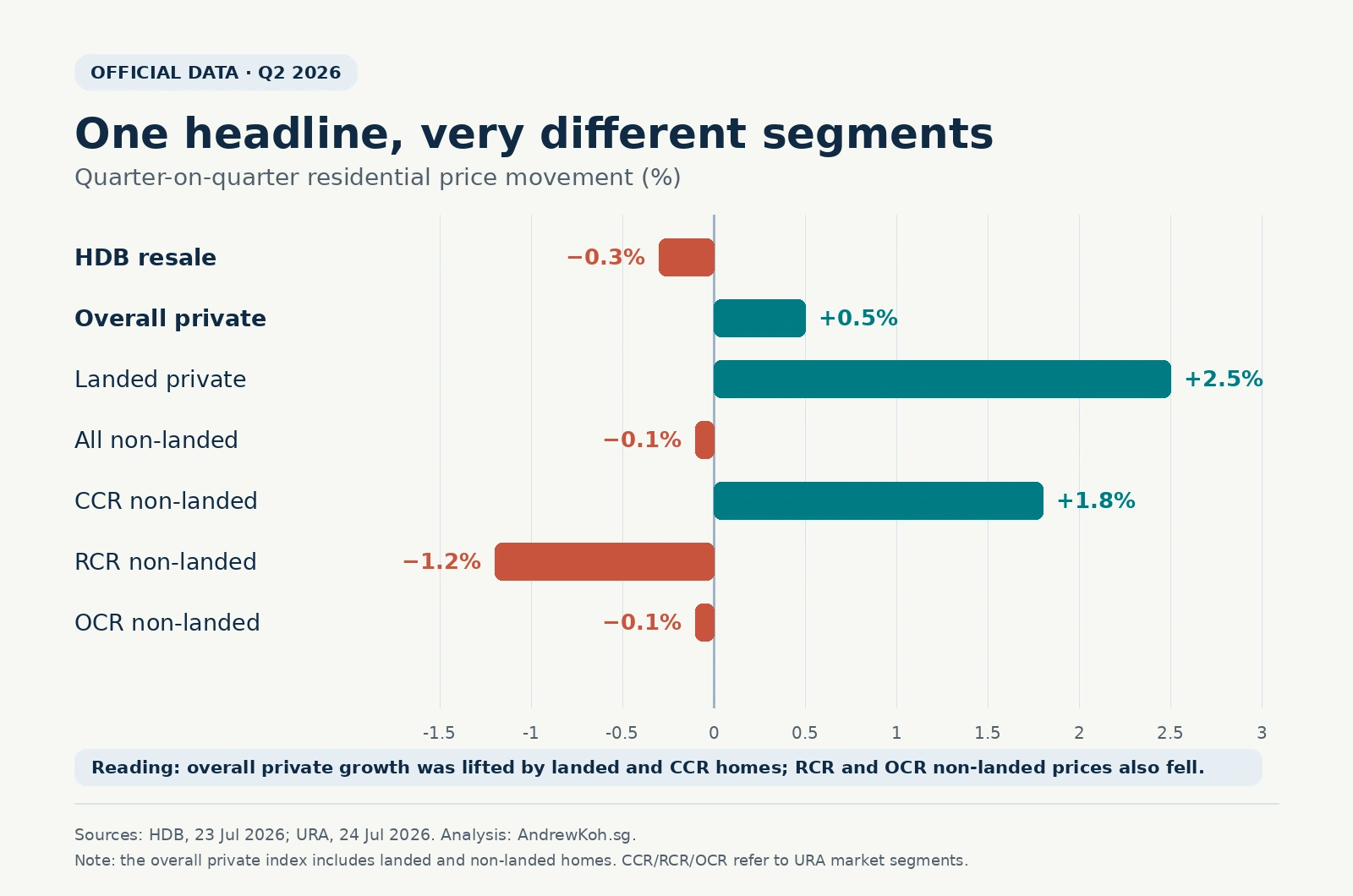
This distinction matters. Many HDB upgraders looking at private housing are more likely to consider an EC or non-landed home in the RCR or OCR than a landed property. In Q2 2026, both RCR and OCR non-landed prices also declined.
Evidence check: Comparing the overall HDB index with the overall private index can overstate how widely the two markets are separating. Part of the headline divergence came from landed and CCR strength, not a uniform rise across private housing.
The Huttons/EdgeProp analysis nevertheless identifies a longer-term affordability issue. It calculated that from the beginning of 2016 to the first half of 2026, private residential prices rose by 59.9%, compared with 50.7% for HDB resale prices. It also found that HDB-address buyers accounted for roughly 20% of new private-home purchases in the RCR and OCR in 1H2026, down from around 50% in 2016.
These are useful industry observations, but one methodological limit must remain visible: an HDB address is a proxy. It does not prove that every buyer owned and sold an HDB flat before purchasing private property.
2. “Decoupling” can mean three different things
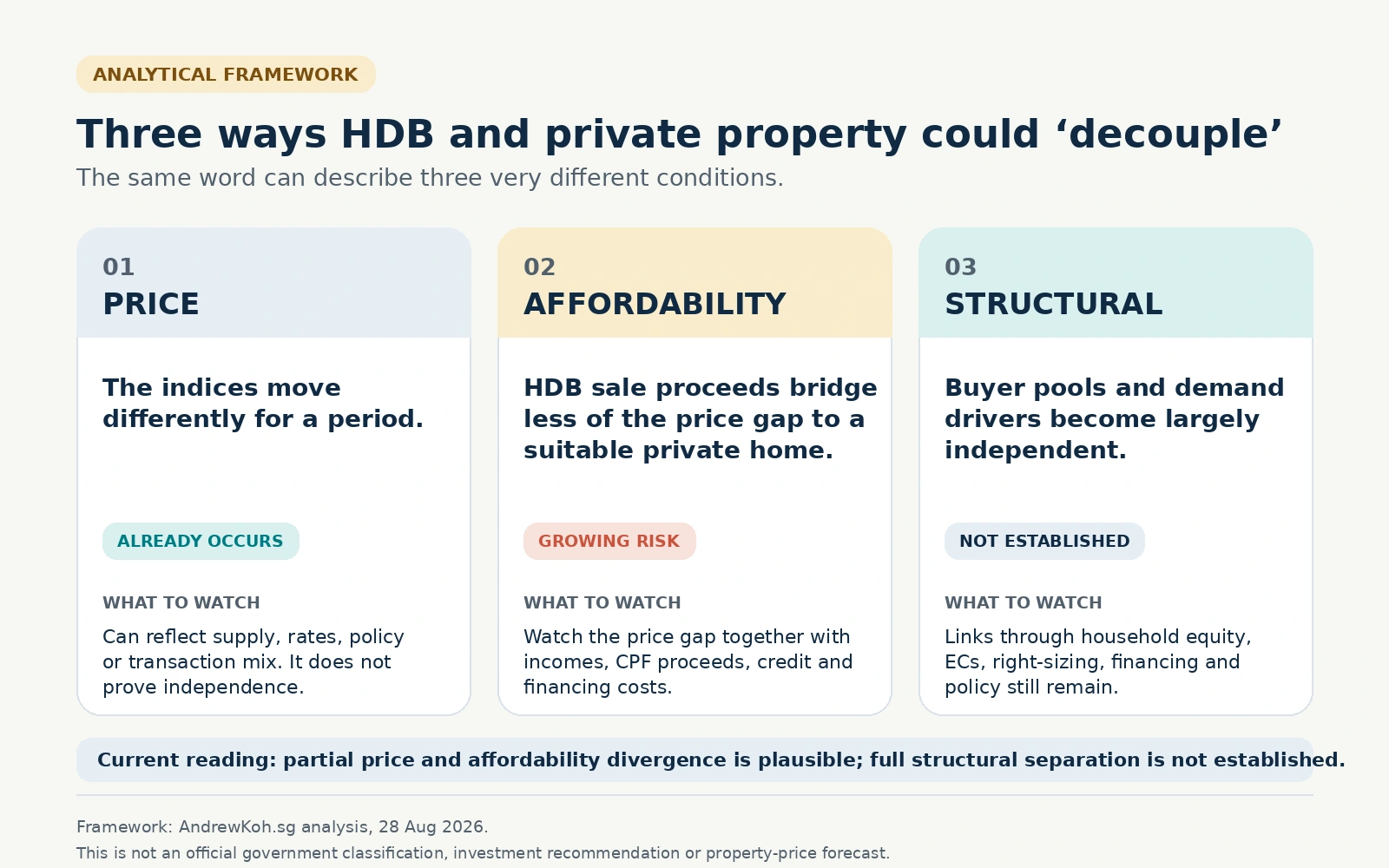
Price decoupling
The indices move differently for a period. This already happens because the markets differ in supply, buyer eligibility, financing, cooling measures, land costs and transaction composition. Temporary divergence does not prove independence.
Affordability decoupling
The net proceeds from an HDB sale, together with household income and financing capacity, bridge less of the price gap to a suitable private home. This is the more important public-awareness issue because households can remain technically eligible to buy while becoming financially less able or less willing to do so safely.
Structural decoupling
The HDB and private buyer pools become largely independent, with private demand no longer materially connected to HDB equity or movement. Singapore has not reached that point. In 2025, 77.2% of resident households lived in HDB dwellings. That large owner-occupied base still affects upgrading, right-sizing, retirement choices and private demand.
3. The NDR 2026 lens: four agendas that should be read together
NDR 2026 provides the broader framework. The speech did not present family support, population, productivity, cohesion and land as separate subjects. It described them as interconnected parts of Singapore’s long-term resilience.
Make family formation more achievable
NDR 2026 raised relevant family income ceilings for subsidised public housing from $14,000 to $16,000 and the ceiling for qualifying future EC projects from $16,000 to $18,000. From the February 2027 sales exercise, first-timer families will receive an additional BTO or SBF ballot chance for every Singapore Citizen child aged 18 or below, including a child they are expecting.
Refresh the population at a measured pace
The speech acknowledged that fertility remains far below replacement and explained why Singapore continues to welcome new citizens. It also stated that the foreign workforce will remain carefully managed, overall population and labour-force growth will slow, and integration must work both ways.
Create more value with slower labour growth
NDR 2026 said more future growth must come from technology, productivity and enabling every Singaporean to realise their potential. This matters to housing because jobs, incomes and financing capacity are fundamental demand drivers, not population totals alone.
Preserve options for future generations
The speech highlighted trade-offs between homes, jobs, transport, infrastructure, greenery and heritage, and described planning horizons of 50 to 100 years. Long Island is envisaged as a future waterfront where people may live and raise families; around 500 hectares on Tekong may eventually be available for civilian uses, although no use has been decided.
The NDR 2026 Marriage and Parenthood package also provides around $70,000 of direct support for each eligible Singapore Citizen child from birth to age 17, together with more childcare leave and progressively lower fees at Government-supported preschool centres.
What these measures are and are not: They are intended to make starting and raising a family more achievable and to preserve access to housing. They should not be presented as a scheme to create property demand, guarantee a higher TFR or raise home prices. Housing eligibility is also not the same as housing affordability.
4. Low fertility changes the future but on a different clock from housing demand
Singapore’s preliminary resident total fertility rate fell to 0.87 in 2025, with about 27,500 resident births. The 2026 Committee of Supply population speech said that without further measures, the citizen population could begin shrinking in the early 2040s.
Without offsetting gains from productivity, labour-force participation or immigration, persistently low fertility can eventually reduce workforce growth and the number of family members available to support seniors. But it does not cause an immediate decline in housing demand. Babies born in 2025 will not form most of their own households for decades.
Near-term housing demand depends more directly on household formation. According to SingStat, resident households increased by 1.6% to approximately 1.487 million in 2025, while resident population growth was slower and average resident household size declined from 3.09 to 3.06 persons.
That is why a slowly growing or ageing population can still require more homes. Smaller families, seniors living independently, adult singles and separated household units can increase the number of dwellings needed even when the number of people grows more slowly.
Immigration supports demographic and economic resilience not property inflation
NDR 2026 said Singapore aims to refresh its citizen population at a measured and sustainable pace, manage the foreign workforce carefully and keep Singaporeans the majority. It also emphasised commitment, shared values, the broad maintenance of the ethnic balance and integration that works in both directions.
The official rationale therefore is wider than selecting workers with strong economic profiles. Newcomers include family members as well as people who bring skills and experience. NDR noted that one in three marriages is now between a Singaporean and a non-citizen. Those who eventually make Singapore home become part of its families, schools, workplaces, communities and shared institutions.
The Government earlier indicated an expected range of 25,000 to 30,000 new citizens and around 40,000 new permanent residents annually over the following five years, with actual numbers adjusted according to demographic needs, applicants’ suitability, infrastructure and society’s capacity. NDR subsequently stressed that overall population and labour-force growth will be slower.
These flows may contribute to rental or ownership demand over time, but the relationship is not one-to-one:
- Non-residents primarily affect rental and worker-accommodation demand.
- Permanent residents, new citizens and other residents face different eligibility and ownership rules.
- Some newcomers join households that already have housing.
- Employment, income, financing, tenure choice and family formation determine effective demand.
- Infrastructure, housing supply and integration capacity affect what is sustainable.
Singapore’s total population reached 6.11 million in June 2025, including 1.91 million non-residents. The official population report notes that much of the recent non-resident increase came from Work Permit holders supporting construction and major infrastructure, followed by migrant domestic workers. Population growth must therefore never be treated as identical to homebuyer growth.
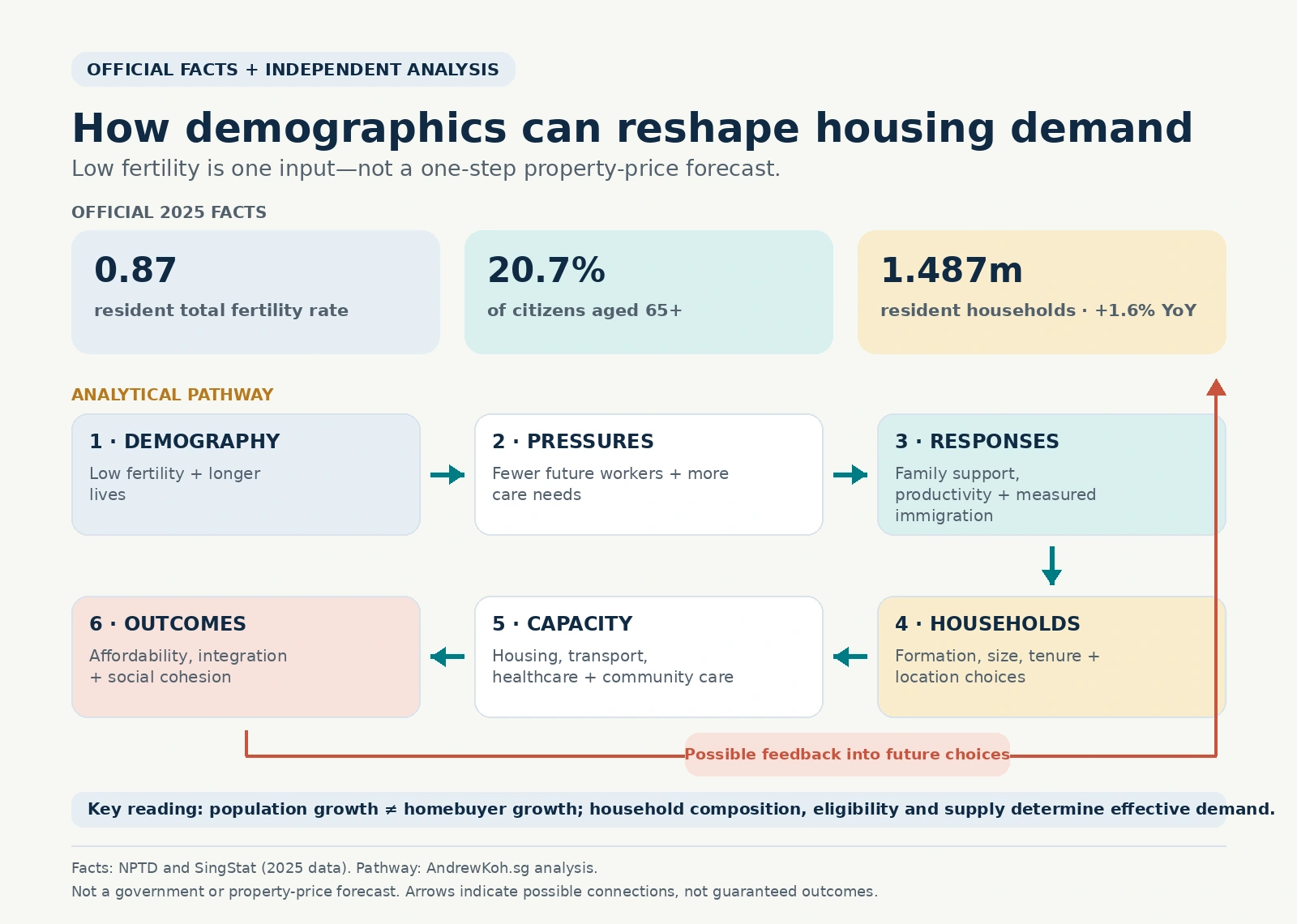
The sustainability test is broader than numbers: Singapore needs enough people and skills to remain economically resilient, enough infrastructure and homes to serve them, and enough integration and affordability for social trust to endure. Weakness in any one of these areas can feed back into family formation and confidence in the future.
5. Ageing will reshape housing demand, care and the use of home equity
In 2025, Singapore had approximately 789,600 residents aged 65 and above, with only 3.3 residents aged 20 to 64 for each resident aged 65 or above. By 2030, one in four citizens is expected to be aged 65 or above.
NDR 2026 said the Government is studying ways to make it easier for seniors to unlock the value of their homes for retirement while continuing to live in them. Details are still being developed and should not be anticipated as confirmed policy.
The response will not be limited to building more nursing homes. MOH expects nursing-home capacity to increase from more than 20,000 beds to around 31,000 by 2030, but has also said institutional capacity alone is not a sustainable long-term answer in land-scarce Singapore. The wider Age Well strategy supports seniors to age in place through community health, Active Ageing Centres, home care, rehabilitation and senior-friendly neighbourhoods.
From the October 2026 BTO exercise, the minimum age for Community Care Apartment applicants will be lowered from 65 to 55. This gives some seniors an earlier option to consider right-sizing and integrated care.
The housing effects may move in both directions:
- Some seniors may remain in existing homes for longer, reducing resale supply.
- Others may right-size from a private home or larger HDB flat, releasing housing equity and returning units to the market.
- Demand may shift towards lift access, barrier-free design, transport, healthcare, markets, community care and proximity to family.
- Lease age and retirement adequacy may become more important than headline price appreciation.
This creates a more two-way relationship between public and private housing. The traditional story was mostly HDB-to-private upgrading. The future will also include private-to-HDB right-sizing and moves towards care-integrated housing.
6. New rules are rewiring the pathways between HDB, EC and private housing
The markets remain connected, but recent changes can alter the speed, direction and eligibility of movement.
| Policy or rule | Confirmed change | Possible housing-system effect |
|---|---|---|
| NDR 2026 income ceilings | Relevant family ceilings rise to $16,000; eligible singles to $8,000; the ceiling for qualifying future EC projects rises to $18,000. | More households may retain access to subsidised pathways, but a higher eligibility ceiling does not mean every household should borrow to its maximum. |
| Family-first ballot priority | From February 2027, first-timer families receive an additional BTO/SBF ballot chance for every eligible child, including a child expected. | Housing support becomes more explicitly connected to growing families and earlier access to a home. |
| Standard, Plus and Prime | Plus and Prime flats carry 10-year minimum occupation periods and tighter resale conditions. | Some households may remain in public housing longer before an open-market move becomes possible. |
| Future affected EC projects | The MOP rises from five to 10 years, full privatisation occurs after 15 years, first-timer priority rises to 90% for two years, and the Deferred Payment Scheme is removed. | ECs become more clearly positioned as long-term owner-occupied family homes rather than a rapid progression step. |
| Private-to-HDB right-sizing | The temporary 15-month wait-out period was removed for private owners purchasing non-subsidised resale HDB flats, subject to prevailing conditions. | Reverse movement may become more practical for retirees, empty-nesters and households reducing housing commitments. |
| Community Care Apartments | The minimum applicant age falls to 55 from the October 2026 BTO exercise. | Housing, ageing and care become more directly integrated within the public-housing system. |
Sources: HDB’s NDR 2026 housing announcement, Standard/Plus/Prime framework, MND’s EC reforms and HDB’s wait-out-period announcement.
What still connects both markets?
- Household equity: proceeds, CPF refunds, outstanding loans, stamp duties and replacement-home costs affect the next move.
- Executive condominiums: ECs remain a formal bridge between public-housing eligibility and eventual private status.
- Household movement: upgrading, right-sizing, divorce, inheritance, caregiving and living near family can move demand between segments.
- Credit and income: interest rates, loan rules, MSR/TDSR and job security affect both markets, although not identically.
- National policy: BTO supply, Government Land Sales, grants, cooling measures and occupation rules are calibrated across one housing system.
7. Three possible long-term scenarios
These are analytical scenarios, not forecasts or recommendations.
| Scenario | What could produce it | What it would mean |
|---|---|---|
| 1. Re-coupling | HDB prices stabilise, incomes grow, private supply remains adequate and mass-market private price growth moderates. | The HDB-to-EC or condominium affordability bridge improves for some households. |
| 2. Partial decoupling and a two-speed market Most plausible current reading | HDB remains shaped by affordability and public supply, while landed, prime and selected new-launch segments respond more strongly to wealth and existing private owners. | The markets remain linked, but different segments move less uniformly and the traditional upgrading ladder narrows. |
| 3. Deeper structural separation | Private prices and high-income wealth diverge persistently from HDB values, while private demand becomes dominated by existing private owners. | Upward movement from HDB weakens materially, although ECs, right-sizing and policy still prevent complete separation. |
What the public should monitor not predict
- The price and monthly-payment gap between a household’s current home and realistic replacement home;
- HDB-address buyer shares by EC, OCR, RCR, CCR and landed segments, with the proxy limitation stated;
- Household-income growth, mortgage rates and financing rules;
- BTO, EC, private and MOP supply pipelines;
- Household formation and average household size, not population totals alone;
- Right-sizing, senior housing and lease-age patterns;
- Whether infrastructure, affordability and integration keep pace with demographic change.
For households: Do not assume an HDB sale will automatically fund a safe private-property upgrade. Test net sale proceeds, CPF refunds, stamp duties, loan affordability, retirement reserves and future caregiving needs. Eligibility is a rule; affordability is a household outcome.
8. So, will HDB and private property fully decouple?
Temporary price decoupling can occur. Affordability decoupling deserves serious attention. Complete structural decoupling remains unlikely under Singapore’s present housing system.
The bigger change may be the gradual weakening of a simple one-way ladder from HDB to EC to private condominium. In its place could emerge a more varied system:
- HDB increasingly centred on secure, affordable and family-supportive owner occupation;
- ECs positioned as longer-term homes for first-timer and growing families;
- mass-market private housing drawing from a narrower and more selective upgrader pool;
- landed and prime private segments moving more strongly with accumulated wealth;
- older households moving in both directions as they age in place, right-size or unlock home equity;
- care, transport and community infrastructure becoming more important to housing value and suitability.
NDR 2026 helps us see why this is not only a property question. A sustainable housing system must support family formation without encouraging unsafe borrowing; remain open without losing social cohesion; use technology and productivity to offset slower workforce growth; care for seniors without relying only on institutions; and plan limited land for homes, work, transport, care, nature and future options.
That is the larger public-awareness message: housing demand is produced by households, life stages, incomes, policy and confidence, not by a single population number. And property prices are an outcome to manage, not the purpose of demographic or family policy.
Sources and methodology
Official facts are drawn primarily from PMO, gov.sg, HDB, URA, MND, SingStat, MOH and the National Population and Talent Division. Buyer-address shares and selected long-run price comparisons are attributed to Huttons Asia through EdgeProp and are clearly identified as industry analysis.
- Prime Minister’s Office: National Day Rally 2026
- gov.sg: Strengthening Our Families—NDR 2026
- NPTD: Marriage and Parenthood Measures at NDR 2026
- HDB: Q2 2026 Public Housing Data
- URA: Q2 2026 Real Estate Statistics
- SingStat: Population and Population Structure
- SingStat: Resident Households
- NPTD: Committee of Supply Debate 2026 Population Speech
- NPTD: Overall Population
- HDB: NDR 2026 Income Ceilings and Family Housing Support
- HDB: Removal of the 15-month Wait-out Period
- MND: Strengthening the Executive Condominium Scheme
- MOH: Ageing in the Community
- MOH/MND/HDB: Community Care Apartment Enhancements
- EdgeProp/Huttons: Has the HDB Market Decoupled from the Private Property Market?
- Council for Estate Agencies: Practice Guidelines and Circulars
Independent commentary, CEA and reader disclosure
General market information last updated on 28 August 2026. This article is independent educational commentary based on publicly available information. It is not produced, sponsored or endorsed by the Government, HDB, URA, MND, MOH, NPTD, CEA, Huttons Asia or EdgeProp.
It does not advertise a specific property and does not promise or predict any price, demand, rental, return or capital-gain outcome. Analytical frameworks and scenarios are AndrewKoh.sg’s own. Industry data based on an HDB address are treated as a proxy rather than proof of HDB ownership or a completed upgrading transaction.
The CEA ethical advertising framework requires market-trend and forecast claims used in advertising to be supported by reliable data, and general market information to remain current and not misleading. Readers should verify current policies and eligibility with the relevant agencies and obtain independent financial, legal, tax or property advice for their circumstances.