Follow the Money: MLM, Pyramid Schemes and Sustainable Business Models
A business may have distributors, team leaders, managers, recruiters, commissions and several layers of remuneration. Those features alone do not tell us whether its economic model is legitimate, healthy or sustainable.
The more useful question is surprisingly simple: Where does the money actually come from?
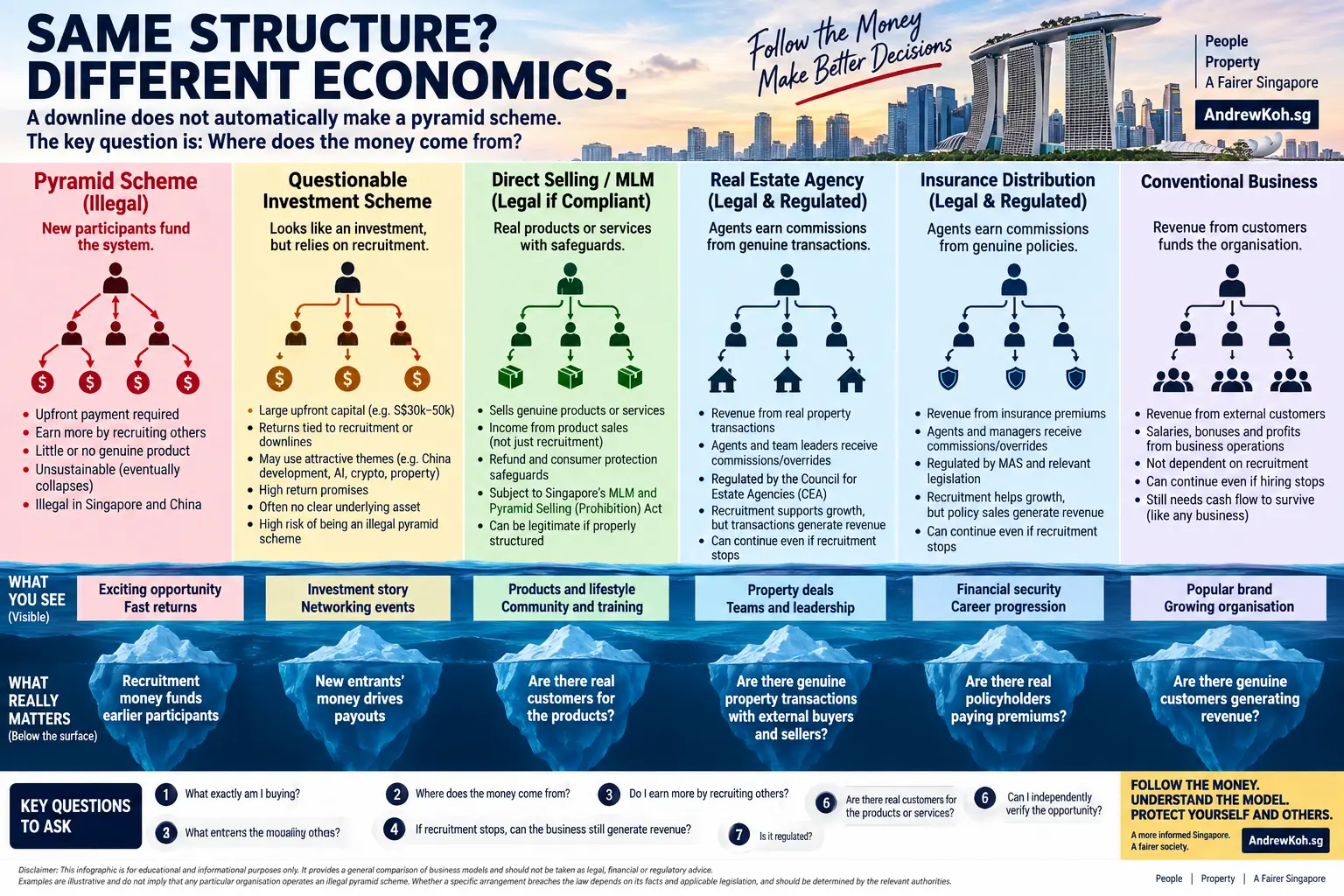
AndrewKoh.sg illustration. The diagram is a conceptual public-education comparison and is not a legal classification of any specific company or organisation.
Why the Nanning Case Is a Powerful Reminder
On 4 September 2026, Channel NewsAsia reported on Singaporeans who had been approached over what was presented as a business and investment opportunity connected with Nanning in China’s Guangxi region.
According to CNA’s interviews, participants were introduced to membership levels requiring substantial upfront payments. Interviewees described amounts of about S$30,000 or S$50,000, with the ability to recruit different numbers of “downlines”.
One interviewee told CNA that commission came from the membership fee of the person’s downline. CNA also reported that participants were told returns depended on recruiting additional people. One person who attended the presentations described the arrangement as having “no product” and being based on membership.
Separately, Singapore’s Ministry of Foreign Affairs and police confirmed on 4 September that 52 Singaporeans had been arrested and detained in Guangxi over suspected pyramid-scheme activities and related offences.
Important legal distinction
The Nanning investigations and related legal proceedings must be allowed to take their course. Arrest, detention, allegations or media reporting do not establish the guilt of any particular individual. This article discusses publicly reported structures and general regulatory principles for education.
The broader lesson is not simply “avoid Nanning”.
It is to understand the architecture that can appear underneath many different labels: investment, entrepreneurship, membership, education, cryptocurrency, wellness, property, technology, overseas development or private business opportunity.
Begin by asking, “What activity produces the money?”
Legal Does Not Automatically Mean Healthy and Healthy Does Not Mean Risk-Free
Three questions should be kept separate.
Legal Test
Does the arrangement fall within Singapore’s applicable laws, regulations and exclusions?
Economic Test
What activity generates the revenue? Genuine customer demand, or participant payments and recruitment?
Sustainability Test
Can the model continue if recruitment slows, customer acquisition becomes harder or sales volumes fall?
This distinction matters because a structure might satisfy applicable legal requirements yet still have weak economics, high participant turnover, excessive acquisition costs or limited genuine consumer demand.
Conversely, ordinary businesses may experience severe cash-flow pressure without being remotely similar to pyramid schemes.
Singapore Does Not Simply Divide the World Into “MLM” and “Not MLM”
Singapore’s Multi-Level Marketing and Pyramid Selling (Prohibition) Act 1973 prohibits the promotion of and participation in prohibited multi-level marketing and pyramid-selling schemes or arrangements.
At the same time, the Government recognises that not every multi-level distribution technique is undesirable.
The Ministry of Trade and Industry explains that the Multi-Level Marketing and Pyramid Selling (Excluded Schemes and Arrangements) Order excludes certain legitimate arrangements from the prohibition when the required conditions are satisfied.
Examples identified by MTI include qualifying insurance businesses, master-franchise arrangements and certain direct-selling arrangements.
The critical MTI distinction
MTI states that commission sharing across several layers of salespersons can be permissible in an excluded direct-selling arrangement. However, those commissions must be generated by the sale of the relevant product or service — not merely by recruiting additional participants.
MTI also describes safeguards including restrictions on imposing inappropriate financial risk on salespersons, reasonable inventory refund or buy-back arrangements, prohibitions against misleading “get-rich-quick” representations and requirements relating to earnings claims.
This is why using the phrase “legal MLM” too casually can be misleading. A more precise description is:
Five Levels: From Product-Led Commerce to Recruitment Dependency
Instead of thinking only in terms of “legal versus illegal”, consumers can examine a spectrum of economic quality.
Product-Led Business
Independent customers buy genuine goods or services because they value those goods or services. Revenue primarily comes from customer demand.
Recruitment is not required for the economic engine to function.
Multi-Tier Distribution
A company uses salespeople, distributors, managers or leaders and may share transaction-generated commissions across more than one level.
The organisation may recruit people to expand distribution, but recruitment itself is not supposed to be the source of the commission.
Recruitment-Heavy or Participant-Consumption Model
A genuine product may exist, but a substantial portion of sales may depend on distributors themselves purchasing products, maintaining monthly volumes, qualifying for ranks or continually replacing departing participants.
This category should not automatically be described as illegal. But from an economic perspective, consumers should examine the quality of independent customer demand and whether recruitment is masking weak unit economics.
Product-Fronted Pyramid Risk
A product, course, membership, software package or inventory bundle exists, but obtaining economic rewards is materially linked to bringing new paying participants into the structure.
The existence of a product does not by itself resolve the legal or economic concern.
Pure Recruitment Pyramid
New participants contribute money and recruitment generates the mechanism through which earlier participants expect to benefit.
When recruitment eventually slows, the mechanism becomes mathematically unsustainable.
This five-level framework is an analytical tool created for this article. It is not a statutory classification and should not be used to determine the legal status of a particular company.
“But We Have a Product” Is Not a Complete Answer
One of the easiest mistakes is assuming that the existence of a tangible product automatically proves legitimacy.
Consider two businesses that both sell a S$200 wellness product.
Model A
The customer wants the product regardless of whether a business opportunity exists.
Model B
Both businesses technically have products.
But the economic behaviour is radically different.
It is “Would ordinary independent customers still buy this product at this price if the income opportunity disappeared?”
Inventory Loading Is Another Warning Sign
A company may record substantial “sales” because its distributors are continually purchasing inventory.
But if products accumulate in garages, spare rooms or storerooms because distributors cannot resell them to genuine end customers, the accounting sale may not represent healthy external demand.
This is one reason MTI’s safeguards concerning participant financial risk and reasonable inventory refunds or buy-back arrangements are important.
Who ultimately consumes the product?
Independent customers or mainly people participating in the income opportunity?
Would customers still buy it at approximately the same price without commissions, ranks, bonuses or recruitment?
Are products genuinely moving to end users, or accumulating with participants?
What event actually triggers compensation a customer purchase or another participant joining?
The Three-Year Recruitment Stress Test
Imagine that an organisation cannot recruit a single new salesperson, distributor or member for the next three years.
Would its existing network still be able to create revenue by serving genuine customers?
| Structure | If Recruitment Stops | Economic Engine |
|---|---|---|
| Conventional business | Can continue if sufficient customers remain | External customer demand |
| Real-estate distribution | Growth may slow, but existing salespersons can continue completing transactions | Property transactions |
| Insurance distribution | Distribution growth may slow, while existing representatives can continue serving customers and generating business | Genuine insurance business |
| Qualifying direct selling | Should remain grounded in genuine product/service distribution | Product/service sales subject to applicable safeguards |
| Recruitment-heavy structure | Could experience significant deterioration if participant purchasing and replacement recruitment are important to revenue | Mixed external sales and participant expenditure |
| Recruitment-funded pyramid | The underlying mechanism eventually fails when new participant money disappears | New participant payments |
Economic illustration only. The legal status of any particular arrangement depends on its actual facts and applicable law.
Pyramid Scheme and Ponzi Scheme Are Not the Same Structure
The terms are often used interchangeably, but the mechanics are different.
Pyramid
Participants commonly recruit additional participants. Recruitment and participant payments propagate through the structure.
Ponzi
An operator typically attracts investors and uses incoming money to create the appearance of returns to earlier investors. Investors need not recruit each other.
Ordinary Investment
Returns should arise from an identifiable underlying asset, enterprise or economic activity, subject to genuine investment risk.
The common analytical question remains: What real economic activity generated the apparent return?
Why Real Estate and Insurance Can Have Hierarchies Without Being Pyramid Structures
Real estate and insurance are useful examples because both industries can contain multiple layers of people, leadership, recruitment and remuneration.
Looking only at the organisational chart can therefore produce a misleading comparison.
Real estate
Singapore’s real-estate agency industry operates within the framework of the Estate Agents Act 2010 and related regulations administered by the Council for Estate Agencies.
Agency recruitment can increase market reach and sales capacity. But the underlying revenue is generated through genuine estate-agency work and property transactions rather than simply by registering another salesperson.
That does not mean every organisational design is equally productive.
A very large sales organisation could still face legitimate business questions involving agent productivity, leadership cost, transaction concentration, retention, market cycles or excessive reliance on continuous recruitment for growth.
Those are better described as business-model sustainability or productivity questions, not pyramid allegations.
Insurance distribution
MTI specifically identifies qualifying insurance arrangements within the exclusion framework, subject to the applicable regulatory requirements.
Why this distinction matters
This article does not suggest that real-estate agencies, insurers, financial-advisory organisations, franchise systems or legitimate direct-selling companies are pyramid schemes merely because they use hierarchical distribution or leadership remuneration.
Revenue Dependency and Recruitment Dependency Are Different
Every business requires cash flow.
A restaurant requires diners. An airline requires passengers. A preschool requires enrolment. A retailer requires customers. A property agency requires transactions.
Therefore:
is not a useful test for identifying a pyramid structure.
A better question is:
| Dependency | What Must Continue? | Interpretation |
|---|---|---|
| Customer dependency | Consumers continue purchasing genuine goods/services | Normal commercial risk |
| Transaction dependency | Real economic transactions continue | Normal commercial/cyclical risk |
| Distributor-consumption dependency | Participants continually purchase products themselves | Requires closer economic scrutiny |
| Recruitment dependency | New participants continually join and contribute money | Major warning sign |
| New-money dependency | Incoming investor/participant funds support earlier payouts | Fundamental sustainability concern and potentially serious legal issue |
Eight Questions Before You Commit Money
- What exactly am I buying? Can I clearly identify the product, service, asset, membership right or investment interest?
- Who is the real customer? Are ordinary independent consumers buying, or are most buyers also participants?
- Where does the money ultimately come from? Follow the cash flow rather than the marketing story.
- What triggers my commission or return? A genuine customer transaction or another person joining and paying?
- Would people still buy the product without the income opportunity? Remove ranks, bonuses, recruitment and lifestyle promises from the equation.
- If recruitment stopped for three years, would the underlying business still function?
- Who receives and controls my money? Is payment made to an identifiable business or regulated intermediary, or to an individual’s personal account?
- Can everything be independently verified? Check the company, underlying assets, regulators, contracts, claims and people involved through sources independent of the promoter.
Red Flags That Deserve Immediate Attention
MoneySense advises consumers to verify whether relevant entities and individuals are regulated, examine the company’s background and be wary of opportunities promising high returns with little or no risk.
Singapore Police similarly recommends checking investment providers and representatives through official sources and being cautious when promoters cannot clearly explain an opportunity.
Do Not Recruit Someone Else Simply to Recover Your Money
One of the most damaging outcomes of a recruitment-based arrangement is when someone who originally entered as a participant tries to recover losses by placing another friend or family member underneath them.
Stop and document first
If you suspect that an arrangement may be prohibited or fraudulent, consider stopping further recruitment or payment, preserve contracts, bank records, presentation materials and communications, and seek appropriate independent professional or regulatory assistance.
MTI states that the Commercial Affairs Department investigates suspected pyramid-selling schemes.
Under section 3 of Singapore’s Multi-Level Marketing and Pyramid Selling (Prohibition) Act 1973, promoting or participating in a prohibited scheme or arrangement can, upon conviction, result in a fine of up to S$200,000, imprisonment for up to five years, or both.
Do Not Judge the Shape. Judge the Economic Engine.
A hierarchy can exist inside an entirely legitimate business.
A product can exist inside an economically questionable structure.
A business can be lawful yet commercially fragile.
And an impressive investment story can exist without a genuine investment underneath it.
A product does not automatically prove sustainability.
A legal structure does not automatically prove good economics.
Follow the money.
The strongest businesses ultimately have something a recruitment-dependent model cannot manufacture indefinitely: genuine demand from people who are willing to pay for genuine value.
References and Further Reading
-
Singapore Statutes Online.
Multi-Level Marketing and Pyramid Selling (Prohibition) Act 1973.
Singapore Statutes Online -
Ministry of Trade and Industry, Singapore.
Multi-Level Marketing and Pyramid Selling Act — legislation, exclusions and FAQs.
MTI guidance -
Council for Estate Agencies.
Legislation and regulatory framework for estate agents and real estate salespersons.
CEA legislation -
Channel NewsAsia, 4 September 2026.
Singaporeans lured by alleged pyramid scheme linked to investment opportunities in China.
CNA investigation -
Channel NewsAsia, 4 September 2026.
52 Singaporeans arrested, detained in China over suspected pyramid scheme.
CNA report -
Channel NewsAsia, 4 September 2026.
SIAS warns against pyramid-type ‘Nanning scheme’ investment arrangements.
CNA / SIAS warning -
MoneySense, updated 18 August 2026.
How to spot an investment scam.
MoneySense -
Singapore Police Force.
Police Advisory on Investment Scams Involving Chat Groups That Offer Fake Opportunities to Learn Investing.
Singapore Police Force
Follow the Money. Understand the Model.
Before putting money into an investment, membership or business opportunity, look past the presentation and organisational chart. Identify the real customer, the real product and the actual source of the return.
Explore AndrewKoh.sg