Strategic Living · Childhood · Education · AI
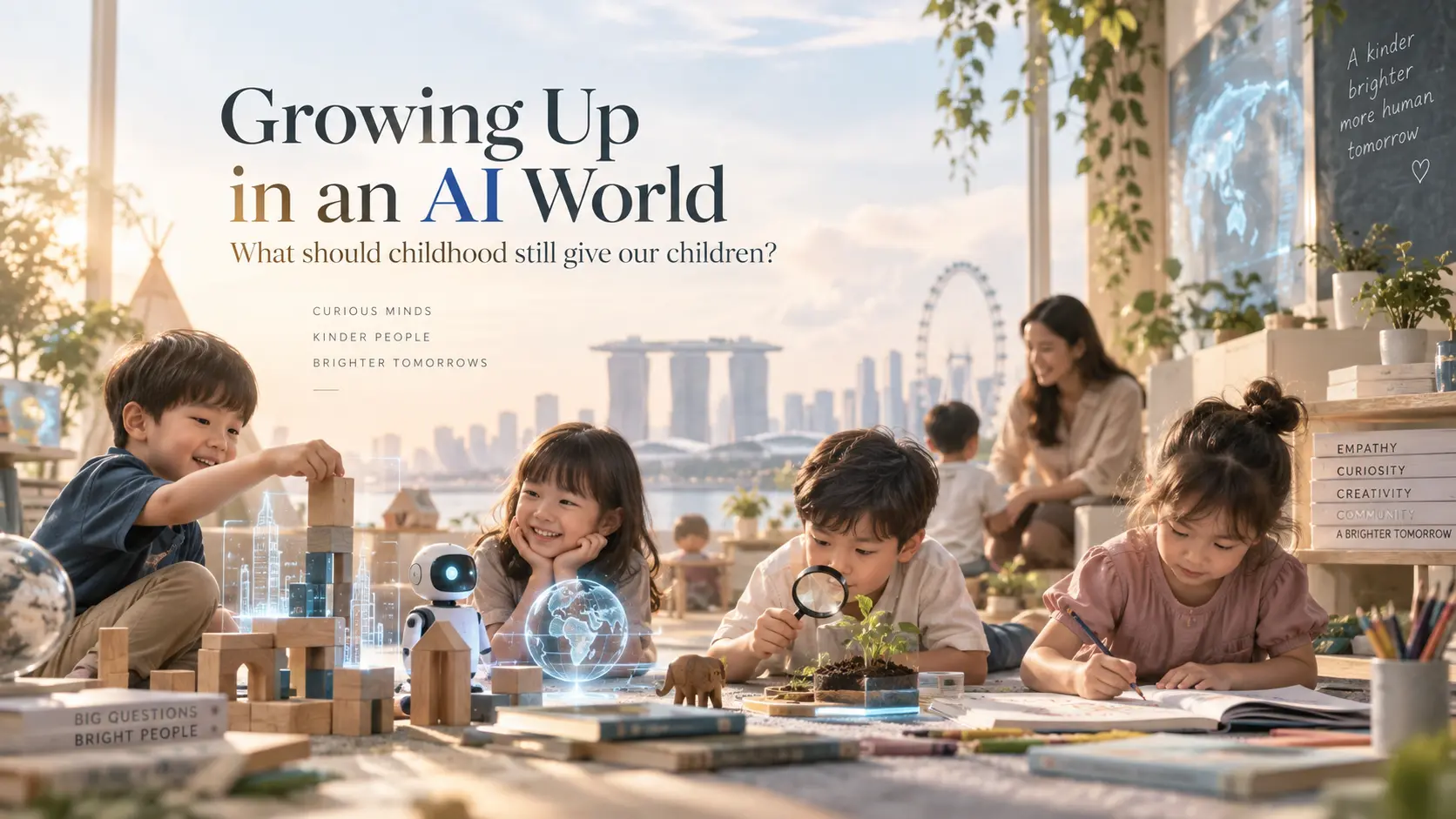
Growing Up in an AI World: What Should Childhood Still Give Our Children?
As artificial intelligence becomes part of everyday learning and work, the more important question may not be how early children learn to use technology but what kind of human beings childhood is helping them become.
Parents are choosing preschools for children who will grow up in a world very different from the one their parents entered. AI can already retrieve information, generate images, translate languages, write code and explain concepts in seconds. By the time today’s preschoolers enter the workforce, many tasks we currently associate with knowledge and productivity may have changed again.
That does not make preschool less important. It changes what we should value in it. Instead of asking only “Which school teaches more?” or “Which preschool costs more or less?”, a more useful question is: What kind of person is this environment helping my child become?
Singapore’s preschool landscape is also changing. Since 1 January 2026, full-day childcare fee caps at Anchor Operator and Partner Operator preschools have been reduced to S$610 and S$650 respectively, before applicable subsidies; the Government has also reported that 80% of preschoolers can have a place in a government-supported preschool.[1]
That is significant for affordability and access. It also makes the next layer of the conversation more important: once a family has considered what it can responsibly afford, what value should it look for beyond price?
AI changes the value of information, not the value of childhood
Singapore is already preparing older children for an AI-enabled future. IMDA says the Code for Fun programme will be updated so that AI skills become core baseline capabilities for primary and secondary school students, with the updated programme available to all schools in 2027.[2]
But the answer for a four-year-old cannot simply be “more technology, earlier”. Singapore’s own early-childhood frameworks emphasise holistic development. ECDA’s Early Years Development Framework gives greater prominence to cognitive, communication and language, physical, and social-emotional development for infants and toddlers.[3] The Ministry of Education’s Nurturing Early Learners framework for children aged four to six similarly emphasises learning through relationships, exploration, communication, cooperation and social-emotional development.[4]
A child who can retrieve an answer is not necessarily a child who can ask a good question. A child who can generate a picture is not necessarily a child who can imagine. A child who can use an AI assistant is not necessarily a child who can negotiate a disagreement, comfort a friend, persist through frustration or recognise when something feels wrong.
Those capacities are built through lived experience: conversation, play, movement, stories, mistakes, friendships, routines, boundaries, care and contact with adults who know the child well.
Preschool choice is becoming more differentiated
Singapore families do not all travel through the same preschool pathway. Some choose government-supported preschools because of accessibility, affordability, proximity or familiarity. Some choose independent private preschools for a particular pedagogy, language environment, programme or school culture. Some families choose preschool within an international-school system because of curriculum continuity, mobility or other family circumstances.
Government-supported
Public support, fee caps and subsidies can make these centres especially important for accessibility and affordability. Individual centres still differ in culture, educators, environment and programme experience.
Independent private
Families may pay more for a specific philosophy, programme, language model, location, class structure or community. A higher price still needs to be justified by value that parents can actually observe.
International pathway
Some families value continuity with an international curriculum or future schooling route. These environments may serve different family needs and should not be treated as a direct one-for-one substitute for every local preschool pathway.
Diversity of choice is not itself a problem. It can allow families to find an environment suited to their child. But it raises a broader social question: as housing, schooling and enrichment choices become more segmented, are children spending more of their formative years mainly among families whose circumstances resemble their own?
Social mixing is influenced by far more than preschool fees including neighbourhoods, housing, transport, family networks, activities and later schooling. The point is therefore not to label one preschool model as socially better than another. It is to recognise that exposure to difference may need to be created deliberately: across cultures, generations, abilities, neighbourhoods and life experiences.
The question is not “Which preschool wins?”
The useful question is whether a particular environment fits the child, fits the family’s circumstances and helps the child grow into a capable, grounded person who can live well with other people in a technologically powerful world.
Price and value are not the same thing
Lower fees do not automatically mean lower quality. Higher fees do not automatically mean better developmental outcomes. Singapore’s Anchor and Partner Operators receive public funding precisely so that they can keep fees affordable while investing in quality.[1]
But this creates an unavoidable question for any premium private preschool: if a parent is paying several times the government-supported fee cap, what is the additional value actually paying for?
MindChamps’ published 2026 full-day fee for Nursery through Kindergarten is S$2,470 per month before GST, while the 2026 full-day childcare fee caps are S$610 for Anchor Operators and S$650 for Partner Operators.[8] On the headline fee alone, the difference is therefore substantial. Subsidies, promotions and individual family circumstances can change the final out-of-pocket amount, but the strategic point remains: a premium preschool cannot justify that gap merely by saying it offers “quality education”.
So what is a MindChamps parent actually paying for?
The strongest answer is not the décor, the brand name or a claim of exclusivity. It is the attempt to deliver a highly integrated, proprietary education system through trained teachers, a defined learning philosophy, and multiple programmes intended to work together rather than as separate enrichment add-ons.
None of these features automatically proves that MindChamps is the right preschool for every child. The relevant question is whether parents can see these elements being delivered consistently in the actual centre. A proprietary curriculum has little value if it remains on a brochure. Teacher training matters only if it is visible in teacher-child interactions. Lower ratios matter only if the additional attention improves the child’s experience.
The hidden premium · intellectual capital
The minds behind the MindChamps system
Parents naturally compare what they can see: the classroom, facilities, activities, food, location and teacher-child ratio. But part of the value of an education system sits behind the classroom in the people who research, challenge, design and refine how learning is delivered.
MindChamps describes its research and education work as drawing on four domains — Education, Psychology, Neuroscience and Theatre rather than relying on a single pedagogical tradition.[21] Its current team includes senior educational leaders and specialists from several countries.[22]
The strategic value is the chain: research & expertise → programme design → teacher accreditation → classroom practice → child experience. The names matter only if that chain is visible in the daily quality of teaching.
Mrs Carmee Lim’s role is particularly relevant in Singapore. When MindChamps announced her appointment as Mentor Principal, it described her role as helping bridge MindChamps’ learning strategies with Singapore’s education system and curriculum.[23] That gives the brand a credible local educational connection alongside its international research orientation.
The premium preschool market is not one single category
MindChamps also competes in a market where other private preschools have credible and quite different educational propositions. That is important, because MindChamps should not try to look like every other premium school.
| Preschool | Documented educational emphasis | What makes the proposition distinct |
|---|---|---|
| MindChamps | 3-Mind model, S.M.I.L.E.S., proprietary programmes, trained delivery system and primary-school readiness. | An integrated system built around how children learn, think, create and respond to challenge, rather than one imported pedagogy alone.[9][10] |
| EtonHouse | Inquiry-led learning inspired by Reggio Emilia, with IB PYP at selected campuses and a broader international education pathway. | Strong fit for families attracted to child-led inquiry, Reggio-inspired environments and international/IB continuity.[15] |
| Brighton Montessori | Montessori principles, hands-on apparatus, individualised pace, practical life, sensorial work and independence. | Clear appeal for families who specifically value a Montessori learning environment and self-directed mastery.[16] |
| MapleBear | Canadian curriculum, English-Mandarin bilingual immersion, play-based learning and defined learning outcomes. | Distinctive for families prioritising bilingual immersion within a Canadian educational model.[17] |
| Mulberry Learning | Reggio-inspired learning combined with the Habits of Mind framework, Multiple Intelligences and project inquiry. | Positions strongly around thinking dispositions, inquiry and problem-solving habits.[18] |
| Holland International School Preschool | International Early Years Curriculum, play, outdoor experiences and learning within an international-school community. | Different proposition for families seeking an international setting, outdoor play and continuity with an international-school environment.[19] |
These are not rankings. They are different educational propositions. A family drawn to Montessori may prefer Brighton. A family prioritising Reggio-inspired inquiry or an IB pathway may prefer EtonHouse. A family focused heavily on bilingual immersion may find MapleBear compelling. An internationally mobile family may value an international-school preschool environment.
MindChamps should not compete by trying to be “more premium” than other private preschools. Its clearest position is: a Singapore-rooted premium preschool system that integrates learning skills, creativity, character, bilingual foundations and school readiness through proprietary curriculum and a trained teacher-delivery model.
That positioning is especially relevant in an AI world. Information is becoming cheaper and easier to access. The premium value of education therefore cannot simply be “more content”. The stronger proposition is helping a child learn how to learn, how to think, how to create, how to communicate and how to recover from setbacks.
In other words, the case for paying more is not that a child should know more facts at age five. The case has to be that the preschool offers a sufficiently different developmental system and daily experience to justify the family’s investment.
From preschool brand to education community
There is another potential source of long-term value that is less about curriculum and more about network effects. As a preschool system grows, every new child and family can add to a larger community of parents, educators, former Champs and future alumni.
This should not be marketed as a powerful alumni network before such a network is demonstrably active. But strategically, MindChamps has the ingredients to build one: a recognisable education philosophy, multiple centres, a common teacher-development system and a shared language around the Champion, Learning and Creative Minds.
The opportunity is not to become the “most expensive preschool”. It is to become one of the most recognisable and trusted education ecosystems where a MindChamps family understands what the brand stands for, wherever the centre is, while each centre develops its own authentic local community.
This is the useful part of comparing MindChamps with global consumer brands such as Starbucks or McDonald’s: not mass-market commoditisation, but systemisation, recognition and consistency. In education, however, consistency must never mean treating children as standardised products. The system should create a dependable educational foundation while leaving space for individual children, teachers and communities to remain human.
In an AI world, that distinction becomes even more important. Technology can scale content almost infinitely. A strong education brand must scale culture, teaching quality, relationships and values the things that cannot simply be downloaded.
What should parents actually look for?
Brochures, facilities and social-media posts can help a parent form a first impression. But a centre visit remains valuable because preschool quality is experienced through people and interactions.
Human relationships: How do teachers speak to children? Does a child appear known, heard and emotionally safe?
Language and communication: Are children encouraged to express ideas, listen, converse and make meaning rather than simply repeat answers?
Agency and curiosity: Is there room to explore, create, make choices, ask questions and solve small problems?
Self-regulation and resilience: How are frustration, waiting, mistakes, disagreement and transitions handled?
Community: Does the centre feel like a relationship between children, educators and parents or mainly a transaction?
Digital literacy will matter. AI literacy will matter. But IMDA’s own framing is worth noting: young people should use technology ethically and responsibly, avoid becoming over-reliant on it, and keep humans and humanity central to technology’s development and use.[5] That principle can begin long before a child learns to write a prompt.
Community may become one of the most valuable things a preschool can build
Parents often think of preschool as something delivered to a child. In practice, a strong early-childhood environment can also shape the family around the child. Teachers know parents. Parents meet other parents. Families share milestones. Children grow up seeing familiar adults and friends.
Over time, that can become a form of community capital: relationships, trust, shared experiences and a sense that the family belongs somewhere.
This is also where authentic centre-level communication matters. A social channel should not exist only to push promotions. It can help parents see how a centre thinks, celebrates, learns, interacts and involves families. Real school-life content does not replace a visit, but it can make the culture more visible before a parent ever walks through the door.
From reflection to real-world exploration
Two MindChamps communities parents can explore
The following centres are included as practical examples for families who want to look beyond a brochure and examine school culture, parent communication and day-to-day learning more closely. They are not presented as a ranking against other preschools. Parents should compare fees, subsidies, travel time, programme details, educators and their child’s needs before deciding.
MindChamps PreSchool @ JTC Summit
8 Jurong Town Hall Road, The JTC Summit, #05-01, Singapore 609434
MindChamps’ official centre page states that MindChamps PreSchool @ JTC Summit opened in 2010, and highlights its community events, parent trust, safety, and a happy environment for active learning and play.66
Why MindChamps PreSchool @ JTC Summit Stands Out in Singapore’s West
In the heart of Jurong, MindChamps PreSchool @ JTC Summit has something that cannot be created overnight: history, continuity and an established community.
Located within The JTC Summit, a prominent government building serving Singapore’s industrial and business community, the preschool has been part of the building since 2010. For parents, this setting brings an added sense of structure and security, supported by the controlled environment and round-the-clock security of the building.
But a preschool is ultimately defined not by its address, but by the people and culture within it.
At JTC Summit, the MindChamps philosophy comes alive through the everyday relationships between children, teachers, the principal and parents. Over the years, these relationships have created a centre culture built around familiarity, trust, encouragement and a shared commitment to each child’s development.
The learning environment also reflects a different approach to preschool life. Instead of relying solely on a conventional outdoor playground, children have access to an indoor MindScape environment designed for active learning, movement, exploration and play. This allows physical activity and purposeful play to remain part of the preschool experience regardless of Singapore’s heat or rain.
Parents choosing JTC Summit are therefore choosing more than a preschool place. They are entering a learning community supported by the wider MindChamps system, including its proprietary curriculum, teacher development framework, and Champion Mind, Learning Mind and Creative Mind philosophy, while experiencing it through a centre that has developed its own identity in the West.
Its story shows up in the moments that matter: children discovering new abilities, teachers guiding them patiently, parents joining celebrations and activities, excursions and projects beyond the classroom, friendships formed over several years, and the gradual journey from the early years to Primary 1.
For families living and working across Jurong and western Singapore, this creates a compelling proposition:
A trusted MindChamps preschool in the heart of the West established since 2010, supported by a strong team of educators, shaped by a close-knit parent community, and centred on giving every child the confidence to learn, explore and grow.
Perhaps that is JTC Summit’s real strength.
It is not simply a MindChamps centre located in the West.
It is a MindChamps community that has grown with the West.
Official centre page Instagram Facebook Call 6896 8896 WhatsApp
MindChamps Chinese PreSchool @ Thomson
512A Thomson Road, #02-01, SLF Podium, Singapore 298137
Thomson: Where Bilingualism Becomes Part of Everyday Life
At MindChamps Chinese PreSchool @ Thomson, Chinese is not just another subject on the timetable. It is woven naturally into the children’s everyday preschool experience through conversations, stories, music, movement, play and cultural discovery.
For Playgroup and Nursery 1, Chinese is the main language of instruction for most lessons, except for MindChamps Reading & Writing™ and Creativity & Theatrical Strategies™.[7] This gives younger children meaningful exposure to Mandarin during the formative years when language is often absorbed most naturally.
As children progress from Nursery 2, each class is guided by one English and one Chinese teacher, creating a more balanced bilingual environment as they move towards their primary-school years.[20]
But the character of Thomson goes beyond language alone.
The wider MindChamps curriculum remains at its heart, combining experiential learning, enquiry, movement, creativity and the development of the Champion Mindset, while the Chinese Preschool environment adds another dimension through Chinese language, culture and appreciation.
Children are introduced not only to Mandarin, but also to aspects of Chinese heritage through experiences such as stories, art, calligraphy and other hands-on cultural activities.[20]
Located at the SLF Podium along Thomson Road, the centre provides a spacious environment where children can learn, move, create and grow together. Just as importantly, the story of Thomson is also found in its people, its principal, teachers and families who shape the everyday experience of the school.
For parents, this creates something distinctive: a preschool journey where a child does not have to choose between English confidence and Chinese confidence, or between academic preparation and the joy of childhood.
The aspiration is to nurture children who can move comfortably between both languages and cultures while remaining curious, confident and proud of who they are.
Editorial note: AndrewKoh.sg presents this article as independent commentary on Strategic Living, childhood, education and community. MindChamps centre links are included so readers can investigate the environments directly. Programme details, fees, promotions, subsidies and availability can change; parents should verify current information with the relevant centre before making an enrolment decision.
Preserve childhood while preparing for the future
We should prepare children for AI. But preparation should not mean turning early childhood into an earlier version of adult competition.
A child still needs time to run, build, argue, reconcile, laugh, get bored, invent games, listen to stories, make something imperfect, ask inconvenient questions and experience the consequences of small choices.
Those are not distractions from future readiness. They are part of future readiness.
Technology will continue to improve. The economic value of some technical skills will change. Education systems will adapt. But a society will still need people capable of judgement, responsibility, cooperation, imagination and care.
For parents considering these two centres
Experience the environment, not just the brochure.
Look through the centres’ real school-life updates, then arrange a visit. Observe the educators, interactions, learning environment and how your child responds. The right preschool decision is ultimately personal.
References & further reading
- Ministry of Social and Family Development (MSF), 2026. “A Singapore Made for Families, A Good Start for Every Child.” MSF states that 80% of preschoolers can have a place in a government-supported preschool and that, from 1 January 2026, full-day childcare fee caps at AOP and POP preschools are S$610 and S$650 respectively. Source.
- Infocomm Media Development Authority (IMDA), Committee of Supply 2026. IMDA says the Code for Fun programme will be updated to integrate AI skills as core baseline capabilities for primary and secondary school students, with the updated programme available to all schools in 2027. Source.
- Early Childhood Development Agency (ECDA). Early Years Development Framework 2023. The framework gives greater prominence to cognitive, communication and language, physical, and social-emotional development for children from birth to three. Source.
- Ministry of Education (MOE). Nurturing Early Learners Framework 2022. The framework provides guidance for preschool education for children aged four to six, including social-emotional learning, relationships, communication, cooperation and meaningful learning experiences. Source.
- Infocomm Media Development Authority (IMDA). Code for Fun Programme. IMDA states that students should learn to use technology ethically and responsibly, avoid becoming over-reliant on it, and keep humans and humanity central to technology’s development and use. Source.
- MindChamps. MindChamps PreSchool @ JTC Summit official centre page. The page lists the centre at 8 Jurong Town Hall Road, #05-01, and describes its history, community events, parent trust and emphasis on safety and active learning. Source.
- MindChamps. MindChamps Chinese PreSchool @ Thomson official centre page. The page lists the centre at 512A Thomson Road, #02-01, SLF Podium, and describes its Chinese-language and bilingual preschool environment. Source.
- MindChamps; Ministry of Social and Family Development, 2026. MindChamps publishes a 2026 full-day Nursery-to-Kindergarten fee of S$2,470 before GST for its standard preschool programme. MSF states that 2026 full-day childcare fee caps are S$610 at Anchor Operators and S$650 at Partner Operators. MindChamps fees · MSF fee caps.
- MindChamps. Philosophy and pedagogy: the 3-Mind model comprises the Champion Mind, Learning Mind and Creative Mind. Source.
- MindChamps. Preschool curriculum: S.M.I.L.E.S. methodology, nine research-backed proprietary programmes and the “100% Respect, Zero Fear” philosophy and attributes. Source.
- MindChamps. Teachers and trainers: MindChamps states that preschool teachers receive up to 200 hours of additional training and accreditation regardless of their previous early-childhood qualifications. Source.
- MindChamps. Published teacher-child ratios include 1:6 for Playgroup, 1:7 for Nursery 1, 1:9 for Nursery 2, 1:11 for Kindergarten 1 and 1:12 for Kindergarten 2, compared on its site with ECDA ratios. Source.
- MindChamps. MindChamps Music is described as an interdisciplinary methodology integrating musical, numerical, language, social and emotional literacies, with patents listed in Singapore, the US, UK and Australia. Source.
- MindChamps. Programme overview: MindChamps describes primary-school readiness, Crafted Play, literacy/creative writing and the K2 “Here I Come, P1!” transition theme as parts of its preschool proposition. Source.
- EtonHouse. EtonHouse describes its preschools as inquiry-led and inspired by Reggio Emilia, with IB PYP at selected campuses and an international education pathway. Source.
- Brighton Montessori. Brighton describes a Montessori approach built around hands-on materials, individualised pace, independence, practical life, sensorial learning, language, mathematics and cultural studies. Source.
- MapleBear Asiawide. MapleBear describes a Canadian-developed curriculum using bilingual English-Mandarin immersion, play-based learning and outcome-based curriculum design. Source.
- Mulberry Learning. Mulberry describes a preschool model combining Reggio Emilia-inspired learning with Habits of Mind, Multiple Intelligences and project inquiry. Source.
- Holland International School. Its preschool uses the International Early Years Curriculum and emphasises play, outdoor learning, confidence, relationships and an international setting. Source.
- MindChamps Chinese PreSchool. MindChamps states that Chinese is the main language of instruction for Playgroup and Nursery 1 except for two named enrichment programmes, while Nursery 2 onward uses one English and one Chinese teacher. Source.
- MindChamps. MindChamps describes its World Research, Advisory and Education Team as drawing on Education, Psychology, Neuroscience and Theatre and identifies Emeritus Professor Allan Snyder as Chair of Research. Source.
- MindChamps. Current “Our Team” page listing senior education and advisory figures, including Mentor Principal Mrs Carmee Lim and Chief Academic Officer Mr Steven Andrews. Source.
- MindChamps, 2006. Announcement of Mrs Carmee Lim’s appointment as Mentor Principal, describing her role in connecting MindChamps’ learning strategies with Singapore’s educational system and curriculum. Source.