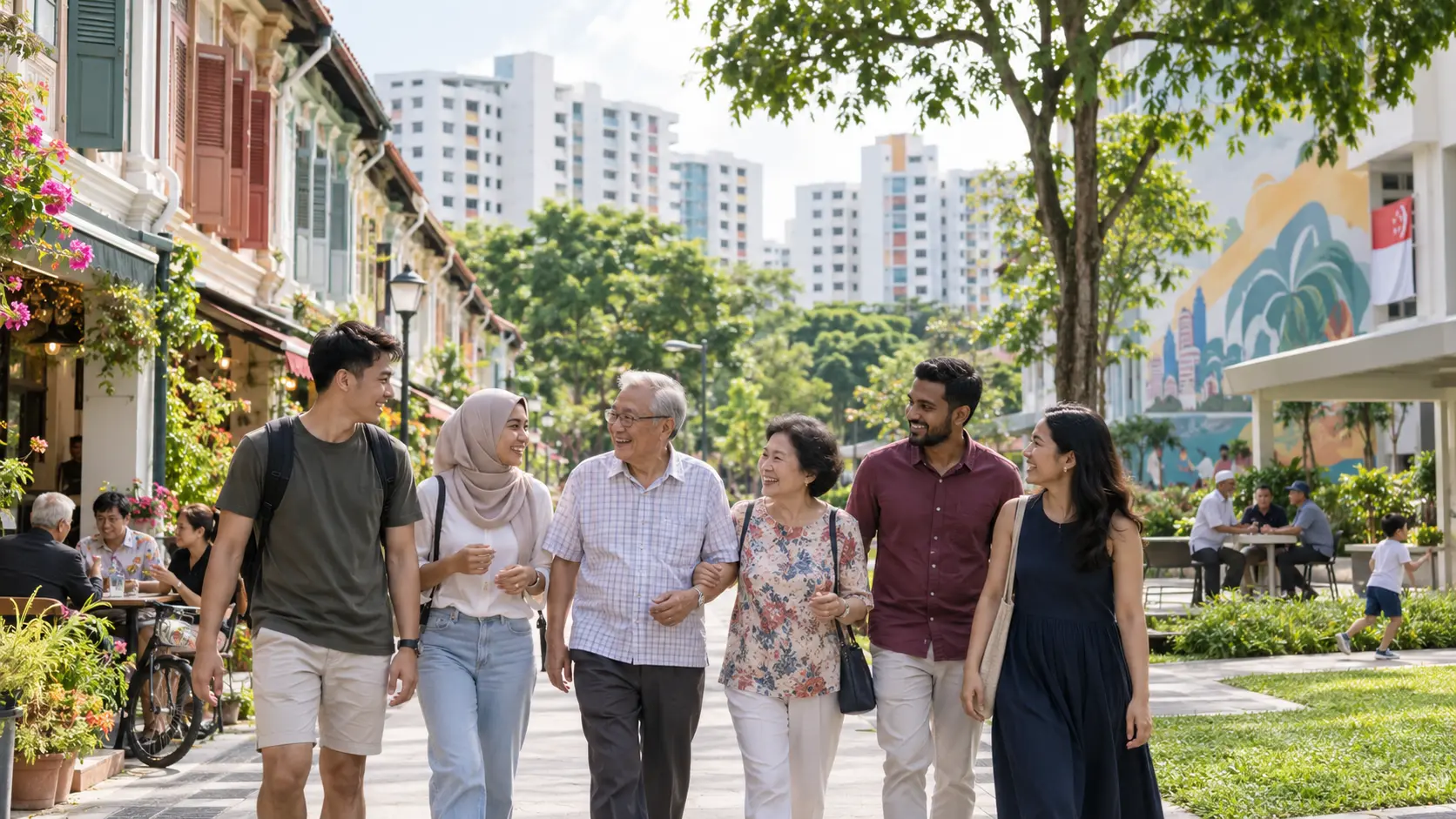
Stories, places, and people shape how we live and why we belong. This space documents Singapore’s heritage, community encounters, and lessons across generations.

Why Heritage Shapes Identity
Singapore’s identity was never handed down from a single source; it was built, layer by layer, through the stories of people who arrived with nothing but ambition and resilience. Heritage matters here not as a relic of the past, but as the living foundation of who we are today. To understand what Singapore has become is to understand where its people came from: the trade winds that brought merchants to these shores, the kampung ties that held communities together, and the collective memory of building something meaningful from the ground up.
At the heart of that story is migration. The Nanyang era that sweeping chapter when Chinese, Malay, Indian, and Eurasian communities converged across Southeast Asia gave Singapore its cultural DNA. These were not passive settlers; they were craftsmen, traders, clan leaders, and visionaries who transplanted traditions while forging entirely new ones. The Nanyang spirit is one of adaptation without erasure, of honouring roots while reaching forward. That tension between the old world and the new is precisely what makes Singapore’s identity so layered and so enduring.
Heritage also lives in the physical world around us in a shophouse facade, a temple tucked between towers, a hawker stall recipe passed down through three generations. These built environments are more than architecture; they are memory made tangible. Whether we preserve them or let them disappear, we make a statement about what we value. Intergenerational continuity is not automatic; it must be chosen, retold, and kept alive. A brand that understands this understands something true about Singapore: that the strongest identities are not invented, they are remembered.
Community Encounters Across Generations
When you slow down long enough to listen, Singapore’s older generation has an extraordinary amount to teach. Over the years, some of my most formative experiences have not come from boardrooms or books, but from conversations with seniors in void decks, at community centres, and along the quiet corridors of places that carry deep cultural memory. These encounters have shaped how I see this city, and why I believe so strongly in the value of intergenerational connection.
Sitting Across the Mahjong Table
There is something about mahjong that strips away pretence. I remember sitting in on a session at a senior activity centre, watching four uncles and aunties move through the game with a rhythm that needed no explanation between them. As the tiles clicked and the banter flowed, one auntie in her mid-eighties began talking about her early years in a Chinatown shophouse, how the whole floor shared one kitchen, how neighbours were family because they had to be. She was not nostalgic in a sad way. She was matter-of-fact, almost amused that things had changed so much. That conversation stayed with me. It reminded me that behind every elderly face in Singapore is a story of survival, adaptation, and quiet dignity that rarely makes it into any official record.
Walking Through Haw Par Villa
Haw Par Villa is one of those places that means different things depending on how old you are when you visit. As a child, the Ten Courts of Hell terrified me. As an adult walking through it with an elderly gentleman I had met through a heritage volunteer programme, it became something else entirely, a window into how an older generation was taught to live. He explained each diorama not as mythology but as moral instruction, the kind his parents gave him not through conversation but through imagery and consequence. “Last time, we learned values like this,” he said simply. It struck me that so much of what shaped the worldview of Singapore’s pioneer generation was encoded in cultural symbols that younger Singaporeans have largely stopped reading. To him, Haw Par Villa was not a theme park. It was a classroom.
Conversations That Quietly Shift Your Perspective
What intergenerational conversations offer is something no algorithm can replicate: lived context. When a senior tells you what a street used to look like, or what it felt like to watch a neighbourhood disappear overnight for redevelopment, they are not just sharing information. They are sharing the emotional geography of a city that now exists only in memory. These conversations have consistently challenged me to think beyond the present moment, to ask not just what Singapore is but what it has been, and what we risk losing if we stop asking. Community is not just about proximity. It is about continuity, the willingness to pass something forward, and the humility to receive what has been passed down.
Why This Matters for How I Work
My belief in heritage, community, and identity did not come from research alone. It came from these encounters with mahjong tiles and painted statues and the unhurried voices of people who have seen this country transform several times over. When I speak about Singapore’s story, I speak with their perspectives woven into my own. That is, I think, exactly how intergenerational learning is supposed to work, not as a formal transfer of knowledge, but as something absorbed through presence, patience, and genuine curiosity about another person’s life.
Preserving Continuity in a Vertical City
Singapore does not do anything slowly. Blink and a skyline shifts. Walk a familiar street and find that the kopitiam you grew up in has become a condominium lobby. We are a city that has always chosen progress, and largely, that choice has served us well. But somewhere between the old five-footways and the new fibre-optic cables, there is a question worth sitting with: when a city rebuilds itself this completely, what do families do with the pieces of themselves that no longer have a physical home?
The HDB Block as a Universe
For most Singaporeans, identity begins not with a country but with a block. Block 123, level 8. The unit where your grandmother kept a small altar near the window, where the smell of her cooking filled the corridor every evening without fail, where the neighbour’s door was always open, and nobody thought that unusual. The HDB estate was never just public housing. It was a carefully engineered attempt at community, and against considerable odds, it worked. Strangers became neighbours. Neighbours became something closer to family. Children grew up understanding, instinctively, that life was shared, that walls were thin, and that you were never entirely alone.
That texture of living is harder to find now. Not because people are less kind, but because the architecture of daily life has changed. We move more. We upgrade. We privacy. The vertical city keeps building upward, while something quieter, more horizontal, the habit of knowing the people beside you, slowly thins out.
What the Shophouse Remembers
There is a particular kind of grief that comes with watching a shophouse being gutted. Not the dramatic grief of sudden loss, but the slow, helpless kind watching tiles being stripped, a staircase dismantled, a facade repainted into something neutral and saleable. These buildings were never just commercial spaces. They were the physical record of how immigrant families organised their lives, business on the ground floor, family above, ancestors remembered in the alcove by the door. The shophouse was a complete moral universe compressed into three storeys.
Many of Singapore’s founding families built their first footholds in these spaces. The clan associations that supported new arrivals, the family businesses that funded the next generation’s education, the informal economies that kept communities alive before the state could reach them, all of it happened within those narrow, deep, terracotta-roofed structures. To preserve a shophouse is not an act of nostalgia. It is an act of honesty about how this city was actually built, and by whom.
Family Legacy in a City That Keeps Moving
What strikes me most when speaking with older Singaporeans is not bitterness about change, but the quiet determination to pass something forward anyway. A grandmother who no longer lives in her kampung teaches her granddaughter the same recipes she learned there. A son who never worked in his father’s provision shop still keeps the account ledger, handwritten in faded ink, because it tells him something about where he comes from that no certificate ever could. Legacy, in a city like ours, becomes portable. It migrates from place to person, from building to story, from street to memory.
This is both Singapore’s challenge and its quiet resilience. We cannot always save the physical thing. But we have proven, generation after generation, that we are capable of carrying the meaning of a place even after the place itself is gone. That is not a small thing. That is, in fact, the very definition of a community that has learned how to survive transformation without losing itself.
Social Cohesion Is Not a Policy — It Is a Practice
Governments can build estates. They can mandate ethnic integration, design common corridors, and fund community programmes. But social cohesion, the real kind, happens in small moments. It is the uncle who always knows when your family is going through a hard time without being told. It is the unspoken agreement to look out for the elderly neighbour who lives alone. It is the ability to sit comfortably with someone whose language you do not share, whose faith looks different from yours, and still feel the warmth of genuine community.
Singapore has always been an experiment in whether people who have no obvious reason to belong together can choose to, anyway. Decades in, the answer remains carefully, imperfectly, remarkably — yes. But that, yes, requires tending. It requires each generation to decide that continuity matters consciously. The older man in the void deck has something worth hearing. The old building on the corner is worth understanding before it is replaced. That a city is not just what it builds, but what it chooses to remember.
Carrying the City Forward
Preserving continuity in a vertical city does not mean freezing Singapore in amber. It means building upward without forgetting what the ground once held. It means letting the new and the old exist in honest conversation with each other, the gleaming tower and the weathered five-footway, the smart nation and the hand-painted signboard, the future we are racing toward and the past that made the race possible in the first place.
That balance is delicate. It always has been. But it is also, I believe, exactly what makes Singapore worth the effort of deep understanding, not as a miracle of efficiency, but as a very human story about people who came from everywhere, built something together, and are still, quietly, trying to make sure it lasts.