From the SAF NCO Club to THE CHEVRONS: A Singapore Story of Community, Camaraderie and Heritage
From Beach Road to Jurong East, photographs of aerobics classes, senior gatherings, treasure hunts and a Golden Jubilee time capsule reveal something larger than the history of a clubhouse: they tell a story about belonging, family, service and the spaces that bring generations together.
A building can disappear, a club can change its name, and an institution can move across Singapore. Yet the memories created inside it can survive for generations.
That is what makes the story of the former SAF Non-Commissioned Officers Club — better remembered by many as the SAF NCO Club worth revisiting. Its history is not simply a chronology of names, addresses and renovations. It is also a social history: servicemen meeting one another, families participating in activities, seniors being hosted, children joining excursions, and communities gathering around shared experiences.
Seen in that context, photographs of an aerobics class, a senior citizens’ event, a road treasure hunt and a commemorative time capsule become more than nostalgic images. Together, they help us understand how an institution can create belonging and why preserving such memories matters.
Before the SAF NCO Club: the Britannia Club
The story begins before the SAF NCO Club existed. According to THE CHEVRONS’ official history, the British Armed Services established the Britannia Club in 1951 as a recreational venue for servicemen and allied troops. The club became a social meeting place where personnel from different backgrounds could interact and share experiences. [1]
In 1971, the club was handed back to the Singapore Government and subsequently transferred to the SAF. Three years later, the SAF NCO Club emerged from this earlier institution. [1]
That continuity is significant. The physical space did not begin as a blank slate in 1974. A venue originally created for military recreation was adapted to serve a young Singapore Armed Forces, acquiring new meaning as Singapore’s defence institutions matured.
1974: a place that servicemen and families could call their own
MINDEF’s record of THE CHEVRONS’ 2024 Golden Jubilee explains that the NCO Club was intended as a place where warrant officers and specialists could bond and participate in recreational and educational activities. [3]
THE CHEVRONS’ commemorative history similarly describes a club that became increasingly family-oriented, with activities and services designed not only around servicemen but also around their families. [1] [2]
Heritage becomes more meaningful when we look beyond the institution and ask a simpler question: who came through its doors, and what did the place allow them to experience together?
Fitness was also a social experience
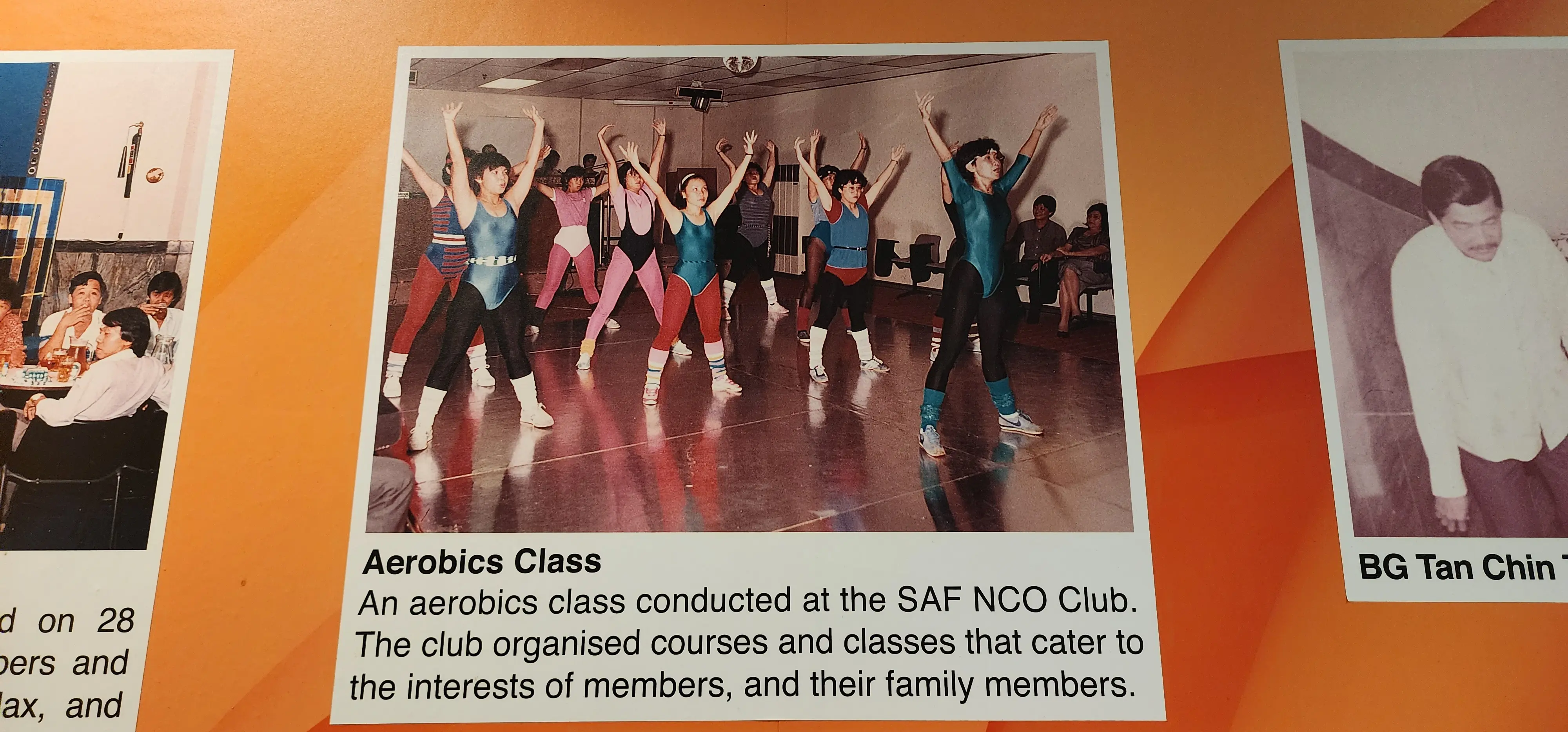
One photograph preserved in this story shows an aerobics session associated with the SAF NCO Club. The image is immediately recognisable as a product of its era – coordinated movement, group participation and the distinctive visual character of organised aerobics.
It would be easy to see it only as a fitness photograph. But the wider history of the club suggests another interpretation. Recreation was one of the ways members and families interacted. Physical activity therefore sat within a broader social environment rather than existing purely as an individual pursuit.
Looking back from today’s fitness culture, that feels remarkably familiar. Exercise may change in format and terminology, but participation becomes easier to sustain when people feel welcome, supported and part of a group.
The photograph documents an aerobics activity. The broader interpretation about belonging and participation is an author reflection based on the club’s documented emphasis on recreation, family interaction and camaraderie.
Remembering seniors as part of the community
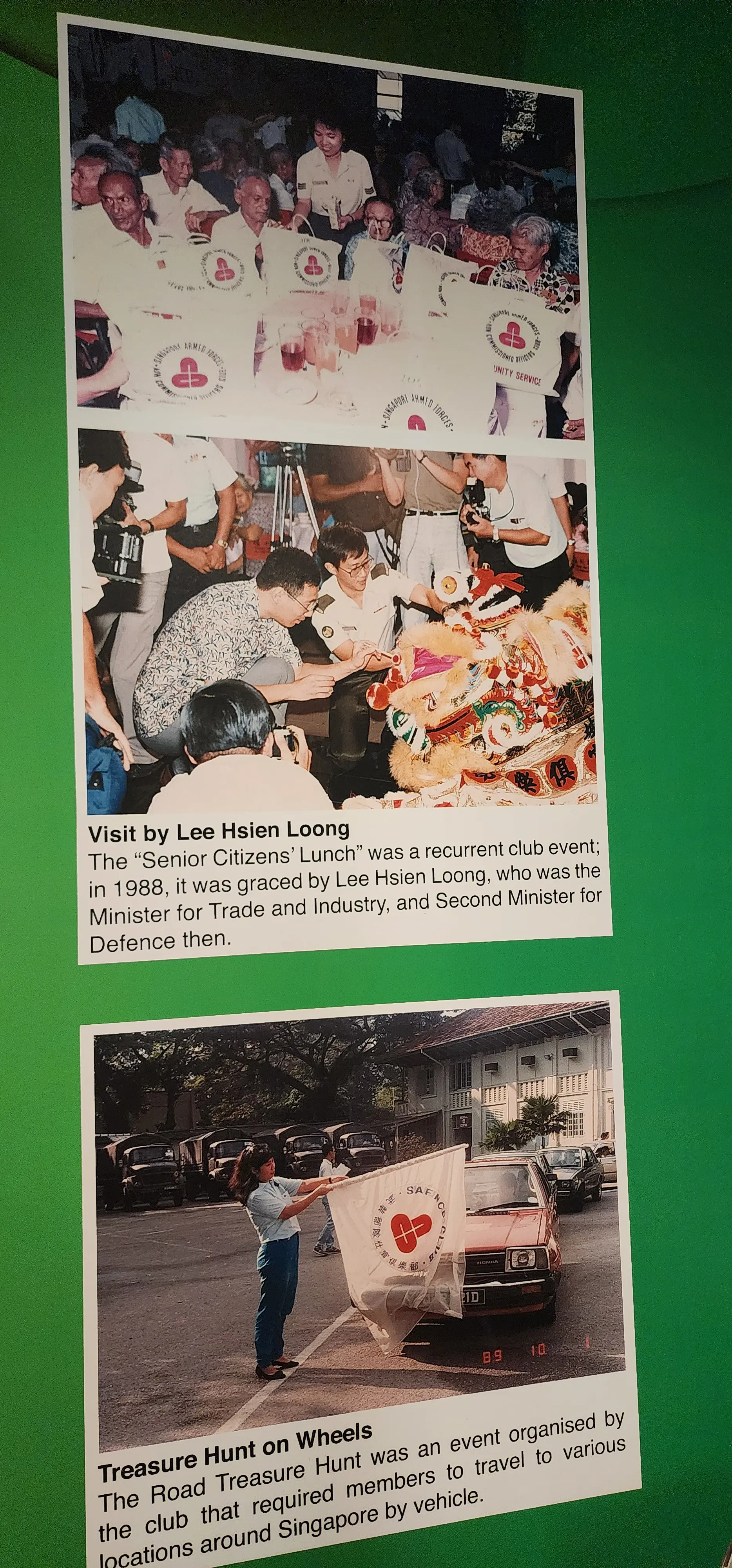
The senior citizens’ gathering carries another dimension of the club’s story. THE CHEVRONS’ commemorative history records that senior citizens from various homes were regularly invited to charitable functions at the club. Guests received meals, performances and tokens of appreciation. [2]
That detail matters because it moves the story beyond nostalgia. It shows that community life included an outward-looking element: a willingness to make room for older people and create occasions where they could participate, socialise and be recognised.
A lunch may appear modest when compared with major institutions or national programmes. Yet community is often built precisely through such modest acts, sitting together, sharing food, recognising someone’s presence and creating a reason for people to leave isolation behind for a while.
A 1988 leadership moment and how it should be read
One of the heritage materials photographed for this story identifies a 1988 visit involving Lee Hsien Loong.
The Prime Minister’s Office independently confirms that in 1988 Mr Lee was serving as Minister for Trade and Industry and Second Minister for Defence, offices he held from 1987 to 1992 and 1987 to 1990 respectively. [5]
For accuracy, the visit itself is attributed here to the heritage display rather than presented as independently established by the PMO record. The government source is used to verify his ministerial appointments at the time.
This distinction may seem small, but it is important in heritage writing. A photograph or exhibition caption can be valuable historical evidence, while an official biography may verify a separate part of the context. Good heritage storytelling should allow both sources to speak without making either claim more than it actually establishes.
The road treasure hunt: Singapore itself became part of the activity
The Road Treasure Hunt offers a particularly vivid glimpse into the club’s recreational culture. THE CHEVRONS’ commemorative history describes participants travelling to checkpoints including Jurong Bird Park, MacRitchie Reservoir and the Singapore Science Centre, where they searched for clues and accumulated points. [2]
Other documented activities ranged from excursions and familiarisation visits to festive functions, sports and trips beyond Singapore. [2]
These activities reveal why a club can become much more than its clubhouse. The physical venue may have been the meeting point, but the real institution existed in the relationships that formed around participation.
Years later, people may forget the administrative details of an event, yet still remember the people they travelled with, the laughter along the way, the place where everyone gathered before setting off, or the feeling of being included.
From NCO Club to Warrant Officers & Specialists Club
The institution evolved together with the SAF. In 1992, the NCO Corps was restructured into the Warrant Officer and Specialist Corps. By 1994, the SAF NCO Club had been renamed the SAF Warrant Officers & Specialists Club. [2]
The name changed, but the underlying social function continued: providing opportunities for members to meet, participate in activities and strengthen connections with their families.
2002: a new home and a new identity
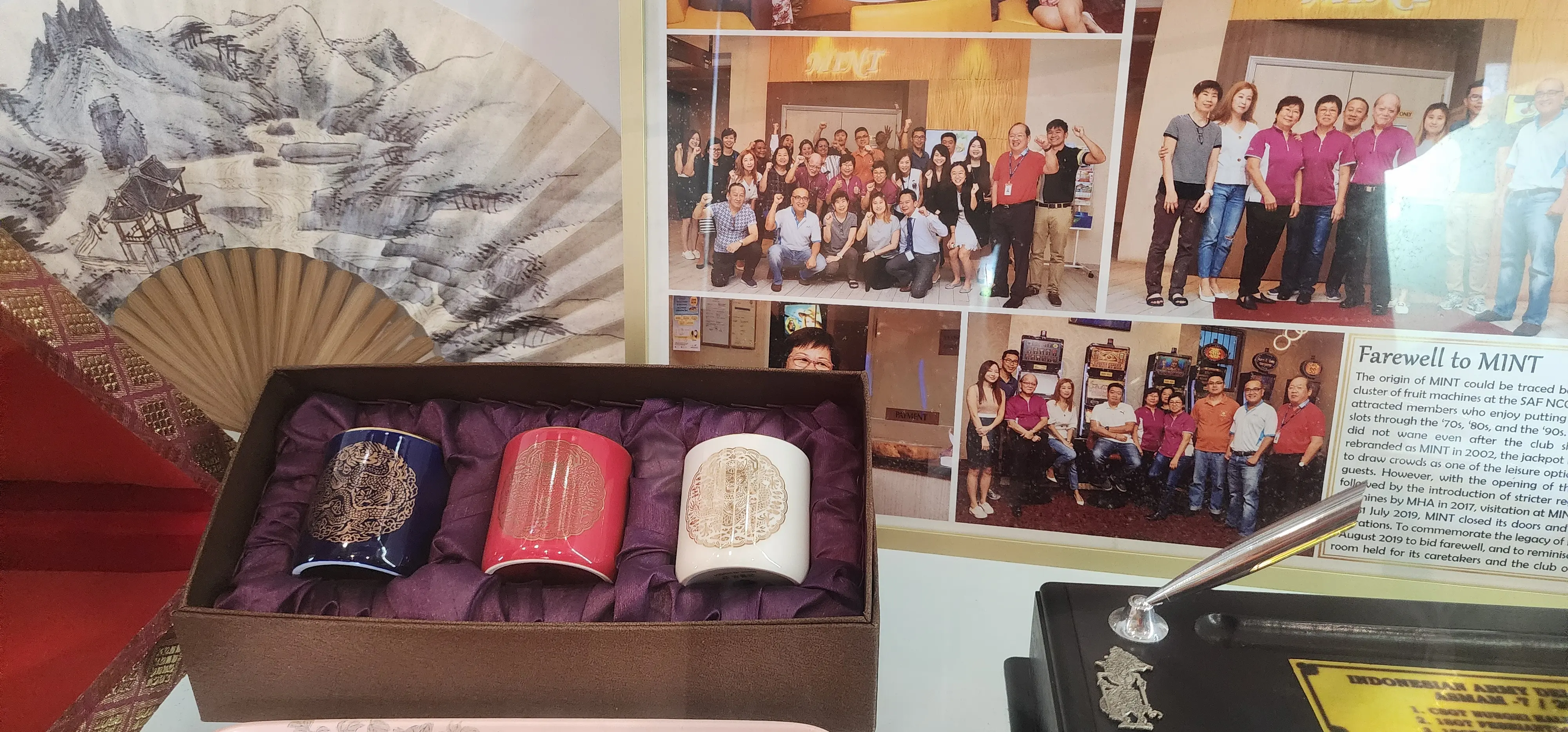
Expansion of the membership base and redevelopment of the former site eventually led to relocation. THE CHEVRONS’ official history records that the new clubhouse in Jurong East opened on 8 February 2002 under the identity by which it is known today — THE CHEVRONS. [1]
This is where the heritage story becomes particularly interesting. Institutions do not preserve heritage merely by remaining physically unchanged. Sometimes continuity survives through adaptation. Buildings move. Facilities modernise. Generations of members change. But values and collective memory can travel with them.
2024: placing memory into a time capsule
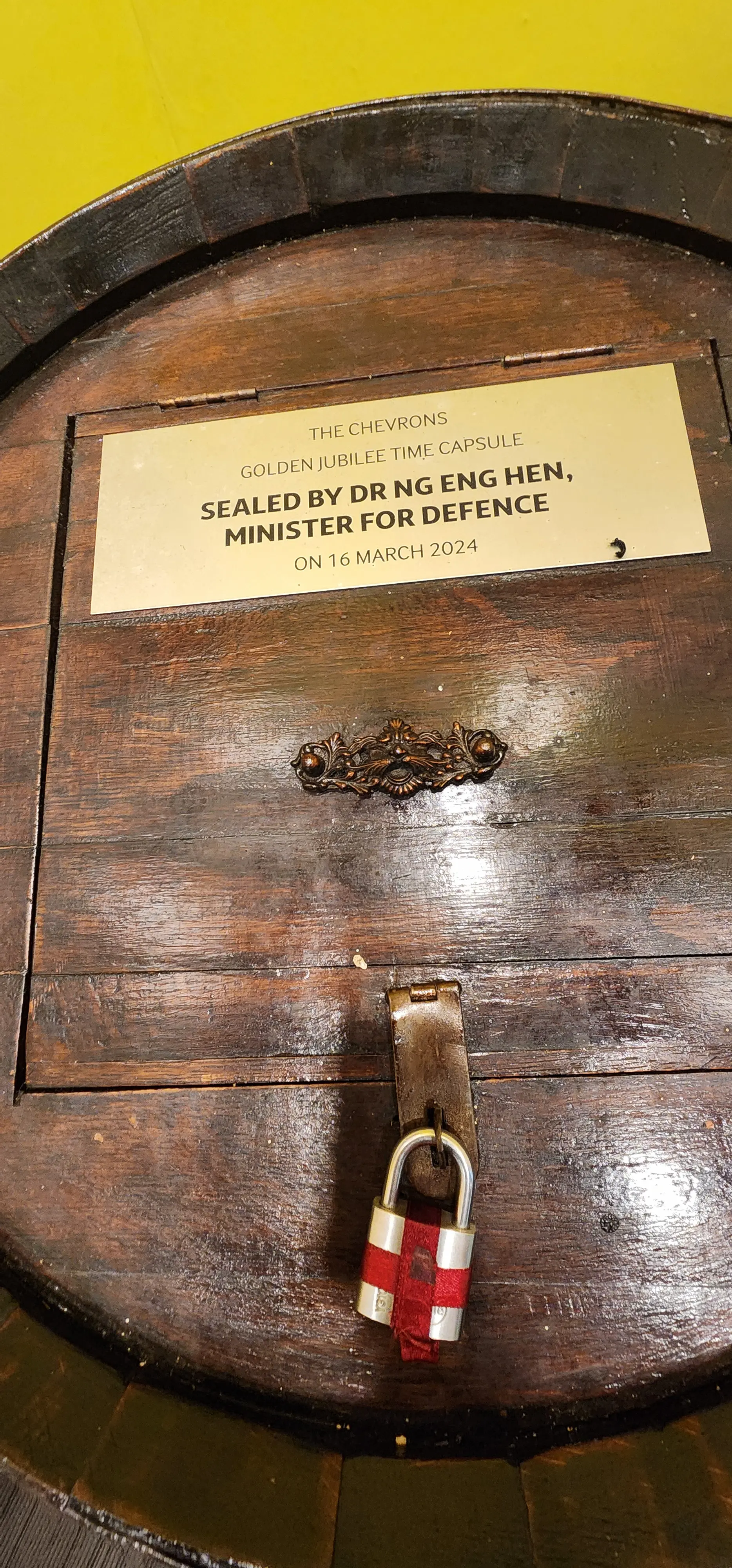
On 16 March 2024, THE CHEVRONS celebrated its Golden Jubilee with Minister for Defence Dr Ng Eng Hen. As part of the commemoration, Dr Ng sealed a time capsule commissioned for the anniversary. [3] [4]
THE CHEVRONS’ official release records eight significant items being placed inside, including commemorative plaques, a 50th anniversary commemorative book and coin, and a Golden Jubilee Bear. [4]
During the anniversary, Dr Ng reflected on the transformation of the club from its 1974 beginnings and the continuing role of THE CHEVRONS as a meeting place for Warrant Officers, Specialists, Military Experts, their families and friends. [3]
The building changed. The name changed. The generations changed. Yet the idea of creating a place for camaraderie, recreation, family and belonging endured.
Why this history still matters in Singapore today
Heritage is sometimes treated as something we preserve after its practical usefulness has ended. But stories like this suggest another possibility: history can also reveal social principles that remain useful.
Community spaces matter because people need reasons to meet one another. Activities matter because participation can create connection. Intergenerational occasions matter because older people should remain visible within community life.
From an old photograph to a current national conversation
This is not merely a sentimental connection. Singapore’s current Age Well SG framework explicitly seeks to help seniors age actively, remain socially connected and continue living within their communities. [6]
Today’s systems, professional standards and community infrastructure are very different from the club activities captured in these historical photographs. We should not pretend they are the same.
What does continue, however, is a recognisable human need: opportunities to move, participate, contribute, meet other people and maintain a sense of belonging as we grow older.
Heritage is not only architecture
Singapore has changed dramatically within a few generations. Buildings that once looked permanent can disappear. Familiar institutions can relocate. Neighbourhoods can be rebuilt and renamed.
This is why photographs, oral recollections, commemorative books and heritage galleries matter. They preserve dimensions of history that a building alone cannot explain.
A photograph of an aerobics class records movement and participation. A senior citizens’ lunch records inclusion. A treasure hunt records recreation and companionship. A time capsule records an institution’s conscious decision to send part of its memory forward.
None of these moments by itself tells the whole story. Together, however, they begin to show how community is formed.
What should we carry forward?
Perhaps the most important heritage question is not simply, “What used to be here?”
It is also, “What happened here that is still worth remembering?”
In the story of the SAF NCO Club and THE CHEVRONS, the answer appears repeatedly: people gathering, servicemen bonding, families participating, seniors being included, activities creating friendships and one generation deliberately preserving memories for another.
Singapore will continue to modernise. It should. But progress becomes richer when we also understand the human experiences that came before us.
Heritage does not live only in old walls. It lives in photographs, stories, traditions and memories and most importantly, in the people who continue to remember what those places meant.
References & source notes
Priority has been given to official institutional and Singapore Government sources. Where a photograph or heritage display supports a specific observation, that is stated separately from independently verified documentary facts.
- THE CHEVRONS — “Our Story”. Official institutional history covering the Britannia Club, the SAF NCO Club, the SAF Warrant Officers & Specialists Club and the move to Jurong East as THE CHEVRONS.
- THE CHEVRONS — commemorative histories and 50th Anniversary materials. Used for documented club activities, the restructuring of the NCO Corps, family programmes, senior citizens’ functions, excursions and the Road Treasure Hunt.
- Ministry of Defence, Singapore — Speech by Minister for Defence Dr Ng Eng Hen at THE CHEVRONS’ 50th Anniversary Celebration, 16 March 2024. Used for the Golden Jubilee context, the club’s 1974 origins and its continuing role as a place for bonding, recreation and community among members and families.
- THE CHEVRONS — Golden Jubilee News Release, 16 March 2024. Used for details of the commemorative time capsule and items placed within it.
- Prime Minister’s Office, Singapore — Biodata of Mr Lee Hsien Loong. Used to independently verify that in 1988 Mr Lee was Minister for Trade and Industry and Second Minister for Defence. The specific club visit described in this article is attributed to the photographed heritage material.
- Ministry of Health, Singapore — Age Well SG / Ageing in the Community. Used only for the contemporary context regarding active ageing, social connection and supporting seniors to age within their communities.