
Archives April 2026

From Buffet Tables to Supermarket Aisles: Active Ageing, One Grocery Trip at a Time

Health & Movement • Active Ageing

From Buffet Tables to Supermarket Aisles: Active Ageing, One Grocery Trip at a Time

We often think active ageing begins in the gym, at the clinic, or during a health screening. But sometimes, it begins somewhere quieter in the supermarket aisle, in the wet market, and in the simple act of choosing what we bring home.

Some people see grocery shopping as a routine chore.

I no longer do.

Over the years, I have come to realise that where we shop, what we buy, and the habits we build around food may quietly shape how we live and how we age. What looks ordinary on the surface may actually reveal something much deeper about our knowledge, our discipline, our lifestyle, and even our future health.

For me and my family, grocery shopping is not just about filling the fridge. It is part of our routine, part of our bonding, and part of the way we care for ourselves. Whether it is NTUC FairPrice, Sheng Siong, Cold Storage, Giant, Little Farms, Huber’s or the wet market, we still prefer to go in person. We seldom do online grocery shopping because we believe there is still something meaningful about seeing, touching, comparing, and choosing for ourselves.

Perhaps that is why grocery shopping has become more than an errand to me.

It has become a quiet lesson in living.

Packaged bananas displayed for sale at a supermarket produce section
Fresh avocados displayed in crates at a supermarket produce section

My family and I have always loved food. We enjoy buffets too, from Marina Bay Sands, Hilton, Hyatt, Ritz-Carlton, St Regis, Parkroyal, Conrad, Paradox, InterContinental, Grand Copthrone and Shangri-La to more familiar places like Swensen’s. We have enjoyed the variety, the atmosphere, and the beauty of seeing so many cultures of taste brought together in one place.

I am blessed to have good cooks in our family, and even some close friends who are wonderful cooks too. Food has never just been about eating. It has been about warmth, care, sharing, hospitality, memory, and love.

I have always loved spicy food, especially Peranakan flavours, as well as Mediterranean and Italian cuisine. But over time, I have noticed a change in myself. Today, I naturally turn more towards vegetarian choices, more greens, and more fruits than before. These are now the foods I increasingly prefer. Perhaps age teaches us that enjoyment and wisdom do not have to compete. They can grow together.

Packaged fresh strawberries displayed in clear plastic containers at a supermarket
Fresh pineapples displayed in protective foam sleeves at a supermarket

And over time, I have also come to see food differently.

Beyond the indulgence, a buffet reminds me that every dish begins somewhere. Behind every beautiful spread is the same foundation: ingredients, groceries, preparation, and choices. Before food becomes presentation, flavour, and enjoyment, it begins quietly in the market, in the supermarket aisle, and in the hands of someone deciding what to bring home.

That thought stayed with me.

If we love to eat, perhaps we should also learn to choose wisely. Perhaps we should build the habit of buying better, cooking more, and understanding more deeply what goes into our bodies. Eating out is part of life, and there is joy in it. But I have also seen enough to know that when health begins to change, food is no longer only about taste.

One important lesson I have learnt from nutritionists and dietitians is the value of reading nutritional information and ingredients properly. It is not enough to look only at the front of a package or be attracted by branding and marketing. We need to understand what is really going into the stomach and, over time, into the body.

Sugar levels, sodium, fats, additives, preservatives, and ingredient lists all matter more than many people realise. The label at the back often tells a more truthful story than the words at the front.

Nutrition facts and ingredients label on wafer crackers packaging

What goes into the trolley often goes into the stomach, and what goes into the stomach may shape health over time.

That awareness has changed the way I look at food.

It has taught me that what we eat is not just about filling hunger. It is about understanding what we are feeding our body with, what we are asking our digestive system to process, and what kind of long-term support or burden we may be creating for ourselves.

For many facing health struggles, food must be viewed through another lens. It becomes about comfort, tolerance, digestion, inflammation, energy, and support. A person may still want to enjoy food, but now has to ask harder questions. Can I take this? Will this worsen my condition? Is this nourishing me, or only satisfying me for a moment?

That is where awareness begins.

I have met enough people facing health challenges to know that the freedom to eat easily should never be taken for granted. Some can no longer tolerate the foods they once loved. Some must avoid certain textures. Some must reduce sugar, salt, oil, processed foods, or certain ingredients altogether. Some discover that even a simple meal now requires careful thought.

That is why I have come to respect food differently.

Food is not only pleasure.
It is support.
It is memory.
It is culture.
It is healing for some.
And for others, it becomes a daily challenge.

The more I observe, the more I feel that active ageing is not built only through exercise, movement, and health screenings. It is also built quietly, one grocery trip at a time.

One particular encounter stayed with me.

We were standing in the aisle, comparing pasta sauces and looking through the different options, when a voice from behind suddenly said, “Barilla is the best.”

Barilla pasta sauces and other jarred sauces displayed on supermarket shelves

We turned around and met a friendly and eloquent lady who shared that she had worked on a cookbook for Mrs Lee. She spoke with the calm confidence of someone who truly understood food, not in a loud or showy way, but with the ease of someone deeply familiar with ingredients, flavour, and quality. She even pointed us towards a canned item that was not easily found elsewhere.

It was such a simple exchange, but it stayed with me.

Sometimes, the supermarket becomes more than a place of transaction. It becomes a place where knowledge is shared, where taste is refined, and where unexpected human encounters leave a quiet but lasting impression.

That day reminded me once again that grocery shopping is not a small thing.

It is part of how people live.

It is part of memory.

It is part of culture.

It is part of health.

It is part of ageing well.

When I look at the foods I am drawn to now, ginger, avocados, bananas, strawberries, pineapples, olive oil, simple sauces, and ingredients that allow us to prepare meals at home, I realise I am not just choosing what to eat for today. I am also choosing the kind of support I want to give my body over time.

Fresh ginger roots displayed in mesh bags at a supermarket produce section
Bertolli olive oil bottles displayed on a supermarket shelf

This does not mean life must become rigid or joyless. It does not mean we can never enjoy a buffet, never eat out, or never indulge in what we love. It simply means that with age and experience, we begin to see that our repeated choices matter more than we think.

Health is rarely shaped in one dramatic moment.

It is shaped quietly, repeatedly, and often invisibly, in what we buy, what we cook, what we ignore, what we learn, and what we normalise over the years.

That is why I believe a person’s knowledge, perception, and lifestyle may influence much about their later health. The one who only chases taste may one day be forced to chase tolerance. The one who learns balance earlier may perhaps stand a better chance of ageing with greater strength, dignity, and awareness.

As I grow older, and as I continue meeting people from all walks of life, I find myself looking at the supermarket differently.

It is no longer just a place to shop.

It is a place of observation.

A place of choice.

A place of discipline.

A place of culture.

A place of reflection.

And perhaps, for many of us, it is also one of the places where active ageing quietly begins.

From buffet tables to supermarket aisles, I have come to believe that the roots of health often begin with what we choose to bring home.

Share this reflection

If this story speaks to you, share it with someone who values ageing well.

Where My Running Journey Began: Sundays at Botanic Gardens and Taman Serasi

Health and Movement

Where My Running Journey Began: Sundays at Botanic Gardens and Taman Serasi

A reflective return to Singapore Botanic Gardens where childhood Sunday jogs, family ritual, teh tarik, roti John, and today’s kopi kosong come together in a story about memory, discipline, ageing, and carrying forward a culture of movement.

Featured image: White swan on calm water at Singapore Botanic Gardens, a quiet reminder that movement, stillness, and reflection can coexist.

Some places remain with us not only because they are beautiful, but because they quietly helped shape who we became. For me, Singapore Botanic Gardens is one of those places.

Since the age of seven, Sunday mornings there had already become part of my life. I would jog with my uncle and my dad, and afterwards we would head to the old Taman Serasi Hawker Centre just outside the Gardens for teh tarik and, at times, roti John. At that age, I did not think about discipline, endurance, or active ageing. I only knew that this was part of our rhythm, part of our routine, and part of a memory that felt simple and good.

National Orchid Garden entrance at Singapore Botanic Gardens
Returning to Singapore Botanic Gardens always feels like returning to a place that has quietly shaped memory, movement, and reflection across the years.

Looking back now, I realise those mornings may have given me more than fond childhood memories. They may well have helped build the foundation for my long-distance running, and for the 800m and 1500m events that I later came to dominate during sports day. What felt ordinary then was quietly preparing me for something greater.

Long before I understood training, discipline, or active ageing, Botanic Gardens had already become part of my foundation.
Learning Forest emblem on the pathway at Singapore Botanic Gardens
Some paths do more than guide our steps. They quietly invite us into memory, movement, and reflection.

Where movement first became memory

There is something powerful about early exposure to movement. Not harsh training. Not pressure. Just consistent activity, repeated over time, rooted in family and familiarity. In many ways, that is how lasting habits are formed. Before we even call it exercise, it becomes a way of life.

Today, things have changed. The teh tarik of those younger days has changed to kopi kosong. But in many ways, I am still carrying forward the same culture, a culture of movement, routine, discipline, and quiet reflection. What began as Sunday jogs with my uncle and dad has remained with me through the years, even as age, habits, and perspective have changed.

Welcome to the Learning Forest sign at Singapore Botanic Gardens
Returning now, I see Botanic Gardens not only as a place of beauty, but also as a place of memory, learning, and quiet reflection.

Slowing down enough to notice

Returning to Botanic Gardens now feels different. The beauty is still there. The calm paths, the towering trees, the quiet greenery, the reflective waters, and the sense of stillness in the middle of a fast-moving city. Yet what has changed most is my perspective.

As we grow older, we often begin to notice what we once walked past too quickly. The Gardens reward those who slow down enough to notice the smaller details, where even a simple plant display or a sign about stingless bees can become part of the learning journey.

Plant display with ginger-like roots in the Learning Forest at Singapore Botanic Gardens
The Gardens reward those who slow down enough to notice not only beauty, but also usefulness. Ginger has long been traditionally appreciated for its comforting qualities, from helping to ease bloating to bringing warmth and relaxation through a simple foot bath.
Stingless bees sign in the Learning Forest at Singapore Botanic Gardens

Most of us know bees by their sting, yet here in Singapore Botanic Gardens I was reminded that nature is often more nuanced than we think. Stingless bees, small and easily missed, became another quiet detail rewarding those willing to slow down and observe.

Rain forest sign and path at Singapore Botanic Gardens
Some paths do more than lead us through nature. They lead us back into memory, reflection, and a quieter pace of life.

Ageing, discipline, and the importance of maintenance

In youth, movement often feels natural. The body responds quickly, recovers quickly, and carries us with a certain ease. As we age, that changes. When I jog now, I know it is no longer what it was in my twenties.

That realisation is not discouraging. It is clarifying. It reminds me that if we stop training, the body will naturally slow down with age. That is why maintaining movement matters. It is no longer only about performance. It is about discipline, function, and lifestyle. To maintain is not to settle for less. To maintain is to respect the body and to keep showing up.

That is also why I believe movement must remain part of life, just as strength training should remain part of life. Jogging, walking, and strength work each have their place. One supports endurance and cardiovascular health. The other helps preserve muscle, stability, and function. Both become increasingly important as we grow older.

Elderly woman resting on a bench at Singapore Botanic Gardens
A quiet moment in the Gardens reminded me that ageing well is not only about movement, but also about finding peace, breath, and dignity in green spaces like these.

During this visit, I noticed an elderly woman seated quietly, simply enjoying the fresh green surroundings. It was a simple sight, but a meaningful one. It reminded me that places like these are not only for exercise or sightseeing. They are also spaces where one can slow down, breathe, reflect, and age with grace.

Age may change our pace, but it should not take away our discipline to keep moving.

Foundations, continuity, and carrying the culture forward

Perhaps that is why places like Botanic Gardens matter so much. They are not only green spaces. They are spaces where memories are formed, values are passed on, and foundations are quietly built. A child may simply see a morning outing. Only later does he realise he was learning consistency, endurance, and the importance of movement without even knowing it.

Today, I return with older eyes. I see not just a beautiful place, but a part of my own beginning. A place where family, discipline, and movement came together long before I understood their full meaning. A place that reminds me that health is not built only through ambition, but through repetition, routine, and a willingness to keep moving across the years.

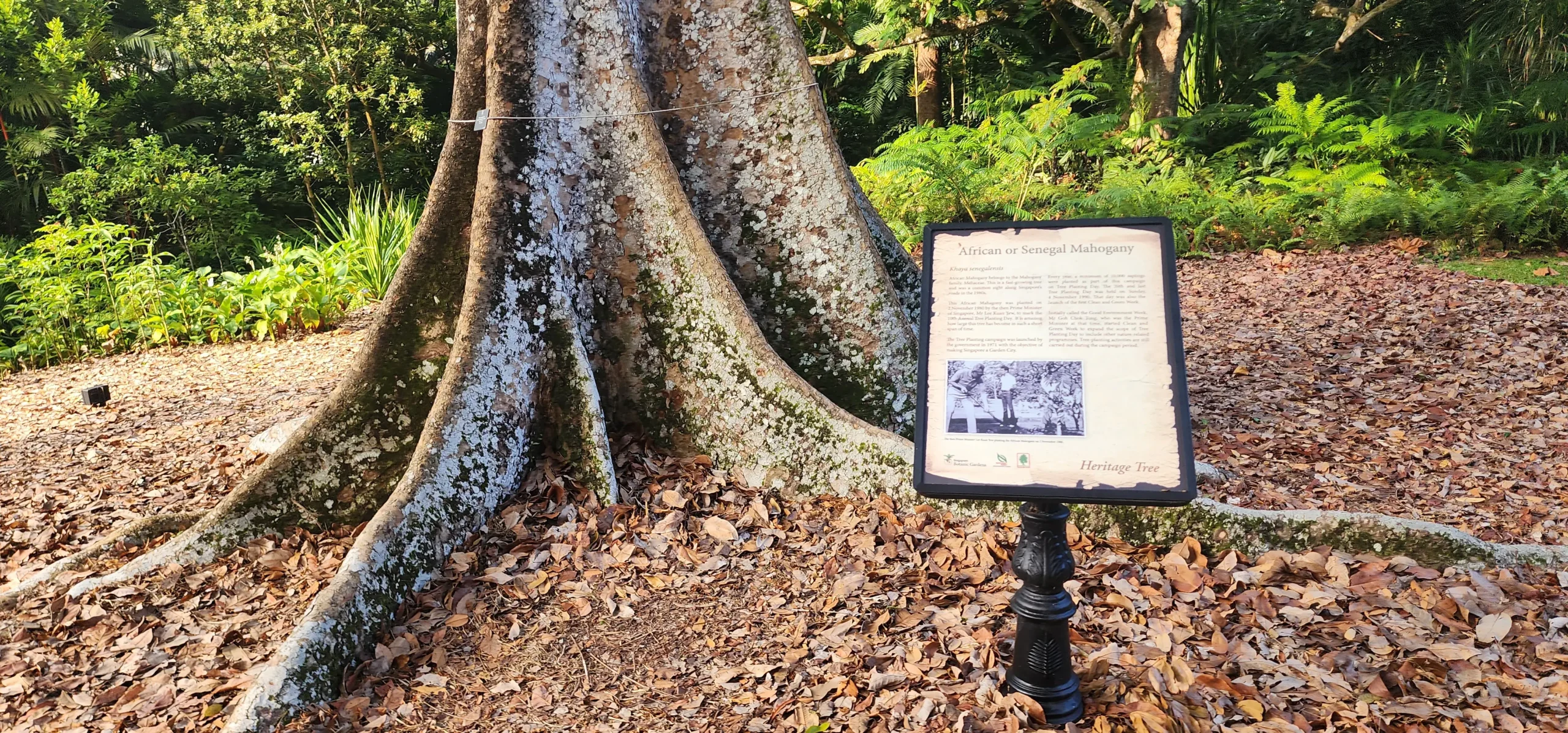
Heritage tree sign in the Learning Forest at Singapore Botanic Gardens
Some foundations endure quietly through time. So do the values, habits, and disciplines that shape a life.
Strangling fig in the Learning Forest at Singapore Botanic Gardens
Nature does not stand still, and neither do we. Growth, adaptation, and endurance are part of every stage of life.

The body may no longer move like it did in youth. But that is precisely why discipline matters. Sometimes, the strongest foundations in life begin with something simple, a Sunday jog with family, teh tarik and roti John at Taman Serasi in younger days, and kopi kosong, roti prata with eggs in the present, all part of a culture I continue to carry forward.

Forest boardwalk steps in the Learning Forest at Singapore Botanic Gardens
The journey continues not always with the speed of youth, but with the discipline to keep moving forward.

Some places stay with us not only because they are beautiful, but because they quietly helped shape who we became. For me, Singapore Botanic Gardens is one of those places. What began as childhood Sunday jogs with my uncle and dad, followed by teh tarik and roti John at Taman Serasi, has become something deeper over time a culture of movement, routine, reflection, and discipline that I still carry forward today.

The drink may have changed from teh tarik to kopi kosong. The body may no longer move with the ease of youth. But the rhythm remains. And sometimes, that is what matters most.

Botanic Gardens Singapore Botanic Gardens Learning Forest Health and Movement Active Ageing Running Taman Serasi Teh Tarik Roti John Kopi Kosong Discipline Nature Walk

Share this reflection

If this story on movement, memory, and active ageing resonated with you, share it with someone who may appreciate a quieter reminder to keep moving.

Follow Andrew Koh Singapore

Stay connected for more reflections on health and movement, heritage and community, and strategic living in Singapore.

Mandai Boardwalk: A Walk Through Nature, Memory and Wellness

Health and Movement

Mandai Boardwalk: A Walk Through Nature, Memory and Wellness

What began for many Singaporeans as childhood memories of the zoo now feels like something larger, a place where walking, greenery, wildlife and intergenerational movement come together in a more restorative and meaningful way.

Like many Singaporeans, some of my earliest memories of Mandai were tied to family visits to the zoo. Back then, the outing was simple: go there, see the animals, enjoy the experience, and head home with those images staying in your mind for years.

Returning today, Mandai feels very different. It no longer feels like just a zoo destination. It now carries the atmosphere of a larger integrated nature precinct, where wildlife, public spaces, greenery, family-friendly design and movement all seem to come together in one setting.

We completed the walk from the start all the way to the exit towards River Wonders, and what stayed with me was this: the experience was not only scenic. It quietly became a story about health and movement.

Health does not always need to begin in a gym. Sometimes it begins with a walk that invites the body to move, the mind to slow down, and the senses to reconnect with nature.

Why This Walk Felt Different

There was something restorative about the entire route. The boardwalk, the reservoir, the thick greenery, the changing light and the sense of openness made movement feel natural rather than forced. It did not feel like exercise in the strict sense. It felt like a return to something more basic and sustainable: walking, breathing, observing and simply continuing forward.

I also noticed how the space welcomed different generations. I saw young schoolchildren on the route, families moving at their own pace, and even seniors walking the stretch. That, to me, is what makes a place meaningful from a health and movement perspective. A good movement space is one that does not exclude. It is accessible, inviting and able to support people across different stages of life.

In that sense, Mandai Boardwalk is more than a leisure path. It is a gentle public reminder that movement can still be simple, inclusive and closely connected to place.

Photo Story

Schoolchildren walking along Mandai Boardwalk beside the reservoir and dense greenery
Seeing schoolchildren on the boardwalk was a quiet reminder that meaningful movement spaces can nurture curiosity, health and connection with nature from a young age.
Lush courtyard garden at Mandai Wildlife Reserve with greenery, pond and walkways
The lush courtyard shows how Mandai has evolved into more than a wildlife destination, blending greenery, design and movement into one shared experience.
Upper Seletar Reservoir view from Mandai Boardwalk with calm water and surrounding greenery
The calm waters of the reservoir gave the walk a restorative quality, turning simple movement into a moment of reflection.
Mandai Rainforest Resort by Banyan Tree nestled across the reservoir amid dense greenery at Mandai Wildlife Reserve
Looking across the reservoir, I could not help but wonder what it must feel like to wake up each day facing jungle, water and stillness, a different rhythm of living shaped by nature.
Take-a-picture spot overlooking Upper Seletar Reservoir at Mandai Boardwalk A small photo point along the boardwalk, inviting visitors to pause, take in the reservoir view and enjoy the walk a little longer.

A More Integrated Mandai

For those who remember older Mandai, the change is striking. The area now feels more cohesive, more thoughtfully connected, and in some ways closer to the scale of an integrated destination experience. Yet what makes it different is that the identity here is still rooted in nature.

Even the built spaces seem to soften into the landscape. The courtyards, elevated walkways, water views and dense planting all contribute to an atmosphere that encourages people to keep moving without feeling rushed. This is where the health and movement angle becomes especially meaningful. The environment itself does part of the work. It invites walking. It encourages pause. It lowers the mental resistance that people often feel toward exercise.

That is why this walk stayed with me. It was not only about distance covered. It was about how space, design and nature can shape healthier behaviour in a quiet and sustainable way.

More Moments From the Walk

Closing Reflection

For many of us, Mandai began as a childhood memory. Today, it offers something more. Not just a place to visit animals, but a place to rediscover movement, nature and wellness in a way that feels shared, accessible and quietly restorative.

What stayed with me most was not only the scenery, but the simple truth behind the experience: some of the best forms of exercise are not always the most intense, but the most sustainable walking, observing, breathing, reflecting, and simply continuing to move.

Mandai is no longer just about visiting animals. It is also about walking, wellness, reflection and rediscovering movement in a way that feels sustainable.

 
Share this article

Help this story reach more readers

Share this reflection on health, movement, heritage and purposeful living in Singapore. A meaningful article often travels further when one reader chooses to pass it on.

Link copied successfully.
Stay connected

Receive new reflections by email

Subscribe for thoughtful updates on health and movement, heritage and community, and purposeful living in Singapore.

By subscribing, you agree to receive occasional updates from AndrewKoh.sg. You may unsubscribe anytime.
Prefer social? Follow AndrewKoh.sg across platforms and share stories that speak to health, movement, heritage, community and purposeful living.

Truths, Mystery and Memory: Why the National Gallery Singapore Still Fascinates Me

SINGAPORAMA artwork by Navin Rawanchaikul at National Gallery Singapore

In Singapore, I have always been fascinated by truths, mystery and curiosity. Since young, I have loved exploring places that carry stories deeper than what the eye first sees. Over the years, the National Gallery Singapore has remained one of my favourite places for that reason. It is not just a gallery of art. To me, it is a place where architecture, memory, identity and community quietly meet, inviting us to look again at how Singapore became what it is today.

Each visit feels like stepping into layers of Singapore. The grand civic building, with its columns, stone facade and sense of weight, reminds me that this place once stood at the centre of public life. Today, it carries a different role, but no less meaningful. It is now a home for art, reflection and memory. That alone says something extraordinary about heritage in Singapore. We do not simply preserve old spaces and leave them behind glass. We give them new life, new purpose and new relevance.

One of the first works that immediately caught my attention was SINGAPORAMA by Navin Rawanchaikul, and I loved it the moment I saw it. It was impossible to ignore. Monumental in scale, vibrant in detail and full of life, it felt far more than an artwork hanging in a large space. Knowing that it is the largest artwork ever produced by Navin Rawanchaikul and his studio makes it even more remarkable. Created in less than six months, the monumental canvases were entirely hand-painted in a realist style, marked by meticulous detail and extraordinary scale. Complemented by video interviews and a travelogue film, the project reflects an immense collective effort, bringing together painting, moving image and storytelling in a way that feels both ambitious and deeply human.

Set against the grand facade of the National Gallery, SINGAPORAMA felt like a living collage of Singapore. The historic building behind it carried the weight of civic memory, while the artwork in front seemed to pulse with faces, stories, voices and shared experience. That contrast stayed with me. If the building preserves history in stone, SINGAPORAMA seems to preserve it in people. In that moment, it felt as though the past and present were speaking to each other one holding the structure of history, the other carrying the lived and breathing energy of community.

What moved me most about SINGAPORAMA was its collective spirit. Heritage is rarely created by one person alone. Community, identity and memory are built through many hands, many encounters and many lives. That is why this work felt so fitting within the National Gallery. It did not just impress visually. It expressed something essential about Singapore that our story is layered, collaborative and always larger than any one individual.

Over the years, I have probably lost count of how many times I have chanced upon the works of Xu Beihong, Georgette Chen, Chen Wen Hsi, Liu Kang, Lim Tze Peng and many others. Yet each encounter still feels fresh. There is something timeless about old art. I have always been drawn to that world, from classical paintings and calligraphy to abstract art that leaves room for thought, interpretation and feeling. Good art has a way of meeting you differently at different stages of life. What once looked beautiful may later feel meaningful. What once seemed distant may suddenly feel personal.

That is one reason why the National Gallery keeps drawing me back. It is not just about seeing artworks. It is about revisiting familiar names and finding new meaning in them each time. Art, to me, preserves more than beauty. It preserves mood, culture, memory and the quiet spirit of a people. In a fast-moving city like Singapore, these works remind us that our story was never built only through steel, policy and progress. It was also shaped through imagination, expression, struggle, tenderness and human observation.

Mother and Child sculpture by Ng Eng Teng at National Gallery Singapore

One work that caught my attention again was Ng Eng Teng’s Mother and Child. There is something warm and enduring about it. Beyond its form, what fascinates me is that the sculpture itself has had a journey over the years. In some ways, that feels symbolic of heritage in Singapore too. Memory is not always fixed in one place. Sometimes it is carefully moved, preserved and given a new home, so that another generation can continue to encounter it afresh. A work like this reminds me that heritage is not static. It travels with us, and we continue to reinterpret it through time.


Former City Hall conservation display at the National Gallery Singapore

I was also drawn to the installations that showcased the conservation story of the Gallery itself. Looking at old photographs, restoration details and architectural elements, I was reminded that the National Gallery is not only a place that houses heritage. It is itself part of heritage. The former City Hall and old Supreme Court are not just impressive buildings. They are part of Singapore’s civic memory. Seeing how the space was carefully transformed deepened my appreciation for the idea that conservation is not merely about protecting walls, but about preserving meaning.

Even the wider experience of the Gallery adds to this sense of layered culture. The presence of heritage dining within the building, including Violet Oon’s restaurant, reinforces the idea that Singapore’s story is not only found in art and statehood, but also in food, memory and lived culture. In one space, architecture, art and culinary heritage quietly speak to one another.


Singapore state symbols display at the National Gallery Singapore

Another part that stayed with me was the display of Singapore’s Constitution, state symbols and early nationhood materials. Standing before these exhibits, I felt that heritage was no longer only about culture and aesthetics. It became something deeper, about responsibility, belonging and the shared journey of nationhood. The Constitution, the state flag and the state crest were not just objects behind glass. They were reminders that Singapore’s identity had to be shaped, defined and carried forward with intention.

The section on citizens’ duties struck me too. In modern Singapore, we often speak about rights, convenience, progress and opportunity. Yet heritage also reminds us that citizenship carries responsibility. A nation does not become strong only through development and economic growth. It depends on whether people understand their role in society, whether they contribute, whether they care, and whether they choose to be part of something larger than themselves. That was a powerful reminder that community is not accidental. It is built.

Electoral history display at the National Gallery Singapore

One of the exhibits that moved me most was the electoral display linked to Singapore’s early self-government period. Looking closely, these were not merely old campaign posters and candidate sheets. They represented a generation of political figures standing at a defining point in our history, including those who would later be remembered among Singapore’s founding generation. What struck me was that before they became names etched into national memory, they were first candidates before the people, seeking trust at a time when Singapore’s future was still unfolding.

That made the experience feel deeply human. History often presents great figures as if they were always larger than life. But exhibits like these remind us that nationhood begins in very real and ordinary ways, through participation, responsibility, trust and choice. It begins with citizens who vote, leaders who step forward, and a society willing to shape its own destiny together. In that moment, heritage did not feel distant. It felt alive in the faces, decisions and uncertainties of the past.

Perhaps that is why the National Gallery Singapore continues to fascinate me after so many visits. It speaks to the part of me that has always been curious since young, always wanting to know more, look closer and uncover the stories beneath the surface. Every corner seems to reveal another truth, another question, another layer of memory. Sometimes it is found in an old master’s painting. Sometimes in a sculpture. Sometimes in a constitutional display, an election poster, a conservation installation or a monumental work like SINGAPORAMA that gathers people, memory and imagination into one visual field.

To me, the National Gallery is more than a favourite place to visit. It is one of those rare spaces in Singapore where art, history and nationhood do not feel separate. They come together and remind us that heritage is not just about the past. It is about how we see ourselves today, and what kind of community we want to continue building for tomorrow.

In a city that moves quickly, places like this matter. They slow us down. They ask us to remember. They invite us to reflect. And perhaps most importantly, they remind us that behind every institution, every milestone and every national symbol, there were always people, stories and shared hopes that made Singapore what it is.

That is why I keep returning.

A Quiet Reminder in Stone

Before leaving, I found myself looking up once more at the facade of the building. It was not only the grandeur of the columns or the weight of history that caught my attention, but something quieter. Looking closely, some parts did not seem fully reinstated. I took these photographs because that detail stayed with me.

To me, it felt like more than an architectural detail. It felt like a reminder. Not everything in heritage needs to be polished back into perfection. Sometimes, what remains visible speaks more deeply than what has been renewed. The building seems to carry memory in silence, reminding us that Singapore’s story was shaped not only by progress and success, but also by hardship, disruption and endurance. In a fast-moving city, such traces matter. They invite us to pause, reflect and remember that the past was not without scars. Perhaps that is one of the deeper meanings of heritage: not everything is meant to be erased. Some marks remain, so that memory can remain too.

And in that quiet reminder, the building still speaks of Singapore.

Architectural facade detail of the National Gallery Singapore showing unrestored ornamental sections