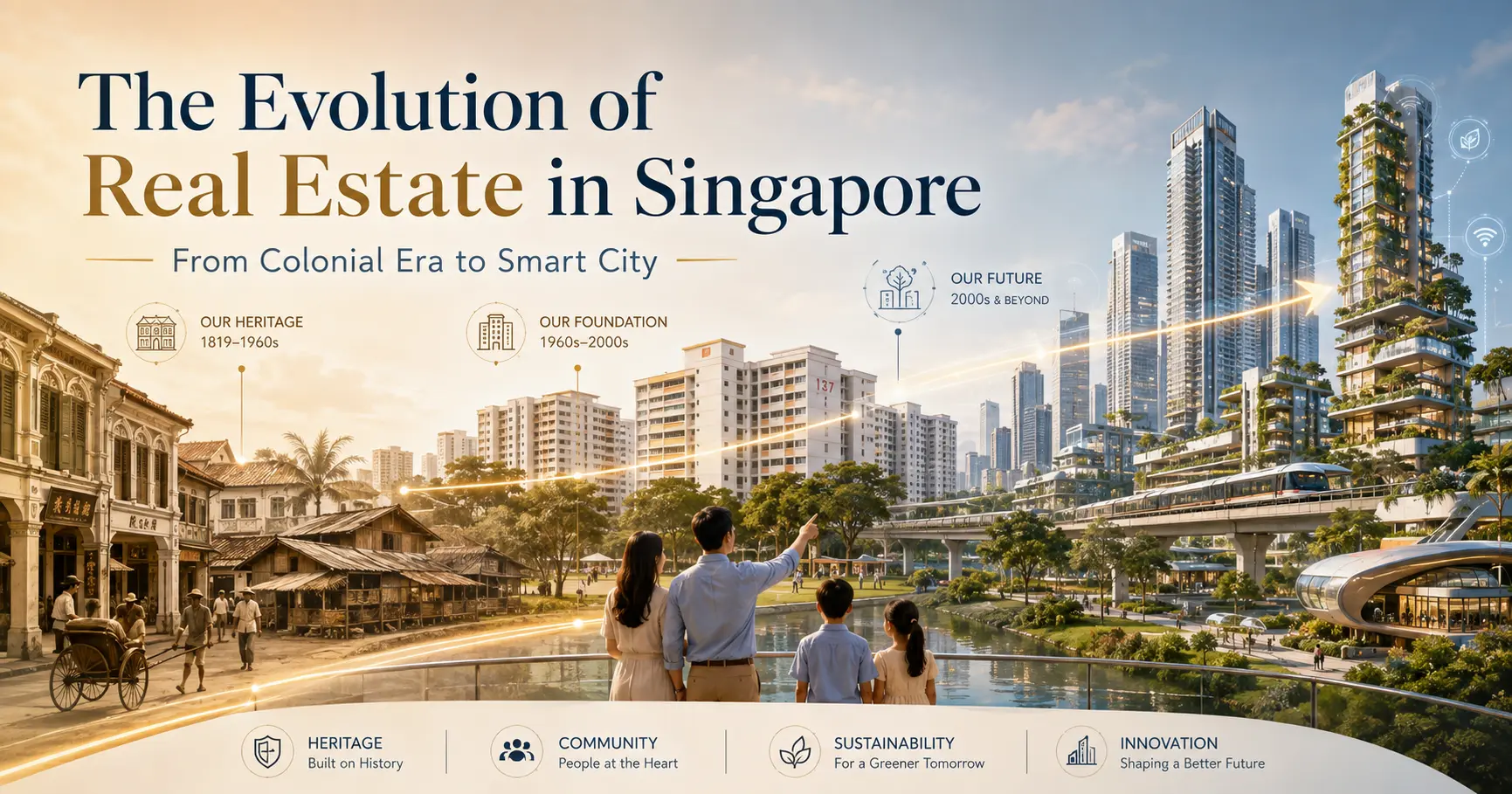
From Housing a Nation to Designing the Next Singapore
Singapore’s property story began with an urgent need for shelter. Six decades later, the challenge is more complex: how do we design homes, neighbourhoods and property decisions for longer lives, changing families, limited land, climate resilience and a technology-driven future?
There was a time when Singapore’s biggest housing question was not whether a property was near an MRT station, whether a condominium had attractive facilities, or whether prices would rise.
In the years following the Second World War, Singapore faced an acute housing shortage. Overcrowding, squatter settlements and inadequate sanitation were part of the reality of a rapidly growing city.
When the Housing & Development Board was established in 1960, its immediate mission was therefore not to create an investment market. It was to build homes.
In 1964, the Home Ownership for the People Scheme marked the shift from providing rental housing towards enabling Singaporeans to own their homes.
Source: Housing & Development Board →That distinction matters, because the history of Singapore real estate is not primarily the history of property prices.
Singapore’s property evolution is fundamentally a story of nation-building.
It began with shelter, progressed to home ownership, expanded into complete towns and sophisticated urban infrastructure, and is now entering another phase — one shaped by longevity, sustainability, connectivity, technology and the changing needs of households.
From housing crisis to future-ready city
Singapore’s built environment did not arrive fully formed. Each era solved a different national problem — and created the foundation for the next.
Trading Port & Colonial City
Shophouses, warehouses, kampongs and early residential districts grew around a rapidly developing port.
HDB Is Established
Large-scale public housing responded to severe shortages and transformed living conditions.
Home Ownership Expands
Housing increasingly became not only shelter, but part of family security and long-term household planning.
A New Planning Chapter
Master Plan 2025 guides development around liveability, sustainability, resilience, connectivity and heritage.
The Next Singapore
New districts, ageing-ready communities and areas such as Paya Lebar Air Base will reshape how Singaporeans live and work.
From providing shelter to building communities
The earliest HDB flats were deliberately practical. Singapore needed large numbers of functional homes quickly.
But as the immediate housing crisis eased, expectations changed. A home could no longer be considered in isolation.
Schools were needed. Shops were needed. Transport was needed. Parks, healthcare facilities, community spaces and places of work had to be considered as part of the wider urban system.
This eventually produced something that is easy to take for granted today: entire Singapore towns planned around daily life.
Good housing is not simply good architecture. A good home exists within a good neighbourhood — and a good neighbourhood exists within a functioning city.
This integrated philosophy remains one of the most important foundations of Singapore’s property story.
When a home also became a major financial asset
As Singapore’s economy matured and household incomes rose, the private residential sector expanded alongside public housing.
Condominiums, landed homes, integrated developments and increasingly sophisticated mixed-use projects created more housing choices.
Property also became more closely associated with household wealth, upgrading aspirations, CPF usage, retirement planning and intergenerational decisions.
For many families, the home became both a place to live and a major component of household wealth.
That creates opportunity — but also responsibility.
When one asset represents a substantial part of a family’s financial position, a property decision can affect far more than the next address. It can influence borrowing capacity, monthly cash flow, CPF balances, retirement reserves, children’s housing choices, caregiving arrangements and the ability to right-size later.
We have entered another property transition
The Singapore of today faces very different challenges from the Singapore of 1960.
We are no longer solving only a shortage of basic shelter.
Singapore must simultaneously plan for a rapidly ageing population, smaller and changing household structures, limited land, climate adaptation, changing employment patterns, stronger expectations for accessibility and quality of life, and an increasingly digital economy.
Master Plan 2025 was officially gazetted on 1 December 2025. Its major planning themes include a happy and healthy city, sustainable growth, urban resilience, and stewardship of nature and heritage.
Source: Urban Redevelopment Authority →This tells us something important about the future of real estate:
Future property value will increasingly be connected to how well a place supports life — not simply how impressive the building looks.
What may define the next era of Singapore real estate?
Not every future trend can be predicted. But several structural changes are already visible in Singapore’s official demographic, housing and urban-planning direction.
Ageing becomes a property issue
In 2015, 13.1% of Singapore citizens were aged 65 and above. By 2025, this had risen to 20.7%. By 2030, the projection is approximately 23.9% — around one in four citizens.
That means accessibility, proximity to healthcare, transport, family support, daily amenities, home maintenance and right-sizing will become progressively more important housing considerations.
Population.gov.sg →Location becomes more multidimensional
The old property conversation often revolved around distance from the traditional city centre.
Singapore’s increasingly polycentric planning approach means the future question may instead be: how connected is the home to employment, transport, healthcare, family, amenities and the places that matter to everyday life?
URA Master Plan 2025 →Entire districts will continue to be reimagined
Paya Lebar Air Base is planned for relocation from the 2030s onwards, making way for a new mixed-use town with homes, workspaces and community infrastructure.
Elsewhere, new housing and neighbourhoods are planned around areas such as Pearl’s Hill, Newton and other parts of Singapore.
URA: Paya Lebar Air Base →Climate resilience moves closer to the property conversation
Tomorrow’s buildings and neighbourhoods must respond to energy use, urban heat, intense rainfall, carbon reduction and long-term maintainability.
BCA’s Green Mark framework continues to evolve, with Green Mark Version 7 representing the latest refresh of Singapore’s green building certification approach.
Building and Construction Authority →Technology reduces the value of information scarcity
Property listings, transaction histories, market commentary, calculators and neighbourhood information are increasingly accessible to consumers.
AI will accelerate that trend. The competitive advantage of the future professional therefore shifts from merely possessing information towards interpreting it responsibly.
CEA Industry Transformation Map →The human role moves higher up the decision chain
Software can organise data, compare properties and automate administrative work.
But families still need judgement when balancing affordability, CPF, financing, retirement, children, ageing parents, location, risk and competing priorities.
Information becomes cheaper. Good judgement becomes more valuable.Three numbers worth remembering
Number reported by CEA as at 1 January 2026.
Around one in four citizens by 2030 under current demographic projections.
The medium-term development horizon guided by Singapore’s statutory Master Plan.
The property agent of the future
The traditional property agent once enjoyed a major advantage through access — access to listings, buyers, sellers and market information.
Technology has progressively reduced that information advantage.
CEA’s Real Estate Industry Transformation Map reflects this change. Its three stated strategies are to digitalise property transaction processes, promote technology adoption by property agencies, and enhance the value added by property professionals through skills development.
It is technology combined with higher-value professional capability. That distinction matters.
Source: Council for Estate Agencies →Consumers can already obtain enormous amounts of property information independently.
Artificial intelligence can process even more.
It can compare properties, organise documents, summarise information, analyse patterns and streamline administrative processes.
But faster access to data does not automatically create a better property decision.
A family may understand the transaction history of twenty condominiums and still not know whether upgrading is financially sensible.
A senior may understand the estimated value of a home and still not know whether selling improves retirement resilience.
A buyer may identify every project near an MRT station and still choose a property poorly suited to the household’s future needs.
Information is becoming cheaper. Judgment is becoming more valuable.
The enduring role of a good property professional should therefore move higher up the decision chain.
The conversation should increasingly involve affordability, CPF, financing, holding power, transaction costs, competing housing pathways, family needs, official planning information, accessibility, right-sizing, retirement considerations, risks and trade-offs.
Sometimes good advice will lead to a transaction.
Sometimes it will lead to a different property.
And sometimes the responsible answer may simply be: do nothing yet.
That is the difference between selling and advising.
The real future of property is its connection to the rest of life
Singapore’s first housing revolution gave people roofs over their heads.
The next expanded home ownership. Later generations experienced better towns, more housing choices, integrated developments and increasingly sophisticated infrastructure.
The coming transformation may be less visible but just as important. Property decisions will increasingly intersect with longevity, mobility, family structure, financial resilience, sustainability and technology.
A home should therefore not be judged solely by price per square foot, tenure, district, floor level or potential appreciation.
Those factors matter — but they are incomplete.
Six questions worth asking first
Nobody can predict property prices twenty years from now with certainty. But households can improve their decisions by asking better questions today.
What stage of life am I planning for?
Do not plan only around today’s household. Consider how family, work, health, mobility and caregiving needs could evolve.
Can I comfortably hold this property?
Being able to complete a purchase is different from maintaining long-term financial resilience.
What happens to my CPF, cash and retirement position?
A property should be considered alongside the wider household balance sheet, not in isolation.
What credible official plans may change the neighbourhood?
Refer to primary sources such as URA, HDB and LTA rather than relying solely on marketing narratives.
Will this home continue working as I age?
Accessibility, transport, healthcare and proximity to essential services deserve consideration earlier than many people realise.
Does the property fit my strategy — or am I reacting to fear?
Urgency, FOMO and market excitement should never replace a clear understanding of purpose and trade-offs.
Singapore’s property story is still being written
Singapore once transformed kampongs and overcrowded settlements into planned towns. Today, those towns are being transformed again for a different future.
New neighbourhoods will emerge. Former air-base land will eventually support new communities. Jobs and amenities may move closer to homes. Buildings will become more environmentally responsive. Technology will make information increasingly accessible. An ageing society will change what many households require from their homes.
The buildings will change.
The technology will change.
The planning map will change.
But one principle should remain constant:
That may be the deeper lesson from more than six decades of Singapore’s housing evolution.
We did not build Singapore merely by building more property.
We built homes, neighbourhoods and communities around the lives Singaporeans hoped to lead.
The next chapter should do the same.
Before asking what property to buy, start with a better question.
“What does my next home need to achieve for my family, finances and future?”If you are considering buying, selling, upgrading or right-sizing, UProperty.sg provides structured Singapore property education and planning perspectives designed to help you understand the decision before committing to it.
Primary Singapore sources
Wherever practical, this article uses Singapore Government and statutory-board sources for historical facts, demographic projections, industry data and future planning directions.
- Housing & Development Board — Our History.
HDB’s formation in 1960, the early housing programme and the introduction of the Home Ownership for the People Scheme.
View HDB source → - Urban Redevelopment Authority — Master Plan 2025.
Singapore’s statutory medium-term land-use plan and development framework for the next 10 to 15 years.
View URA source → - Urban Redevelopment Authority — Paya Lebar Air Base.
Future redevelopment of Paya Lebar Air Base from the 2030s into a new mixed-use and community-oriented district.
View URA source → - Population.gov.sg — Longevity.
Singapore citizen ageing trends and the projection that around one in four citizens will be aged 65 and above by 2030.
View population source → - Council for Estate Agencies — Real Estate Industry Transformation Map.
Singapore’s roadmap for digitalising property processes, technology adoption and higher-value professional capability.
View CEA source → - Council for Estate Agencies — Industry Statistics.
Official number of registered property agents and agencies in Singapore.
View CEA statistics → - Building and Construction Authority — Green Mark Version 7.
The latest evolution of Singapore’s Green Mark framework for a greener and lower-carbon built environment.
View BCA source →